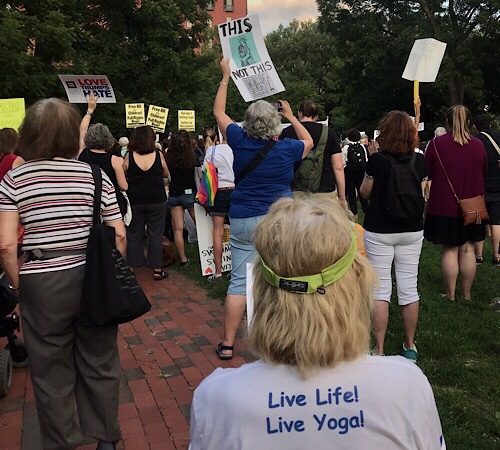
At William Penn House for Tuesday Before Thanksgiving Yoga Practice

My friend Olga has written a series of blog posts reflecting on the Certified Teachers’ Gathering and what it means to her to to be a part of the Anusara community. I found most interesting the reflections on how Anusara is growing as a community, even as an “institution.”
One of the things that I ponder in connection with being a member of any group is how deeply to be involved, whether I can pick and choose from among the teachings and practices offered and still be regarded as a true participant? Whether I can be uncomfortable with some of the organizational structure, but still be true to the ultimate goal or teachings? What does it mean at the workplace — for me the giant bureaucracy of the Department of Labor? What does it mean if we are a member of an organized religion (I’m a member of the Friends Meeting of Washington)? A group of like-minded practitioners? A neighborhood? A society?
Although, having been raised as a Quaker and continued to practice as such in adulthood, I do not observe most of the Jewish rituals and holidays. This year I was certain that I at least wanted to bake something traditional for Rosh Hashanah, and I felt engaged with wanting some part of ritual observance.
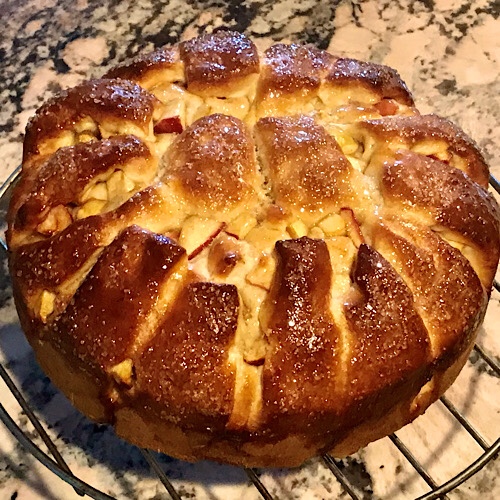
Thus in recognition of RGB leaving this embodiment into that of a tzaddik, I have a honey-glazed, sourdough, apple challah–baked round for the cycle and fullness of the year.
Yesterday morning, before I read the article in the Washington Post I discussed in yesterday’s post, a memory of an acquaintance from Quaker youth camp entered my seated meditation. I had not thought about C in at least 30 years. He was a couple of years older than me, and all the parents were a buzz with talk and worry when C decided that instead of going to college, he wanted to give away his possessions, live in a community devoted to simple living, a vegetarian diet, daily worship, a like-minded community, and spreading what they believe is the word of God. Nowadays, many of the people who are in my broad social network would have nothing but admiration for someone who lived by and practiced such tenets, including the daily chanting of the name of Krishna (or some other deity). In the late 70s, the parents were deeply concerned: “He is in a cult, he is brainwashed, we need to get him back.” “Back to what?” I remember thinking at the time.
I have not seen a member of ISKON (International Society for Krishna Consciousness) in years. Why not? Not because the “cult” has disbanded. Rather, it has grown substantially and become part of the fabric of our global religious society. Now, by virtue of its longstanding existence, its members blend in with accepted norms of social and religious behavior.
What makes a cult? What makes a religion? How do cults and religions foster, spread, or interfere with our own relationship to spirit and our recognition of spirit in others. What is the difference between ritual and religion? Ritual and spiritual belief and practice?
ps Craig made a good point yesterday about being sensitive to the practicing Hindus when we take part in some of their practices, but not in the context of the Hindu religion. He also noted a number of rituals that have morphed and shifted with changing religious groupings in society. ISKON “took” something that was part of the Hindu religious practice and opened it to the masses (proselytizing with enthusiasm). Is that not analogous to the development of any religious sect? Think about the meaning of the word “protestant.” When is an off-shoot of a religion a cult, a “legitimate” religious group, or an offense to the group from which it parted in terms of stated belief or practice? Does it matter that some take offense? What if offense is taking because of a disturbance of a status quo that diminishes and constrains large elements of society (such as women or people of certain classes)? What about practicing a ritual to honor members of another religion — I am thinking, in this regard, of the recent example of the White House seder?
pps. How is this relevant to our yoga practice in the United States? Many of us listen to and practice our asana to the music of “chant.” Krishna Das has a CD called “All One” that has nothing on it but variations of the maha mantra “Hare Krishna” that became so notorious when ISKON was just being known here. What does it mean when we listen to such music, buy such music, share such music, chant these words?
A regular brought a friend to this week’s group house practice. When I asked whether there was anything about her health or practice I should know to enhance her experience in the class, she advised me that she had been having trouble sleeping for the past few months in response to an event in her life. I did not ask about the event, but offered some of my favorite practices when I am not easily falling asleep:
1. gentle ujayi breathing with the exhale twice the length of the inhale. We were sitting up, but this is great to do in vipariti karani (legs up the wall pose).
2. chandra bhedana (the moon breath). This is similar to nadi shodana (alternate nostril breathing) except that for every breath, the inhale is through the left (ida or chandra nostril and the exhale through the right (pinga or surya) nostril.
3. This one I learned from work place yoga teacher Kathy Rowley with whom I took lunch time classes at the Department of Labor for a couple of years. I am not sure I remember it exactly the way she taught it, but it works:
Start lying on one side. Take sixteen deep breaths, keeping count of the breaths, with the exhales longer than the inhales. Quietly roll to your other side and take another sixteen breaths. Continue switching sides, slowly and without disturbing growing sleepiness, each set of two doubling the number of breaths you take. After 16 on both sides, then 32 on both sides, then 64, and so on (though so on is unlikely). Let the breaths get slower and deeper and when you get to the point where it does not seem right to switch sides, then you let yourself sink into deep relaxed sleep.