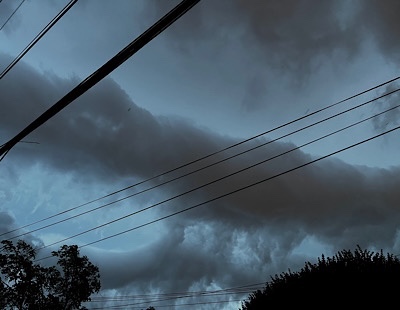

Incoming Storm


For example, I am not concerned with the risk of being filled up by Satan (that’s Satan with a capital “S”) because of practicing yoga. But I am deeply concerned that the people quoted as making such warnings are seeking or are in positions of power. Thanks to my friend D. for sending me the link to this article.
This vendor was right outside a Siva temple we visited on the day after we went to Rameshwaram. I don’t remember the name of the temple (I was not good about writing down the names of the temples that were added to the itinerary after the fact).
I liked the temple more than many. Partly because it was quiet and peaceful since it is off the pilgrimage path (going to some of the temples reminds me of seeing the Rolling Stones at Wembley Stadium, both for crowds and noise level) and partly because it had all eight versions of Dakshinamurti–Siva as teacher.
I was most ready for dinner after a very long day on the bus to detour to this temple, but alas, the sight of street food brings more fear of disease than it does thoughts of slaking hunger and thirst.
For the past couple of weeks, I have been spending as much time as possible in the garden. When it is too rainy or cold to be in the garden, I have been doing indoor spring cleaning. As the days get noticeably brighter and longer, it is delightful to see the new growth in the garden and to polish my treasures and make room to use and enjoy what I have. I’ve been noticing how the first major activities in the garden make a mess. Inside, activities such as cleaning out the refrigerator and the closets also makes things seem messier before they they get cleaner. I’ve persisted, though, and now the garden is teeming with visible new life, unencumbered by the detritus of dead growth on the perennials or spent annuals from last year. With things I do not need given away or repurposed and things clean and repaired, I can more easily use and appreciate what I have in the house. It seemed like quite a mess for a while, though, when I was taking things off of shelves and out of drawers and closets in preparation for cleaning.
There can be phases in our sadhana –both asana practice and meditation and related practices — where all the practice seems to be doing is bringing up old stuff. It seems like we are more physically or emotionally challenged than we would have been if we weren’t practicing. The thought may cross our mind that we would be happier just going to the movies and going on an eating tour of Italy.
Although sometimes strong reactions can mean that a practice is not right for us (at a certain point in time or not at all — similar to a reaction to food), it can also mean that the practice is doing the equivalent of spring cleaning. Part of sadhana is learning how to react in a more optimal way to what manifests and arises from our practice. When a host of old memories or emotions arise or we press up against our limits by digging in deep physically to find where and how to rearrange our bones, muscles, sinews, and energy channels to clear an old injury, we have an opportunity to clear out and let go to make room for new growth. We don’t have to shove the stuff back into our mind-body closet or leave it where it obstructs new growth. The old patterns and memories come up in practice so we can either release them or change our relationship to them so they can become something that serves instead of weighing us down.
When I get into one of those messy spots, I remind myself how good I feel when I’ve done my spring cleaning, and I try to keep going forward, doing the best I can with the teachings I’ve been given. I admit that it is easier to persist because I love the actual activity of the practices (though the ones I need to do most can be the ones that are not my favorite, but that’s a whole other train of thought).
We all (or at least most of those who would be reading this blog) have heard the Buddhist-inspired saying: before enlightenment, the laundry. After enlightenment, the laundry. The question is whether after the moments of enlightenment can we infuse doing the laundry with more joy, acceptance, and peace. A young adult acquaintance asked me the other day whether I was readjusting ok. I did not know to what he was referring, and he had to explain that he was asking how I was doing on my return from my India trip. “It was just a vacation–albeit an extraordinary one,” I replied. “Life continues.”
“The good experiences just slip away like dry sand through my fingers,” he made a motion of letting something slip away.
“When you practice and when you get older, it will be easier to bring the temporary, good experiences into your life without feeling they are lost when you have moved onto the next thing,” I said with hope that would actually be true for him, he seemed so bereft.
The yoga teaches us neither to be out searching for the highs nor actively avoiding the lows; the dance of grasping and avoiding is what makes us suffer. That does not mean that the highs, the times of wild abandoned joy, the experiences of utter fulfillment, of exquisite understanding are of no value. What brings joy is a thing of wonder and an opportunity to deepen our ability to love and be generous. They are only a problem if we ruin our time by vainly clinging to or trying to repeat the sensation. As our practice (and our understanding of a life well-lived and loved) matures, we understand that there is no readjusting in the return to the day to day. We welcome what we have had, try to remember what we have learned, including how much joy and delight we are able to drink in, and approach each day as another opportunity to seek and share connection.