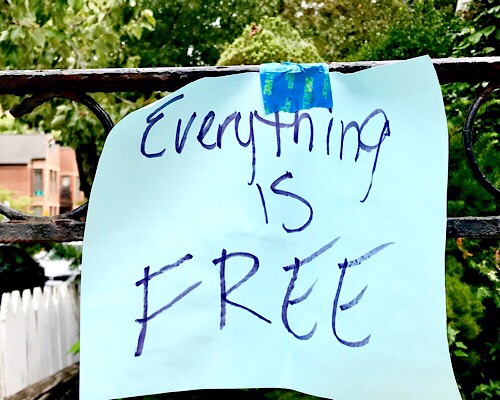
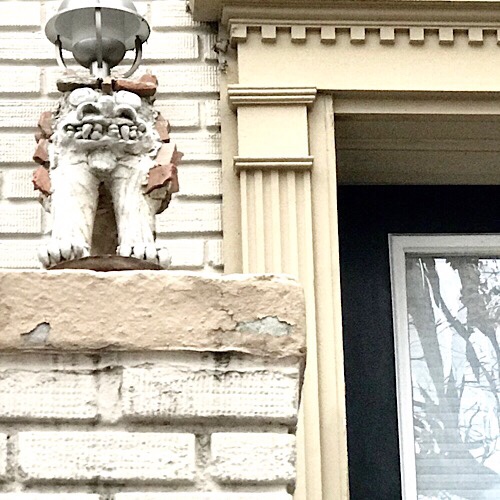
Signs and Blossoms Around Town


A friend from the DC Sunday contact improv jam (one of my favorite places to play) sent this link showing a clip from a documentary in progress about the importance of play to our health. One of the things that I love most about Anusara yoga is that John Friend has always described its practice as being “seriously playful.” I was born serious nature and have worked hard in my adulthood to learn to play spontaneously, and what is being offered here resonates for me.
This is a long clip, but well worth the time. Anusara yogis, notice how familiar some of it sounds. Enjoy!
When I saw this headline the other day, the first thought that came to mind was how much pleasanter life would be if those spending huge amounts of effort and money to “fight” gay marriage would pour that energy into educating children, tending gardens, and being friendly with their neighbors. The next thought, which was not unrelated, was that the headline was a prime example of how the action of mayiya mala serves to alienate us and cause unnecessary rancor.
The three malas or cloakings, in tantric philosophy, are aspects of consciousness that prevent us from recognizing the unifying spirit in all beings. We tend to hear a fair amount in yoga class about the first of these —anava mala, which clouds or covers over our recognition of the divine in ourselves, thus leading to feelings of unworthiness–but there is less focus on the other two (the third is karma mala, which is the illusion that we are doing everything all by ourselves–that’s an oversimplification. Perhaps more another time).
At an elemental level, mayiya mala is the distinction between subject and object that leads us to feel separate from other beings. When this separateness makes us feel threatened or needy, then we can behave very badly indeed (mild understatement). I believe that our superficial requirements of outer sameness–think dress codes or neighborhood rules on what one can plant in one’s front yard–are exactly because we fear difference. If we can instead accept difference as part of the play of what actually connects us (see through mayiya mala, then we can more easily love and embrace others and widest variety of creative expression.
On our mats, one of the things that leads to injury is mayiya mala. When we forget that we the purpose of the practice is to seek the peaceful joyous space within ourselves and instead get competitive or acquisitive about postures (or external emblems of “spiritual advancement”), we are getting caught up in the differences and comparisons generated by mayiya mala and get compelled to push and strive in unhealthy and dangerous ways. When we remember the true purpose of practice, we will seek to expand, but with such sensitivity that we do not hurt ourselves. This, of course, is easier said than done.
Peace and light, E — Posted with WordPress for BlackBerry.
A senior colleague and I spent several hours today working together on a very challenging aspect of a long-term project. When we were wrapping up for the day, I showed him a murti of Ganesha that another co-worker had brought me from the Norton Simon Museum when she had gone on a business trip to Pasadena, where our Los Angeles office is located.
I said that I do not believe in the Hindu deities as gods, but find them helpful for contemplation as archetypes (in the Jungian sense). I said that being on this project has taught me much about yoga and about Ganesha.
“Ganesha,” I explained, “is not so much the remover of obstacles, but the one who places obstacles in your way to teach you the wisdom to grow and find a more enlightened path from having confronted the obstacles.” “Oh,” said my colleague, “like the Marines: adapt, improvise, and overcome.” “Well, sort of,” I replied, enjoying that we found a way to share laughter after our difficult afternoon.
Whom I brought home today from foster care.