Trees Around Town
Harry’s walking stick–outsized, but still not tall enough to create canopy.
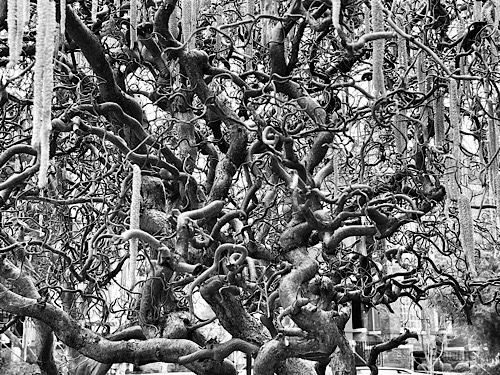
Harry’s walking stick–outsized, but still not tall enough to create canopy.
Last night I went to my neighbors’ “comfort food pot luck.” Comfort food tends to mean for many of us in winter warm, dense, heavy, rich food that is likely to be white, beige, or otherwise pale in color. There is much to be said for the emotional impact of great mashed potatoes or macaroni and cheese, especially when it is cold.
As I was deciding what to bring and remembering that last time I went to this pot luck there were three kinds of macaroni and cheese, mashed potatoes, and multiple kinds of bread, I thought about what would bring me comfort in that context.
My diet is not subject to any particular label. I mostly do not eat meat or cow dairy–perhaps vegetarian/vegan preferred would be a good label to the extent one would need to give a label (we are so fond of those in this society). I also prefer local and organic food, in that order, when available, and find my health benefits from a fair percentage of my diet being raw, fresh fruit and vegetables.
Based on my assumptions of what others would likely bring, I thought that it would give me great comfort to have something fresh, bright, crunchy, raw, organic, and mostly local to go with mashed potatoes (they were delicious Marlene) and assorted casseroles. I took a look at what was in the kitchen and found I had red cabbage, a couple of apples, an onion, and some carrots from the farmers’ market; organic celery, raisins, ginger, lemon, apple cider vinegar, and white miso from the food coop and the organic grocery store; and mung beans sprouting on the counter.
The red cabbage salad and sprout salad was a hit as a foil for the traditional “comfort food.”
Since you asked, here’s how its made:
Mince some onion and dice a small red cabbage. Splash some apple cider over the onion and cabbage so it can start pickling while you are cutting up the rest of the ingredients.
Dice some carrots and celery and add to the cabbage and onions.
Throw in some raisins.
Mince some ginger and add to vegetables.
Mix a couple of tablespoons of mild white/blonde miso and some Dijon mustard to taste (a darker miso will be too strong) and stir in hot water to thin until the miso-mustard mix is a creamy consistency and stir into the vegetables.
Dice an apple or two and mix in with the other ingredients.
Add some fresh bean sprouts if you have them (I always have sprouts growing except in the hottest weather; a good source for supplies is www.sproutpeople.org; best to add the sprouts while they are still short so they are the same texture and size of the other ingredients in this chopped salad).
Squeeze in some lemon juice to taste (or more vinegar if you don’t have a lemon on hand or want to be completely local). If necessary to get the dressing spread evenly over the vegetables, add a little more water.
Add another apple or additional raisins if you need more sweetness to offset the saltiness of the miso and the astringency of the vinegar and lemon juice.
This salad benefits from sitting for at least a few hours. It can sit overnight without the apples and the sprouts–the miso starts to ferment the cabbage as for sauerkraut, which is nice– but the apples and sprouts will get mushy and are better added at the end.
Enjoy. Play with ingredients and quantities and please comment if you come up with a delightful variation.
In yoga practice the concept of diksha — initiation or threshold — carries with it a sense of right timing and conscious understanding of readiness for the next level. For example, knowing I was not yet strong enough, this past weekend I chose not to try to jump from adho mukha svanasana (downward facing dog) to svanasana (headstand), but instead concentrated on doing the poses one at a time, even though I was surrounded by people who could do the transition with ease and my ego was challenged. Until I am stronger and better able to hold the alignment in poses at that level, I would be too much at risk of hurting my neck and shoulders.
In the garden, it is easy to be fooled by a beautiful weekend to move right to activities that are still 3-4 weeks premature. Even though it will hit 70F this weekend, it is not time to plant (other than perhaps an experimental row or pot of kale, chard, or beets, which like the cold). The best gardening you can do in the beginning of March when the weather is swinging wildly from below freezing to unseasonably warm is to read and plan and start seedlings indoors, just like it is best to warm up and work on strength, alignment, and flexibility before going for harder asana in your yoga practice. It will be tempting to get out this weekend, but do the prep stuff and the clean up.
Here are some favorite books of mine to get ready for planning. It is mostly more practical stuff (rather than the super glossy, beautiful garden as splendid art and architecture picture book reading) with some food and yoga overlap and a bias for small urban gardens.
The Yoga of Herbs — An Ayurvedic Guide to Herbal Medicine, D. Frawley and V. Lad (Lotus Press, 2d Ed. 1988)
Gardener Cook, C. Lloyd (Willow Creek Press 1997) (OK — this one is kind of cooking, gardening porn)
The Edible Container Garden — Growing Fresh Food in Small Spaces, M. Guerra (Fireside, 2000)
The Bountiful Container, McGee and Stuckey (Workman Publishing Co., 2002)
Small-Space Gardening — How to Successfully Grow Flowers and Fruits in Containers and Pots, P. Loewer (The Lyons Press, 2003)
Kitchen Herbs — The Art and Enjoyment of Growing Herbs and Cooking with Them, S. Gilbertie (Bantam, 1988)
The New Kitchen Garden, A. Pavord (Dorling Kindersly Ltd., 1996) (Also pretty and glossy, but still practical)
Yesterday, while watching the Capitol City Symphony and Capitol Hill Chorale’s joint performance of Beethoven’s 9th Symphony at the Atlas Theater, I noticed with some amusement the cymbol player reading a novel in the wings through the first three movements. (The triangle player appeared just in time for the fourth movement).
This reminded me of an anecdote John Friend told at the Anusara Certified Teachers’ Gathering in Denver the other week to illustrate the importance of every person and element to the whole. He spoke of the triangle player. What do you say to him after the show, John asked, “great job man; I love the way you came in right when you were supposed to?” Even if showing up and playing one beat at the right time is the triangle player’s only job, the triangle player still is an integral part of the composition, though perhaps not as evidently crucial as the first violinist.
We may not know how we are essential or how we will shift things, but we should always revere and recognize each and every being, including ourselves, as part of the web of existence.