Art and Culture | Asana, Pranayama, and Yoga Practice | Food for the Mind (Yoga Philosophy, etc) | Meditation | Photos
Be Here Now (Var.)
When I think about the Anusara alignment principles in the context of the tattvas (see earlier posts), I think about “opening to grace” appearing in two places on the tier. As “first principle” it is the first among a larger sequence about how we come to the mat, rather than just the first of the physical principles. “First principle” not only starts the practice and the dialogue, but is already there. It is, in this sense, so fundamental that it is not part of the sequence, but is sequenceless (akrama). If you are fully conscious of “grace” and can embody it in all aspects of your physical, energetic, and mental day to day existence without further instruction, study, or practice, then there is no need for other practice or instruction (this I think is a very rare being, and certainly I’m not such a being).
The next set of tattvas — suddha vidya, ishvara, saddha shiva, and shiva-shakti (see link above), correspond to the Anusara alignment principles of “attitude, alignment, and action,” which although they are themselves described in sequence, are fundamentally sequenceless as they happen all at the same time and are more elemental than the practice of the physical/energetic alignment principles in sequenced practice.
In this way of understanding the play between the sequenceless and sequenced, we have a universal “first principle” that embodies the purpose of all we do on and off the mat. It is followed by how we want to practice, described in a way that becomes less of just a concept (which as a universal concept is akrama) and more of a practical understanding (which applies when we are in space and time and therefore in the krama of embodied existence). As we dance in this play between the sequenceless and the sequenced, we come to practice (or to do any activity) with the “attitude” of wanting to live the “first principle,” to know and experience what is fully present and not bound by time and space. We then (because we must) study and practice specific “alignment” to try and express this attitude with our “actions.”
The physical/energetic alignment principles then come in as a the way of better refining, studying, and practicing the desire to recognize with mind and body the “first principle.” The sequence of “open to grace, muscular energy, inner spiral, outer spiral, organic energy” comes then at the level of physical and mental practice to return us back to “first principle.” “Open to grace” is first in this sequence, too, but as “first principle,” for me, it is something more than the first of the alignment principles. “First principle” is not just the start of how we practice when we practice Anusara yoga, but the whole reason for practice. It is the universal, overarching, blissful element of being that draws us to the practice because of our yearning to know it.
Peace and light, E — Posted with WordPress for BlackBerry.
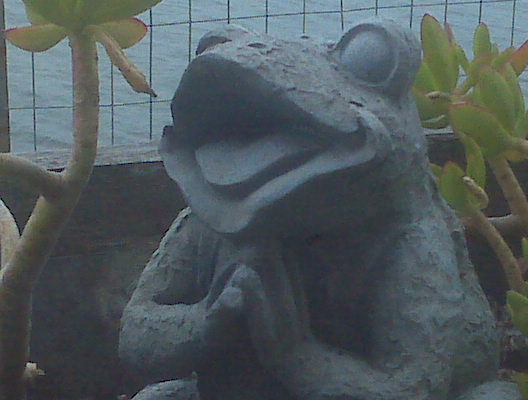
As remembrances and articles of 9/11 start to proliferate in anticipation of the tenth anniversary, I thought I would share this work of art that has become part of my work neighborhood. Change comes from all action, and even the most horrific things can bring small joys in unexpected ways.

Peace and light, E — Posted with WordPress for BlackBerry.
@ The Strand.

Peace and light, E — Posted with WordPress for BlackBerry.
Spiritual pursuit is, in a great sense, a luxury. Without enough time and money for leisure, when and how would we explore spirit? But where else would we find solace if not in spirit when we are suffering from deprivation?
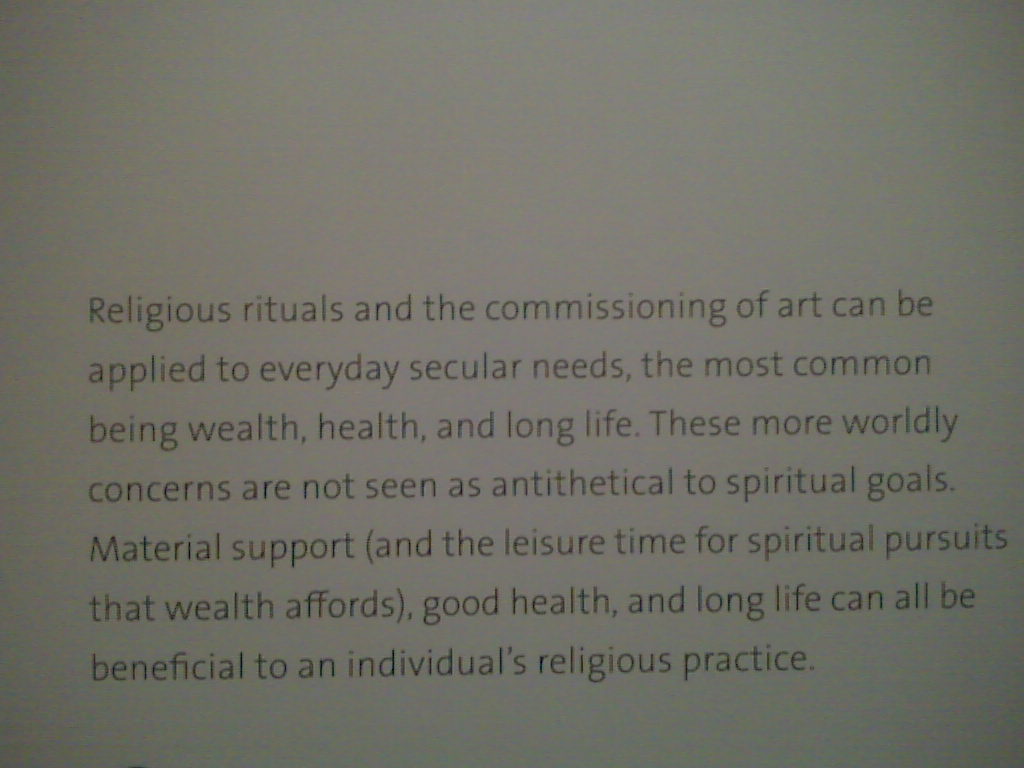
This question becomes even more pointed when we consider it in terms of the curatorial note (Rubin Museum) below. Those who can afford to commission art to further their own spiritual ideals (including prayers for wealth and family) may not be the one percent, but most surely are the ten percent, or any money would all be for food and shelter at the survival level. I would certainly rather see money spent on making art than war, but what about food, education, and shelter for more in society in a way that nourishes the environment? Such a complicated web of questions about individual and collective desire and responsibility in our relationship to each other and the earth past and present when we think of having wealth sufficiently focused to allow individuals to use it to seek religious boons for themselves in the material world.
I say this as one who loves and makes art and engages in spiritual exploration with vacation time and budget, who regularly wonders if that is really for the good of others and not just another way of enjoying what life has to offer the fortunate.
What do you think?
Photo is of exhibit notes at the Rubin Museum in NYC.
Peace and light, E — Posted with WordPress for BlackBerry.