Partner Yoga
Your partner does not have to be the same size as you. Or species.
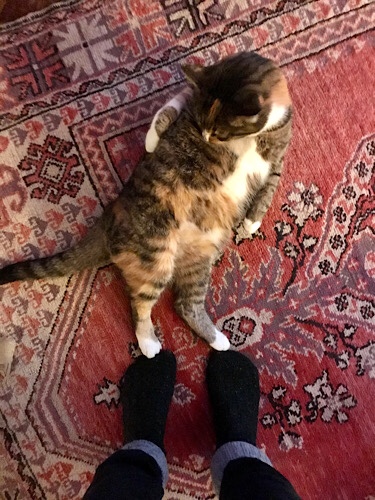
Your partner does not have to be the same size as you. Or species.
On Friday night, Professor Douglas Brooks offered a satsang that was hosted by District Kula. One of the attendees, who said that she did no yoga, but taught Argentinian tango, wanted to know about what she had heard of yoga talking about the dance of masculine and feminine because that’s what tango is all about.
Douglas gave a quick overview of the idea of the tattvas as a foundation for an answer to the tango dancer’s question. As part of this background, he discussed the numerological aspect of the tattvas, saying that Shiva and Shakti relate like this: one is two becomes three becomes five. The two must separate, and the space between them makes three and teaches us the one. Because of the spaces between, we do not have one to two to four, but two (one because inseparable) to three to five. We know the one only when we know two, and the one is therefore part of three. (“Lovely dance of numbers; that makes perfect sense,” I thought, having a happy geekfest in my own mind. “I’ll enjoy pondering how that might be an explanation for there being five top tattvas and not six or four and wondering whether I had even begun finding an understanding, even though what Douglas was talking about is something I have been contemplating for years in various ways and contexts.)
Douglas then led into a description of the inseparable, inextricably intertwined nature of Shiva and Shakti. “It is like that in tango,” the dancer interjected at multiple points. “The better the leader, the more he is listening to the follower, thus allowing the follower to be the leader.” Each time Douglas refined his response, the dancer offered something else about her experience with tango. “Right, when they are dancing well, the man takes on some of the characteristics of the feminine, and the woman that of the man. The difference between them starts to dissolve into the dance itself.” Her eyes lit up, and she bubbled up with speech, in her excitement at finding in the tantric philosophy what appeared to be an explanation of what she experiences in the tango.
The tango dancer and the yoga texts assign specific roles and attributes to the masculine and the feminine, and we tend to fall into that tradition when we discuss the tantric philosophy. As much as the traditional tantrika or tango dancer might say that the masculine and feminine (when embodied) take on/have characteristics of each other, they have assigned masculine/feminine roles to play, and they are still stuck in a paradigm that keeps real humans in assigned roles. These assigned roles impact how male and female are permitted to act in society, regardless of any recognition that who is actually, rather than technically, in charge may be in flux on different levels.
The paradigm of tango dancing kept Friday night’s discussion within the context of typical and rigid roles for male and female, but I do not think that is a required way for us to think of how to bring the tantric yoga philosophy into our lives. When we think of the tattvas as abstract principles, we do not have to privilege in our lives or own thinking the traditional divide between male and female roles as the basis for understanding the play of opposites (though to be true to the text in its historical context we do).
I believe that the dance of shiva and shakti is as much about the dance between the universal and multiplicitous individuality as it is about the specific play between masculine and feminine in assigned roles. The one is two. The two (one) separates into three; when the two separate we discover the one (two), and after that the three becomes five. I remember a friend saying in our college days, “There are three of us in it: there is me, there is my loved one, and then there is our relationship.” To be in the world and relate fully, the tattvas (and dances with partners of either sex) teach us that two are inseparable by being in relationship. By recognizing the appearance of separation, the dance of Shiva and Shakti tattvas shows us the relationship — the oneness. Thus, all consciousness is one, but two, and then three, and yet still one.
How this informs me, other than enjoyable thoughts in my head, is that when we try to be spaciously and openly aware in all of our relationships of this elemental play of individual identity, separability, and indivisible unity, we see the other in ourselves and ourselves in the other. This helps much to inspire friendliness, understanding, and compassion. It also helps bring understanding of the leader when we are following, which it makes it easier to follow with discrimination, but without judgment. When it is our turn to lead, it helps us know that for those who might choose to or be required to follow us for some particular project, that to lead well we must listen to the followers. As the the Grateful Dead taught me decades ago, “you who choose to lead must follow.”

Mark Dion, “The Field Station of the Melancholy Field Biologist, Storm King Art Center
I am planning to be unwired for the next couple of weeks, though if there is an opportunity for a wireless connection or to use hotel internet, I may check emails. I will be in touch when I go back on-line. In the meantime, this is to wish you the best of holidays.

Peace and light, E — Posted with WordPress for BlackBerry.

Peace and light, E — Posted with WordPress for BlackBerry.
I have not picked up a snake since junior high when I was old enough to begin working and the days playing in streams and ponds pretty much came to an end. It’s not something one forgets. And today, there was a black rat snake in the garden (Note: they are harmless and eat small rodents.)
By the time I noticed what was going on, it he snake was completely terrified from having been pulled out from under some heavy farm equipment with a rake. The goal was to bring it to the woods behind the garden, but first to make sure it did not get caught in the machinery.
I invited myself into the fray, gently and securely held the snake about an inch below its head, invited its release from below the rake, and then gave it my other arm for it to wrap around, and it hugged me around my back and to the top of the arm that was holding its head.
Someone else opened the garden gate and I went into the trees and released it into the underbrush. I doubt it helped that I talked softly to it, acknowledging its fear, and apologizing for dislocating it.
It felt like an honor to have this short dance. The musky odor was not so nice; I also appreciated it as a very cool super power.