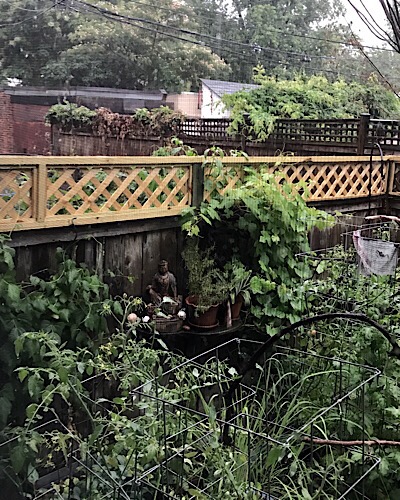
State of the Garden

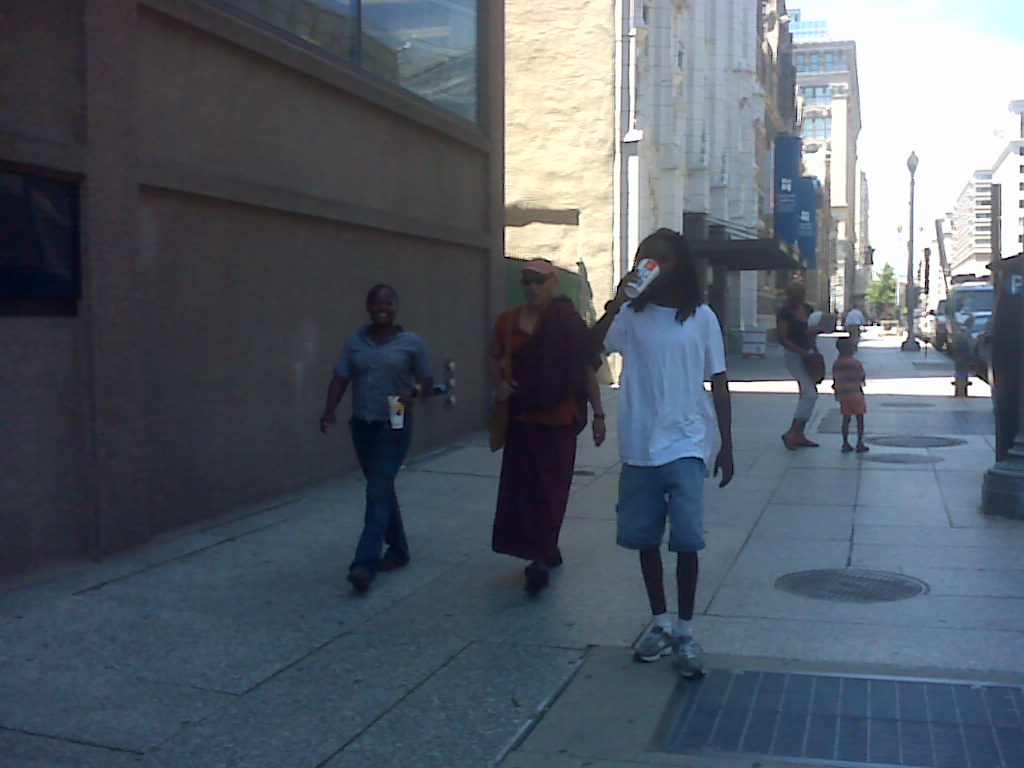
I walked over to the Verizon Center to see how the kalachakra was spreading into the space around it. Towards the end of my foray, the traffic light at a corner outside the Verizon Center changed in my direction, and I headed into the crosswalk. A cyclist going north in the southbound lane started cursing and screaming at me for blocking his way. The loudspeakers were blaring their usual commercial fare, the neon were glaringly lit even by day, the big video screens showing ads and offerings of upcoming sports events, and the tourists were jostling down the sidewalk, carrying their plastic containers full of stuff from McDonalds and Starbucks. On the other side of the Portrait Gallery was a special “market place” with silk shawls, t-shirts, silver and turquoise jewelry, thangkas, prayer wheels, and Himalayan food served in styrofoam containers with plastic forks.
I am as certain as it is possible to be that the space inside the Verizon Center is being transformed by the practice of the kalachakra for world peace empowerment inside. We cannot make others receive such an offering if they are closed and uninterested. We can, though, seek to open our own receptivity and our own hearts. As I observed my reaction to the plastics and the noise and having been cursed out when I had the “right of way,” I thought that the axiom “peace starts from within” is counsel that though we may not be able to change others, we can and are responsible for ourselves.
Peace and light, E — Posted with WordPress for BlackBerry.
Yesterday, a former student of mine stopped me in the hallway at Willow Street and asked whether the “Yoga of Eating” workshop I will be leading on June 13th will cover Ayurveda. “I will mention it,” I said, “but I will not be teaching it.” I didn’t have time to explain further because I was about to lead class. As far as I got was to add that I was not sufficiently trained to teach it.
Ayurveda is a wonderful science, and I honor and respect my yoga friends and colleagues who study, practice, and teach Ayurvedic principles. Ayurveda is a much broader discipline than yoga, though, and is really medical practice rather than yoga. Asana are among the practices that might be recommended by an Ayurvedic practitioner for a client or patient, but eating in accordance with the Ayurvedic principles is not the same as bringing yoga to how we eat. For me, many of the principles of Ayurveda I have read or been taught are useful, but it has not resonated for me as a governing system, just as I do not believe in applying all of the principles of Western medicine to how I heal and nourish my body.
Bringing yoga to my eating, like bringing yoga to all of my life off the mat, is both simpler and harder than being taught a science such as Ayurveda with fairly clear, but quite complex, do’s and don’ts and then following them. For me, practicing the yoga of eating, is practicing conscious eating. It is practicing reverance and moderation. It is balancing nourishment and pleasure. It is knowing deeply when the will to eat is serving us or getting in our way. It is both simple and subtle. It is easy to say, but deeply challenging and sometime complicated to practice — just like practicing the Anusara yoga principles of alignment.
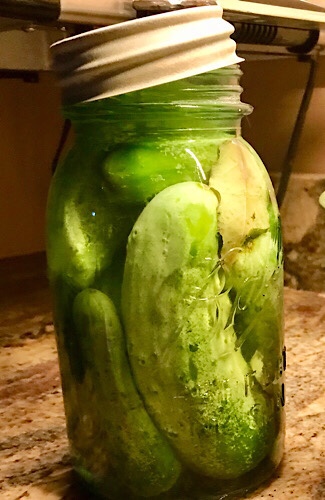
Started another batch of cucumber pickles.