State of the Garden
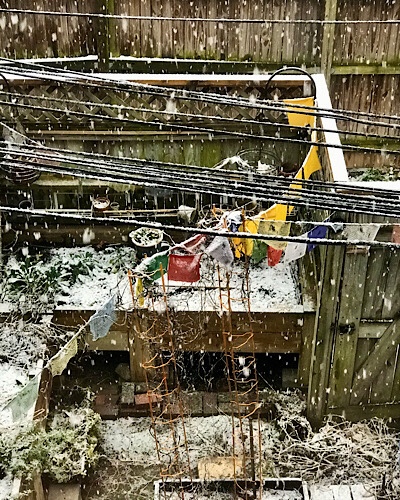
In yoga practice the concept of diksha — initiation or threshold — carries with it a sense of right timing and conscious understanding of readiness for the next level. For example, knowing I was not yet strong enough, this past weekend I chose not to try to jump from adho mukha svanasana (downward facing dog) to svanasana (headstand), but instead concentrated on doing the poses one at a time, even though I was surrounded by people who could do the transition with ease and my ego was challenged. Until I am stronger and better able to hold the alignment in poses at that level, I would be too much at risk of hurting my neck and shoulders.
In the garden, it is easy to be fooled by a beautiful weekend to move right to activities that are still 3-4 weeks premature. Even though it will hit 70F this weekend, it is not time to plant (other than perhaps an experimental row or pot of kale, chard, or beets, which like the cold). The best gardening you can do in the beginning of March when the weather is swinging wildly from below freezing to unseasonably warm is to read and plan and start seedlings indoors, just like it is best to warm up and work on strength, alignment, and flexibility before going for harder asana in your yoga practice. It will be tempting to get out this weekend, but do the prep stuff and the clean up.
Here are some favorite books of mine to get ready for planning. It is mostly more practical stuff (rather than the super glossy, beautiful garden as splendid art and architecture picture book reading) with some food and yoga overlap and a bias for small urban gardens.
The Yoga of Herbs — An Ayurvedic Guide to Herbal Medicine, D. Frawley and V. Lad (Lotus Press, 2d Ed. 1988)
Gardener Cook, C. Lloyd (Willow Creek Press 1997) (OK — this one is kind of cooking, gardening porn)
The Edible Container Garden — Growing Fresh Food in Small Spaces, M. Guerra (Fireside, 2000)
The Bountiful Container, McGee and Stuckey (Workman Publishing Co., 2002)
Small-Space Gardening — How to Successfully Grow Flowers and Fruits in Containers and Pots, P. Loewer (The Lyons Press, 2003)
Kitchen Herbs — The Art and Enjoyment of Growing Herbs and Cooking with Them, S. Gilbertie (Bantam, 1988)
The New Kitchen Garden, A. Pavord (Dorling Kindersly Ltd., 1996) (Also pretty and glossy, but still practical)
Cherry tomatoes and scotch bonnet peppers from the garden; high protein bread (used both pulp from homemade soy-rice milk and sourdough starter). Gardening and cooking are a grounding practice I am grateful to have.

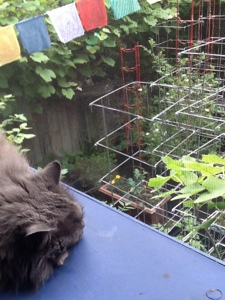
The white flowers growing with the tomatoes and cucumbers (cages) and the beans (red supports) are coriander that over-wintered, and gave lots of good leaves from late winter through mid-spring. I’m now letting them go to flower and then seed. I like to use the flowers as a garnish. Still green and newly forming coriander seeds minced, along with whatever greens are still tender on the plant, are delicious in lightly cooked young vegetables. Almost flowery, like some Persian cooking. The fig in the right foreground, alas, has no buds this year. It wants to be planted in the ground on a sunny side of someone’s house. Local readers, if you want a healthy fig tree, comment or send an email.
In November 2006, the New York Times published a recipe adapted from Jim Lahey’s Sullivan Street Bakery for “no-knead”bread. I immediately adapted it further (as did many of those who commented on-line). Many thought the NYT adaptation benefited from more salt. I also have made it much more energy efficient (the NYT recipe expects the dough to rest in a 70F room and for the oven to be pre-heated for at least a half hour). In the winter, I keep my house at 62F, and pre-heating for only 10 minutes (or baking something else first that doesn’t need pre-heating) is much better for the environment.
As I was baking a loaf (whole wheat, flax seed variation) this week, I thought about how much this recipe teaches about skill and steadiness. The reason the bread doesn’t need to be kneaded, but still yields a crusty peasant-style loaf, is the high liquid content of the dough relative to kneaded breads and the very slow rise time. That one can achieve the results of active labor by mere patience and an understanding of the science of the process recalled for me something I learned at a Rod Stryker workshop a number of years ago about having a steady practice. Rod Stryker was asking students at a week-long intensive whether they had a steady meditation practice. One woman raised her hand and said that she had sat and meditated every day for 30 years. We were all thoroughly impressed. Rod Stryker asked her how long she sat. I think she said three minutes a day, it might have been five. I don’t remember exactly. I was still impressed. Not because she would claim to have a 30 year practice when it was just a few minutes a day, but that she had the self-knowledge to set an amount of time to practice that she could keep. The daily few minute sit was obviously not her only practice or she would not have been at a relatively advanced yoga workshop. It is easy not to develop a home yoga practice, a good home-cooked diet, a garden, or anything else that needs steadiness, if we set the bar too high at the beginning. We don’t want to set it too low either, but finding what we can do with steady commitment and then allowing growth to be spontaneous is the way to keep at it without feeling burdened.
Every once in a while I bake bread that takes attention every day for seven days in a row and then involvement multiple times on the day of baking. It is my having spent the time making more difficult breads that has enabled me to create variations the “no-knead bread” and know it will still come out well. The “no-knead” bread, only modestly varied, I can make whenever I’m out of bread whether I’m busy or not. It just takes throwing a few ingredients in a bowl on a night when I know I’ll be at home the next afternoon or early evening for a three-hour block of time (doing other things almost the entire time).
The basic recipe is as follows:
3 cups of flour. (At least half needs to be bread flour; you should add a tablespoon of wheat gluten for each cup that is not bread flour, e.g., whole wheat or rye.)
1/4 teaspoon instant yeast
2 teaspoons salt (NYT had 1 1/4)
1 and 5/8 cups water
cornmeal or wheat bran for dusting
Day one: mix all the ingredients in a large bowl. If you store your flours in the freezer (which helps keep them fresh and lowers electricity usage because a full freezer is more efficient than an empty one), let them come to room temperature before making the dough. Dough texture is sticky. Cover bowl. Let dough rest for 15-20 hours depending on room temperature.
Day two: dough is ready when the surface is dotted with bubbles. When dough is ready, lightly flour a work surface, place dough on it, sprinkle dough with a little more flour, and fold dough over once or twice. Cover loosely and let rest for 15 minutes. Using just enough flour to keep it from sticking to work surface (I have a cutting board I use only for baking) or hands, shape dough into a ball. Coat work surface and a kitchen towel (not terry) with flour, bran or cornmeal. Place ball of dough, seam-side down on work surface and cover with floured towel. Let rise for about two hours until doubled in size and dough does not readily spring back when poked with your finger. If dough is slow rising because of cool room temperature, put near radiator or put it near stove when cooking something else and when starting to pre-heat oven.
Pre-heat oven to 450F with a 6-8 quart covered pot (cast iron, enamel, pyrex, or ceramic) in oven while pre-heating. When pot and oven are hot and dough is ready, carefully put dough, seam-side down into pot and shake pan to distribute dough more evenly. Don’t worry, it will straighten out as it bakes. Bake covered for 25-30 minutes. Then remove lid and bake for another 15 to 30 minutes until browned. Cook on rack.
Variations: Use just 1/4 cup rye flour along with bread flour. It will taste like a classic french bread. Incorporate a teaspoon or two of olive oil. Semolina flour works well and turns the loaf a beautiful shade of yellow. You can add constituted cracked wheat, but you have to know what dough should look and feel like, because it changes the moisture content. Same for oat bran. I’ve taken to adding flax seed meal into most of my baked goods for the nutritional benefits. Because flax seed meal can be used as an egg replacer, you cannot replace it one for one with flour, but if you replace a quarter cup of flour with a third cup of flax seed meal, and keep the liquid the same, it has worked for me. Try it without a variation first. Practice, enjoy. The more you know about bread-baking, the more options you have. I’ve done it with beer and molasses as part of the liquid and mostly a mix of whole wheat and rye flour to make it taste like pumpernickel. Not my favorite, but it worked.
Play in the same kind of way with your yoga practice at home. Start with a favorite pose you you learned in class. Start small. Start simple, and then let yourself get inspired by the desire to create your own variations.
I was talking to my Dad earlier today. My parents live on Long Island, where they are in the middle of getting three to six inches of snow. He said that the weather forecasters indicated that they were just missing having a blizzard, and he was grateful they were not. For the same reason Long Island is not getting a blizzard, we are seeing sun instead of a couple of inches of snow. We actually needed the snow. Last week’s ice was the first precipitation in almost three weeks, and now, once again, a storm has shifted away from us. It is good to see the sun, but it would be better for the trees to get some rain or snow.
We get what we get and then we have to choose whether to be happy or sad about it. I am happy not to be shoveling. And the chard is starting to come back. Next week, with highs forecast in the 40s and 50s, I’ll be harvesting again.
