Spring Greetings–Embracing Change (web version of e-newsletter)
Dear Friends ,
Greetings to all in this strange, but glorious Spring. As I sit down to write, I cannot help but recall that in my new year’s letter, I wrote of the practice in some Indian temples of cracking open a coconut to symbolically break open the head to get out of old living patterns that do not serve us. I blithely wrote how blessed I was that in having taken myself to India, I was intentionally choosing to be challenged, while recognizing that we don’t always get to pick when challenges will come. Less than two weeks after I returned, my family gathered to visit my father who was in the hospital for a hip replacement (he’s healing well). Only a couple of weeks after that, the Anusara yoga community was turned topsy turvy,. When I wrote of choosing to break myself open to discover new paradigms and possibilities, little did I know what was going to happen to the yoga community that has been and continues to be such an important part of my life.
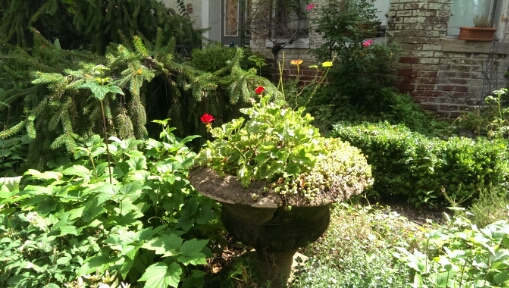
Even Spring is not behaving according to settled expectations. It burst forth especially early–the cherry blossoms are already gone and azaleas and roses are blooming almost a month early. Records were set around the country for the warmest March on record, and we are approaching drought conditions (again) in the Washington metropolitan area.
Not surprisingl for one who likes things to be settled and secure, while admiring the wild blooming around me, I have been thinking about how disconcerting change can be. For someone who prefers warmer weather to winter, getting Spring early is delightful, but I cannot help but recognize that it has come with disastrous storms and high risks for farmers and our food sources, evidence of the fraying relationship between our populous society and the earth. What is a gardener, a yogi, and a member of society to do?
As a gardener, it is necessary to remember old teachings and methods (for example, just because it was prematurely warm does not mean that the danger of last frost is earlier than in other, colder years), but it was also necessary to plant and tend the garden earlier to make sure that cool weather plants, such as greens and snow and sugar snap peas, actually have an opportunity to grow. The erratic weather is also serving as a reminder to try and shift to be more in alignment with the forces of nature and to contribute less to global climate change. In a word, a true gardener, like the dedicated yogi (on and off the mat) will rely on the lineage of teachings and experience, continue to be fully engaged without giving up, be adaptable to the vagaries of season–both serendipity and calamity, and seek to live in a way that fosters the good in oneself and all beings.
It is going with the flow, but in an active and intelligent way. In this time of uncertainty, I believe that an ever deeper and more open study and practice of yoga is a great gift. Yoga when practiced sincerely and in community provides us opportunities to connect more deeply and techniques to turn unsought changes into opportunities for growth and transformation. In that light, in my own yoga offerings to you, there is both stability and change:
The big change in my yoga classes is moving my long-running gentle/therapeutics class at Willow Street to Friday nights. I am very excited about this shift. On a personal level, it gives me free weekends for the first time in six years, which will give me more time and space to study, practice and explore. For you, I intend that the class will now be a perfect transition from the work week to the weekend, fostering and enhancing the ability to heal and celebrate. Those who like things to be steady can still expect the same full hour and a half of nurturing, alignment-based, therapeutic poses and restorative practices. Registration for the full session is preferred, but drop-ins are always welcome. New to the class and want to know what it is about? Please come join me on Friday, April 13th, as part of free class week.
The Tuesday night all levels group practice at William Penn House continues. As always, a portion of the proceeds support the work of William Penn House, and if you cannot pay the suggested donation ($12-15), do not let that keep you away. We want to make the yoga available to those who truly seek it.
I hope to see many of you soon. Please feel free to be in touch by email or Facebook message when you cannot make it to class. For in-between newsletter information, please “like” my “Rose Garden Yoga” page on Facebook, and there are always new photographs and musings about yoga on and off the mat on the blog.
Peace and light,
Elizabeth