Be Here Now (Var.)

The first summer I was in my house, I planted a climbing rose. Last year, two babies separated from the main plant. Although it is mostly shady in the front, I decided to see if it would take there and grace the front entrance. It’s got one bloom and fresh leaves even in the heat wave. I will continue to tend it.
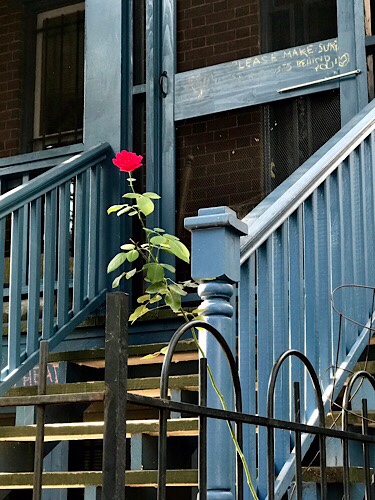

On the way to work. We cannot see beauty unless we pause to look; that may have us seem to lag behind those who are compelled to press forward for the impression of progress.
Yesterday the mysterious beeping was beeping again in Studio 1B. I have all sorts of approaches to teaching with the beeping. One of them is to switch the attention of the ears to music. We flowed to Now by Bhagavan Das (because it was already in the CD player and I like it well enough) and listened to selections from Love Reigns by Diana Rogers during final relaxation. Monty asked me after class to give a list of some good music for home practice. Here are some of my favorite “yoga” cds in no particular order:
Krishna Das — Live on Earth; Faith of the Heart
Wah! — Hidden in the Name; Jai, Jai, Jai
Jai Uttal — Kirtan (this double CD also has a useful spoken background piece on what is kirtan)
Deva Premal — Love is Space; The Embrace
Ragani — Best of Both Worlds
Dave Stringer — Mala; Japa; Divas and Devis
Shantala — Sri; The Love Window
Many of these are available at the Willow Street Yoga Center shops. Most should be available on-line directly from the artists. Dave Stringer also has other music available for download. The rest can be obtained from Amazon. Also great listening is Invocation, which was put together by Ty Burhow. It is a collection of different artists offering versions of the Anusara invocation. Willow Street work studies are raving about MC Yogi’s Elephant Power, which is rap music telling the stories of various deities — funny and delightful.
Mostly, I prefer to teach and practice without music, but I was a dancer and find music helps to lead me into heart and body simultaneously. I find bringing music into a practice session especially helpful when I am having trouble getting settled on my mat. I do not just play “yoga” music, but play whatever gets me into the spirit of play or relaxation and contemplation as I am moved. My bias is towards chamber music (especially Bach) and Indian classical music for a late evening quiet practice and for an upbeat daytime practice anything that would go with being outside on a grassy field on a bright sunny day with frisbee players around. Alice Coltrane is also wonderful if you haven’t discovered yet her discography.
Play what enhances rather than what distracts. Also, check out the artists when they come to town: Wah!, Dave Stringer, and Shantala (Heather and Benji Wertheimer) all come to town. Enjoy!