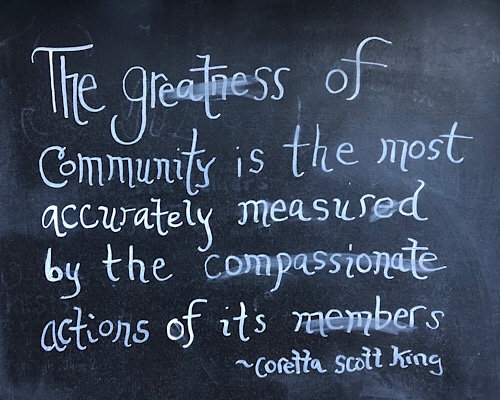
Found Quotation
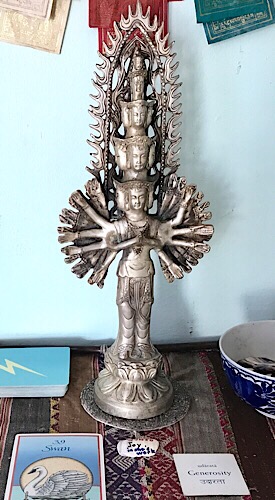
Avilokitesvara– god(dess) of compassion had one head and two arms. Zhe didn’t have enough ears to listen to all the stories of suffering, so one of the buddhas busted one head into eleven. Avilokitesvara’s two arms broke from the weight of helping, but instead of two arms broken and worn out, two arms broke into a thousand arms.
In response to requests, here are some photos of the garden in its current state.
The vine on the left is grapes–there are many dozens of bunches forming. The vine on the right is a kiwi. I planted it four years ago, and finally there are some fruits–at most a couple dozen, but it’s a start. There aren’t enough strawberries to bring inside, but there are always a couple to eat when I am out working.
Current herbs: cilantro, basil (thai and genovese), Mexican and Greek oregano, parsley, sorrel, tarragon, lemon balm, spearmint, kentucky colonel mint, garlic chives, savory, sage, thyme, rosemary, lavender, stevia, and dill. Greens include mesclun, arugula, kale, chard, and are ready to eat now.
Snowpeas are on there way (and I ate snow pea greens with garlic scapes and herbs for dinner tonight). Beans are blossoming; cherry tomatoes and cucumbers have formed, as have a couple of zucchini and a variety of peppers. Blueberries are ripening and figs are just starting to bud on the new growth. Carrots and turnips are mostly just a promise, but I expect at least a few. Leeks and spring onions are poking through, but don’t seem to be getting along with this year’s weather patterns.
What’s growing in your garden? (Even when I lived in an efficiency apartment in school, I had herbs growing in pots. And sprouting is its own kind of gardening and only requires a kitchen counter.) A garden can be made wherever you are, if you want one enough.
A brief afternoon nap is one of the benefits of working from home.

In this society, we tend to think of softness as a negative. If being soft is collapse, laziness, inattentiveness, etc, then it would indeed be a hindrance to growth inner and outer.
We need to soften, though, in order to open or change. When baking a cake, we allow the shortening to soften so that we can cream it with the sweetener. When a seed germinates or a fledgling emerges, the shell softens so that the new life can burst forth.
When I soften as part of the first alignment principle, it is not a collapse, though it does have an aspect of easefulness. It is necessary to soften to invite the support of the subtle energies, to fully experience all the pose has to offer, to expand with light from the inside out. Softening when we start a pose is like the softness of early spring that allows the vigor of full growth to expand.
Being soft in this way — on or off the mat — makes possible the growth of inner brightness and strength that actually makes us less vulnerable then would creating or keeping a hard and brittle shell that can bind or break.
The young woman sitting next to me on the train north from New York, who is impossibly tall and has lovely, strong features (i.e., is perfectly cast), is memorizing Lady Macbeth’s lines.
I had on my own lap print-outs of mantras that Paul Muller-Ortega has invited us to memorize as part of our continuing studies.
To enter the character of Lady Macbeth, one of the first steps is to memorize the lines, to know completely what she says and not just to hear it and appreciate it. Memorizing the lines is an essential part of the route to becoming Lady Macbeth.
Paul Muller-Ortega has suggested that the reason to memorize various mantras is not to acquire them, not to be able to demonstrate a superficial knowledge or skill, but to aid in the profound practice of
bhavana–deep contemplation at the heart level. It is not the fact of memorization, but the activity of memorizing. It is no accident that we call memorizing, “knowing by heart.” We seek to learn by heart to invite ourselves into the space of concentration that requires. It is a slow and difficult process for me. I persist, though, because of the deepening and expanding understanding it facilitates.
I note for those yogis (and other readers) who might find the idea of learning mantras alien or uncomfortable or apparently at odds with your own religious beliefs or practices, that studying the mantras does not require or make one a Hindu. I think of it as an invitation to understand and embody the highest archetypes and principles they invoke and represent and compatible with my other observances.

Peace and light, E — Posted with WordPress for BlackBerry.