Found Exhortation
Dear Friends,
I hope you are thriving to the greatest extent possible under your current circumstances in this outrageous Spring and weathering (pun intended) the wild fluctuations between apparent late winter and seemingly already mid-summer. My garden has been uncertain at several moments, but partly due to careful attention at strategic points and partly out of love and luck, it is thriving–providing lots of herbs and greens and promising lots of tomatoes and peppers and beans.
I write this letter a bit later than might have been desirable, as the summer session at Willow Street has already started, and my partial sabbatical from yoga teaching evidently has begun. In practical terms of time and space this is the first time in almost eight years that I am not working weekends (first Saturdays and then Friday evenings) and commuting out to Takoma Park from Capitol Hill to teach.
It took much contemplation to come to this partial sabbatical. Being a part of the Willow Street Community has been and continues to be important to me, and I have learned an incredible amount from the opportunity Suzie Hurley, and Joe and Natalie Miller, gave me to share my enthusiasm for the practices and the teachings with the fabulous variety of people who come to Willow Street as students. It was an honor and a continuing source of inspiration and focus to be able to study with so many fine fellow teachers over the years. And change can be hard for me. It also is hard to let go of something that has been profoundly important.
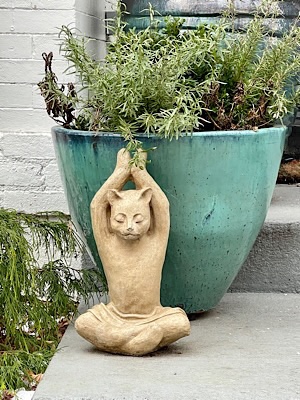
For my optimal health and well being, though, there just was not enough time for me to work full time and go where my heart is currently leading and also continue to teach on Friday nights or Saturday mornings. I had to make a shift or start fraying around the edges, becoming less happy with everything. Better to make some space to breath and feel and think without pressure. Freeing my weekends fully will give me some of the space and time that I need at this crossroad in my life. I am moving, I hope, towards a phase where there is more emphasis on nurturing self and relationship more deeply and exploring other creative pursuits with more seriousness. To be able to work intelligently and with good will as a civil servant at this time and to continue to engage in our society that is in so much upheaval, leads me, for my abiding health and expansion, to the garden and the cat and my own practice and the growing and very special relationship that began on the trip to India (no value judgment implied by the order). It also will be lots easier for me to study; going to a weekend workshop will no longer require my getting a substitute to cover my absence–expect to see me as a fellow student at the Friday nights of weekend workshops at Willow Street. New ideas and opportunities for teaching will likely come, but not for the moment.
I continue to lead the all levels yoga practice at William Penn House on Tuesday nights where you will be warmly welcomed by the regulars whatever your age or ability level and will be sure to enjoy the fruits of my new and varied explorations in yoga and other practices, while still keeping to the fundamental structure of class influenced by Anusara methodology. Please join us. A portion of each student’s payment supports the work of William Penn House. While there is a suggested amount, if funds are a challenge, just pay what you can.
Feel free to e-mail me if you are a more experienced practitioner who is interested in the Wednesday night practice or if you are interested in arranging private sessions or semi-private practices with your own small group.
I look forward to seeing those of you who are local on a Tuesday night or at a workshop around town or in the neighborhood and also continuing to share photos and contemplations on this latest phase of my yogic (yes, I know that isn’t a real word) on the blog.
Peace and light,
Elizabeth

It is too far from my current world and beyond my temporal limits at the moment, but if you are interested, please contact my friend Robin through the website link below, who writes:
Dear Friends and Colleagues,
Take care and thanks so much, Robin

Peace and light, E — Posted with WordPress for BlackBerry.