Happy Diwali (Jai Lakshmi)

Torte of garden greens, herbs, and garlic with spicy pesto; slow-cooked beans, cucumber and cherry tomato salad.
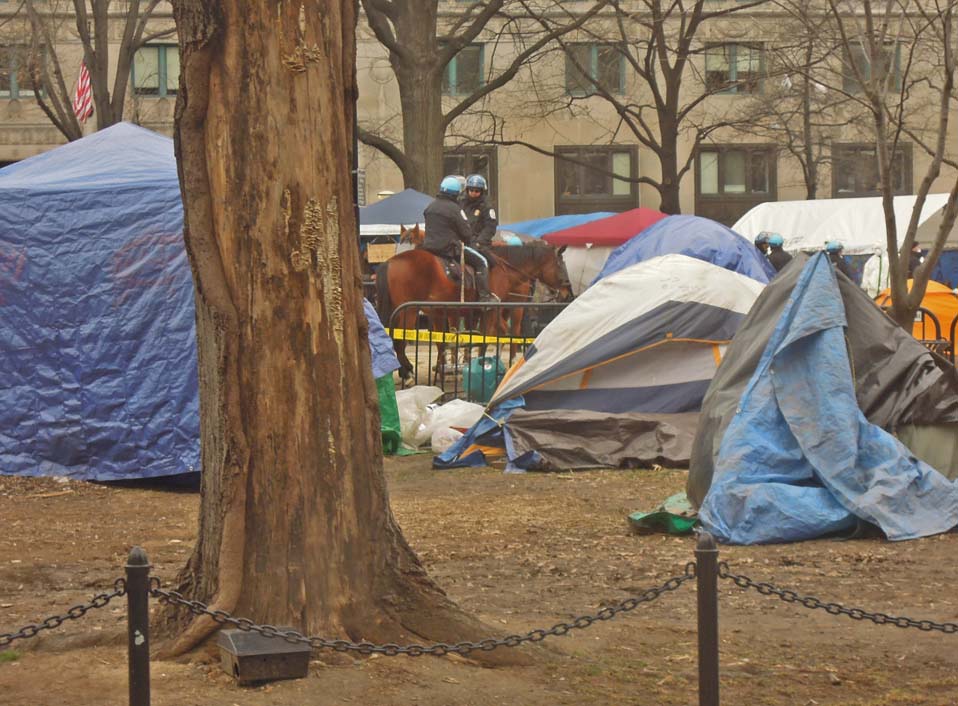
When I was on my way to do volunteer work this morning, I rode the bus past the dregs of Occupy DC-McPherson Square. The police presence was thick. I wasn’t sure why the heavy construction equipment was necessary. It is hard to know what will happen to the movement when it loses its physical location. It is clear that the idea of “occupy” has already entered popular culture, and the idea of the 99% will be part of this year’s Federal elections.
As things are created and dissolved, it is always hard to know what will stay and what will disappear from the fabric of our lives. Part of it depends on the strength of the ideas. Part depends on the commitment of those involved to transform and evolve to keep what is good moving forward even when beset with challenge and upheaval. As for the last photograph, which was taken just down the street (the cop cars were clearly related to those in the Square)–I couldn’t tell you what god or whose country; could you?

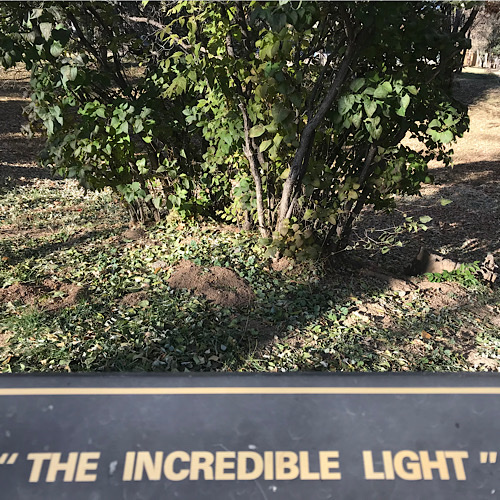
This spring I decided to for the second time growing a fig in a container. It has about five figs, all of which I intend to eat before the squirrels can get them (I’ve beaten them and the birds to the three blue berries that have ripened so far; I have high hopes for the figs). I don’t think my fig in its container is suitable for sharing as “Neighborhood Fruit.” Do you have a fruit tree that has too much fruit for you? Let people know.
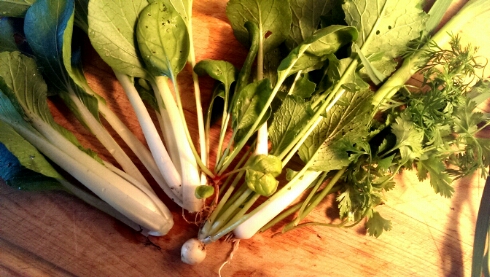
From left to right, pak choi, spinach, baby turnip, new onion, coriander
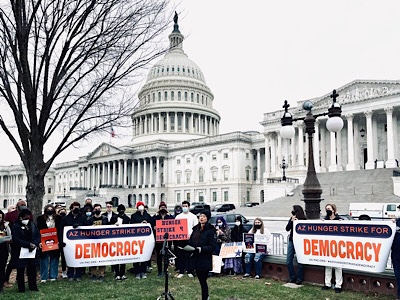
I am not prepared to go on hunger strike—it would not be right for my health. I can bear witness, speak out, and donate. What might you be able to do?
It’s no surprise: I find myself more and more consumed by thought and activity regarding the state of the country and what I can do as a citizen (including voting) to make things better. As I seek to stay engaged, but grounded and without anxiety, I find solace of the teaching in the Bhagavad Gita that true yoga is action without attachment. To be detached is not the same as withdrawing from action. In fact, the Gita suggests that the path of action is better than the path of renunciation.
What is actionless action? Given the Gita’s fundamental premise that we must act in accordance with our duty (what that means is the subject of much debate that is beyond a simple blog), actionless action does not mean disengaging from the process. It also does not mean not caring. Rather, it means that we should act fully in accordance with our principles (which principles should be shaped by the yoga guidelines of non-harming, truthfulness, non-stealing, alignment with nature, non-greediness, cleanliness, contentment, fervor, self-study, and surrender), but with the mental understanding that we are ultimately not in control of the outcome. We act because not to act is a cop out. We offer the fruits of our action to forces beyond ourselves. We act out of love — not selfish love for personal gain — but with loving gratitude for being able to act at all. We engage fully and then still seek to be free of being unsettled by either pleasure or pain from the outcome. Whatever the results, we keep acting, we keep doing our duty, fully and with loving engagement.
See: BG IV.19-20: He whose undertakings are free from anxious desire and fanciful thought, whose work is made pure in the fire of wisdom: he is called wise by those who see. In whatever work he does such a man in truth has peace: he expects nothing, he relies on nothing, and ever has fullness of joy. (trans. Juan Munoz)
He who has abandoned all attachment to the fruits of action,/ Always content, not dependent,/ Even when performing action,/Does, in effect, nothing at all./ Performing action with the body alone, / Without wish, restrained in thought and self,/ With all motives of acquisition abandoned, He incurs no evil. (trans. Winthrop Sargeant)
P.S. I will have voted in the morning and will be teaching at Wm Penn House on Tuesday so come join me resting in yoga before going home to watch the returns.