Similar Posts
- Asana, Pranayama, and Yoga Practice | Community and Family | Food for the Mind (Yoga Philosophy, etc) | Meditation
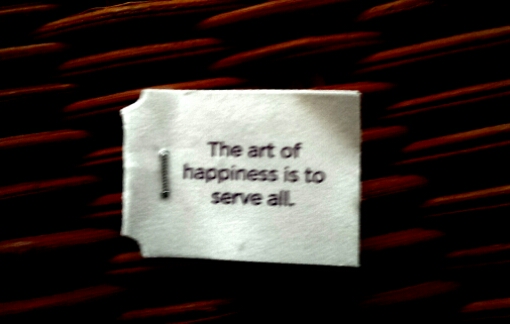
Message From a Teabag
This morning, a friend suggested that if he took into account the needs of others when making plans, all he would be doing is serving others, and he would never get to do what he wants. “Why would I want to do that?” he asked.
I think that’s a common enough question in this society. By uncanny coincidence, the teabag I selected right after the question was posed suggested a possible answer.
As we are taught by the stories of the monkey deity Hanuman, whose main characteristic is a longing for devotion that he demonstrates (while still being utterly himself) through service (seva) cultivating mindful relationship is the highest service to our own self and not just to those with whom we are in relationship.
To take care of our selves can be done with consideration of others without sacrificing our own needs. The answer, I think, is in how we assess and balance our own needs. For me, when I consider the impact of my planning on others with whom I am in relationship as well as my own needs, for example, of freedom, autonomy, and personal delight, I am also considering my needs for companionship, mutuality, connection, and respect. If I completely privilege the former, I may be neglecting the latter and vice versa.
Yes, There Were More
My friend asked me tonight whether I’d gone over to the Supreme Court to see if there were any more heart-shaped clouds during the oral arguments today. I was occupied mostly by errands on my too brief lunch time walk (work was very busy) and didn’t get all the way over to the Supreme Court, but yes, there were more today when I was within a few blocks of the Court:
- Asana, Pranayama, and Yoga Practice | Food for the Body | Food for the Mind (Yoga Philosophy, etc) | Gardening
The Exquisiteness of Order (Winter Theme)
By order, I mean how things are arranged in space or time. Even chaos theory presumes order in that sense. On and off the mat, there is a certain order to things that is optimal. We do not plant seeds and then till the soil. Or think of the difference between peeling and chopping vegetables and then cooking them or cooking them and then peeling and chopping them. One or the other is not necessarily wrong if you do not have a specific dish in mind, but which you choose will dictate the results. Once you have gotten started in the sequence, though, the path shifts and is partly set. To reach an exquisite rather than a disgusting result, the next steps are ordered by the initial choice.
If only one musician is playing a single note, then there is no possibility of discordance. Add more musicians and more notes and who plays what notes when can mean cacophony, a catchy tune, or an extraordinary and ecstatic work of art. None of us are alone and none of us are playing just a single note, so in the great fabric of our being, it is best to understand how to make music.
Sequencing on the mat is more subtle than what poses should be done in what order in a particular practice to emphasize backbends v. forward bends and twists to be able to do the strongest poses with the least possibility of injury, as important as that is. The order in which we apply the Anusara principles not only aligns the physical body, but brings symmetry to the physical and energetic bodies, helping us to feel more in harmony in everything we do on and off the mat. I am, in this, a decent musician and not Bach, but the more I pay attention to the optimal sequence of things (keeping in mind that over most things we have no control as to when, whether, and how they happen) and the more I learn and appreciate the exquisiteness of order, the more I feel, understand, and experience the subtleties and joys of harmony.