Blossoms Around Town
What does it mean to be here? I ask myself how am I present? What am I doing while I am here?
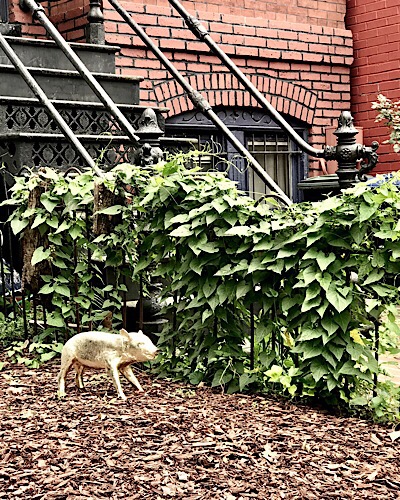
I think it highly unlikely that the neighbor who chose to decorate a front yard with a silver-painted pig and wood chips intended in any way to reference Vishnu in his incarnation as a boar. But as I’m caught up in learning about the animal chariots and incarnations of the 330 million these days, that is what came to mind for me.
There’s a story that Vishnu incarnated as a boar to kill a demon who could not be killed by man or god (similar to the story about Durga slaying Mahisha, the buffalo demon).
When in anthropomorphic form, Varaha is often seen with Bhudevi (Earth goddess) and sometimes also Lakshmi. There she is again–Lakshmi–calling to me to remind me to act from my abundance (from there comes my capacity to slay demons).

Peace and light, E — Posted with WordPress for BlackBerry.
Life will be more rather than less challenging for most for the long haul. Engagement is not optional.
Do you have a ritual or routine that you can rely on to provide a personal pause for gratitude/beauty/center/calm—whichever serves best?
It might include aspects of yoga practice or it might be something else. I had a friend who, at the end of every work day, lay down on the sofa and listened to classical music to restore themself. Perhaps you dance or sing or walk or nap.
I’m spending much time in the garden, including volunteering at bigger ones, and am most at peace these days when fully engaged with the plants.
But the most reliable source of grounding and sweetness for me, whatever might be going on, is meditation. Perhaps that is because I can do it no matter my health or location; it is free, portable, and simple, whether meditating on the breath or with a mantra.
I saw this beautiful roll of chicken wire in the Enid Haupt garden when I was walking back to the office after a quick visit to see the Gods of Angkor exhibit at the Sackler Gallery (sorry about the absence of links; blogging from the BB).
I was first introduced to the idea of “found poetry” in junior high school and have developed a life-long habit of photographing words to change, enhance, and/or question their meaning and hidden beauty by the act of extracting them from their original place and presenting them as a photograph. Marcel Duchamp and others did what poets and photographers were doing with words with ordinary objects by presenting them as sculpture.
Here, where I have photographed the chicken wire roll, is the art a sculpture (because I could treat it as such) of which I have taken a photograph–the photograph being mere documentation? Is the art the photograph of what I have seen to the extent I am offering it as a vision and a dialogue generated by what I saw? Or is the photograph merely a snapshot taken with a hand-held computer device documenting an object that happened to be sitting there–not art at all? If it were not for artists such as Duchamp, could I or would I even be able to ask this question?
I think that analogous types of questions have been and can be asked about the variety of religious and mystical experience. Is there a particular way they must be experienced? Do such experiences have to fit within a prescribed framework to be valid? When are such experiences madness or delusion and when are they the voice of the spirit? Who gets to decide? Does it depend on the era and the culture in which the experiencer lives? Does the answer to any of these questions matter if the experiences lead one to a more loving, compassionate, and beauty-filled life?

