An Offering
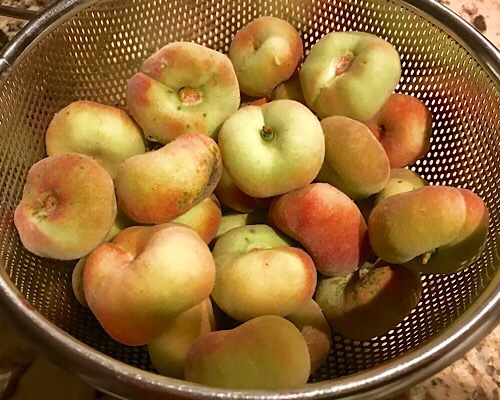
From the tree in her yard, an offering brought by a student coming for house yoga practice.
A mourner asks, who is going to step up and defend the rights of women?
My answer is each and every one of us; how can we expect someone else to step up unless we are doing it ourselves?
I think the wish that RGB Rest In Peace and rest in power can be an exhortation to the living. When we can live resting in our own peace and power, then we will have what we need to persist and shift.

Only five bunches of
Grapes. Who will eat them? Me? Or
Will it be the birds?

The other day was very windy–steady winds of 20-25 miles per hour and gusts of up to 30-40 miles per hour. I needed to go to work, so I had no choice about which direction to walk. That direction was, unfortunately, straight into the wind. It made the already cold day feel much colder, and I felt like I needed brute strength just to move forward. Knowing that I did not have the option of turning the other way to feel warmer and have the wind push me along, I instead consciously softened and leaned into the wind so that I was fighting it less and able to ride it a little.
I was moved by facing the wind to think about the various yoga practices and how they help us understand and be with the force that connects and moves around and between things, without and within us–prana.
When we meditate, the intention is to be in either absolute fullness (purna) or absolute emptiness (sunyata). (I don’t think it matters which one). In the absolute stillness of meditation, prana does not flow, and we experience being in a state where we are not tugged at or blown by the forces of change and relationship between object and beings. Being able to tap into that state is essential, I think, to be able to weather the times when the energies around us are too much of a whirl for whatever reason.
When we practice pranayama (breathing practices), we learn about the many ways prana flows. Although pranayama is often translated as breath control, I think it is more about learning to control our physical and mental relationship to the breath than it is about controlling the breath–the breath serving as the best proxy for us to experience the flow of the life force, prana itself. Learning how to be more intimate with the subtle energies helps make us more humble, more aware, and more skillful in relationship to the world around us.
When we practice asana (postures), we practice dancing with and riding the prana so that we do not have to do everything by rigid physical and mental effort. With steady, educated and discerning practice of asana, we can move with more power and grace and less effort and risk of injury, just as a skilled sailor knows how to align her or his sails both to be able to move when there is just a bit of wind and also to ride out a gale, harnessing the wind instead of being torn up by it.
To those of you facing the blizzard, may you find time to be still and warm and at peace and use skill in alignment to stay safe when clearing out from the snow and moving from place to place.
Peace and light, E — Posted with WordPress for BlackBerry.
Last night, we were talking about the parameters of cultivating a steady and fruitful meditation practice, and Paul Muller-Ortega suggested that it was about the balance of stability and flexibility. He had learned the principle from a different source, but I have contemplated and explored the principle in depth from teachings I have received from John Friend.
A critical aspect of the Anusara alignment principles is to find the perfect balance of stability and freedom. We need stability to stay fully and safely in each pose. We need freedom to achieve the fullest and most delightful expression of the pose.
We find the stability both by making certain that we have established our foundation (which is an aspect of the first principle of opening to grace). By then using the three aspects of muscular energy–hugging the muscles to the bone, drawing into the midline, and drawing energy from the periphery to the focal point, we make possible an expansion of our edge, whatever that might be. Having a solid, aligned foundation and affirming our very core with these actions, gives us security and balance. We also want to reach out, to be playful, to expand to our fullest, which we do using the expansive, outreaching organic energy — from focal point to the periphery, from the midline to our outer edges, from the very marrow of our bones through bone, muscle, skin, and beyond.
If we over-emphasize (including natural inclination) stability, then we can get stuck. If we just let ourselves be free, then we end up all over the place. When these elements are perfectly balanced, we can safely find our deepest freedom of expression.
When I teach this principle as the focus of a class, I always invite my students to think of how important the balance of stability and freedom is for every aspect of our lives.
The discussion last night put this principle in the context of the regularity and steadiness of our practice, with the recognition that to stick with our practice, we will sometimes need to vary the time or amount of our practice, or what elements are included in the practice.
To get the fullest benefits of a practice (this applies to any practice and not just to meditation), we need to show up consistently and to practice in accordance with how we have been taught. To stay steady, though, we need to give ourselves the permission or freedom not to show up, or within appropriate parameters, to modify the practice when life gets in the way of what we think would be the ideal practice. If we think we have to do things at the exact time and place every day in a perfectly precise way, we become rigid. On the other hand, if we are loosey-goosey about it, then we do not have much of a practice and will not realize the benefits that we could get.
Where in your practice or life would more stability and steadiness give a field for greater freedom and happiness? Where could you give yourself a little more flexibility so that you feel that steadiness brings the possibility of joy, rather than tying you down?
Peace and light, E — Posted with WordPress for BlackBerry.
I have been cleaning out old files. Mostly I keep my drawers and closets relatively free of clutter and the unnecessary, but there are occasional pockets that have lived on because they were not a priority and neat enough. Found among postcards and letters from friends was one I received from a friend of a friend in October 2001. I never got to know her well. My friend has since moved out of the neighborhood and his friend moved back to Germany several years ago to start a family. Here is what she sent:
a picture from India [not shown] and a saying for you —
Live with intention
Walk to the edge
Listen hard
Practice wellness
Play with abandon
Laugh.
Choose with no regret
Continue to learn
Appreciate your friends
Do what you love
Live as if this is all there is.
A super sweet message. Now that I have shared it, I will recycle the original piece of paper. Thank you Uta. I hope all is well.
The great texts and teachers of meditation exhort us to look within with the promise that by so doing we will find great peace or bliss or splendor.
For many, though, initial attempts at meditation are just as likely to reveal troubling aspects of the self or agitating thoughts as any sense of beauty or quiet and the reaction can be a dismissal or disbelief in such teachings.
The exhortation to look within is not directing us to introspection or the self-examination of therapy (which are also useful in appropriate circumstances), but rather is inviting us to open to seeing that the beauty and specialness that we might believe of and recognize in others is also within ourselves.
Only when we can first look inside ourselves with love and empathy, can healing, change, growth, and compassion begin regarding those things that make introspection scary and challenging.
Peace and light, E — Posted with WordPress for BlackBerry.