On the Refrigerator Door
Last week, I used as a theme sukha — ease, comfort, happiness. I was inspired by Lorin Roche’s discussion of translating in his “version” of the Vijnana Bhairava, which he entitles “The Radiance Sutras.” In it he notes that “[e]ven more literally, sukha is (according to some etymologies) composed of su, good + kha, space. A good space.” At first blush, teaching about sukha might seem to be off-topic from my session theme of sequencing principles. The whole purpose, though, of seeking to understand, practice, and optimize our sequencing in time and space on and off the mat is to find just that. It is to be in a “good space,” to feel at ease, whether we are being challenged or delighted.
I found myself contemplating sukha yet further this week (it is a recurring practice and contemplation theme for me — I love Patanjali’s sutra “sthiram sukham asanam”), as I have been observing and helping the foster cats make mine their new home. When we are uprooted or out of alignment, we are not in a good space. It is a struggle to feel happy or at ease. When we find our rhythm again, then ease unfolds.
There is a set of principles that generally works for taking uprooted animals (or people) and helping them feel at home. Part of making them at home is their new person holding him/herself in a “good space” for the newcomers, which indeed helps them find their own, which is its own yoga.
The blessing of yoga for us, and why we take ourselves to challenging difficult places on the mat, is so that we can, by use of intelligent sequencing of practices, techniques, and mindsets, discover how to feel connected to our own spirit wherever we are in time and space — the essence of ease in this body and mind. The more we can do this for ourselves, the more we can do it for others.
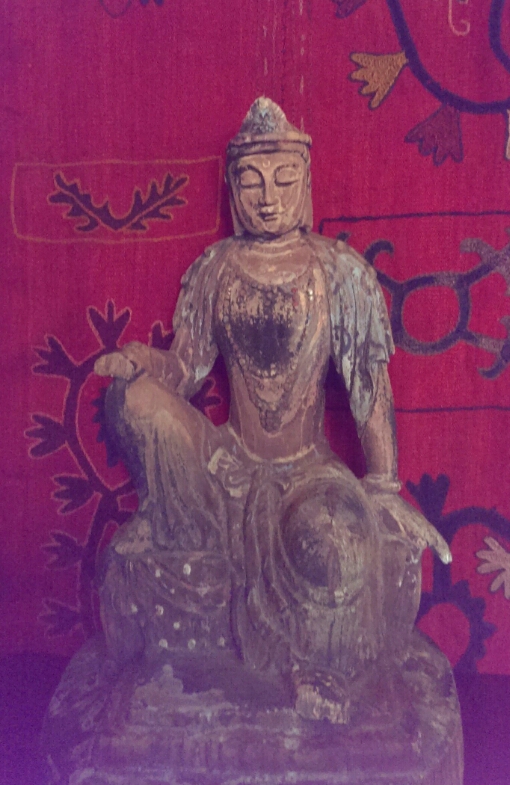
Last Sunday, when I was at Eastern Market to get apples and pears, I saw a small, painted wood statue of Kuan Yin. I have been attracted to this one of the 330 million gods and goddesses for some time. Her primary attribute is compassion. She is said to be a female Chinese metamorphosis of the Buddhist bodhisattva Avalotikeshvara, who, according to some, is an emanation of the Hindu deity Shiva.
She had a price tag of $70 around her neck. It was too much, especially since her hand and foot looked like they had just broken off in transit.
Still, I was attracted to her. The vendor, who is from Pakistan, came over to talk to me, asking me if I was interested.
“Too high,” I said.
“What would you pay?”
Knowing it is holiday season, and the vendors really need to do well to survive the winter, I suggested $45, thinking it was really too much, but I very much liked the impeccably serene expression on her face.
“You have bought things from me before,” he said. I’d bought a couple of older rugs from him last Spring, at which time he had chatted with me for a while and showed me a picture of his chosen guru. “You are a divine being; I will give her to you for free.”
“I bet you say that to all your customers,” I replied.
“Everyone is divine, yes,” he said, ” but you are different. You know it.”
Somewhat overwhelmed by this, I thanked him for the honor and took out my wallet. I had $42 and change. “I will pay $40.”
I paid him and walked her home unwrapped in my arms, thinking it will be hard to live up to his expectations. Who better, though, to remind me to relate to others, always recognizing their inherent divinity (whatever that might mean to me or anyone else), than the goddess of compassion?
Where the wood was raw from having been broken, I rubbed the edges with ash from Chidambaram temple (that I happened to have in the studio), so that the breaks would not visually distract, and one would only notice the sweet face.
Down by the river
I met a crane enjoying
An early dinner.