State of the Garden (Front)
For a few precious days each year, the light in the house and underneath the Japanese maple in front of the house glows red.
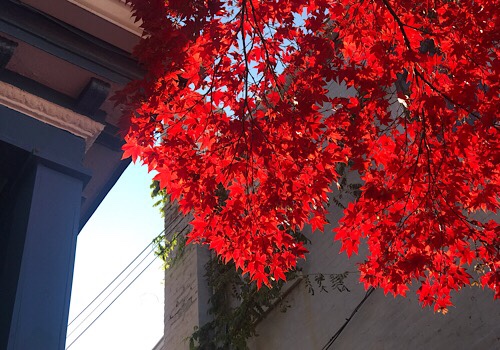
For a few precious days each year, the light in the house and underneath the Japanese maple in front of the house glows red.

I am sitting in Phoenix’s Sky Harbor International airport waiting for the plane that should already be carrying me home to finish being repaired. After having done a full hour of practice this morning in my room, having a last delicious breakfast at the retreat center, and enjoyed the two-hour ride with friends to the airport, I find myself perfectly happy to sit in the airport. I am warm and well-fed. I have bought a novel to read on the plane — Lev Grossman’s “The Magicians” — and put aside a philosophy handout to write. The handout, a translation of the beginning of Abhinavagupta’s “Tantrasara” that was given to us by Paul Muller-Ortega to support our meditation practices, teaches us to seek the power of bliss through the practices, this bliss being true knowledge and true freedom. The more we practice, the more we can draw on this power and abide in a state of true happiness. Paul Muller-Ortega sometimes says that we want to be “unreasonably happy.” As I sit here feeling perfectly content after my weekend of practice and community and watching others in the airport get progressively grumpier with the delay, I feel unreasonably happy. I also feel fully motivated to practice and study ever more deeply so that I can abide ever more steadily and this glorious unreason.

I am looking forward to February’s meeting of the Willow Street Book Club this coming Sunday, where we will be discussing David Frawley’s, Spiritual Secrets of Ayurveda: Tantric Yoga and the Wisdom Goddess. Especially since many of us will likely have been to hear some or all of Professor Douglas Brooks’ discussion of the great goddesses last weekend, the meeting promises to be full of lively, thoughtful, and insight-provoking discussion.
One of the things I have been pondering on this latest read is how I can fully imbibe the wisdom that is offered with the imagery and stories of the goddesses, without getting caught up in being troubled from a feminist perspective. Many yoga practitioners I know rely on the call in the texts to worship the “goddess” as a way of saying that women are not diminished in the classic texts. My conundrum is that when one looks at the texts and the images about the goddesses, all the stereo-typical notions of beauty and youth are inextricably intertwined. Like the Western fairy tales I gobbled up in my youth and their entrancing but insidiously prejudicial archetypes, the sweet, loving, desirable goddesses are the young and fair; the fierce and powerful goddesses are the ugly crones.