Asana, Pranayama, and Yoga Practice | Food for the Mind (Yoga Philosophy, etc) | Meditation | Photos
Tapas
To reach liberation of spirit (moksha), according to various yoga teachings, takes a lot of effort (tapas).

To reach liberation of spirit (moksha), according to various yoga teachings, takes a lot of effort (tapas).
At long last, now that the leaves are turning color and leaving the trees, and the days are getting shorter, the solar system I had installed was turned “on” this morning. I am hoping to watch the meter go backwards during this low usage month.

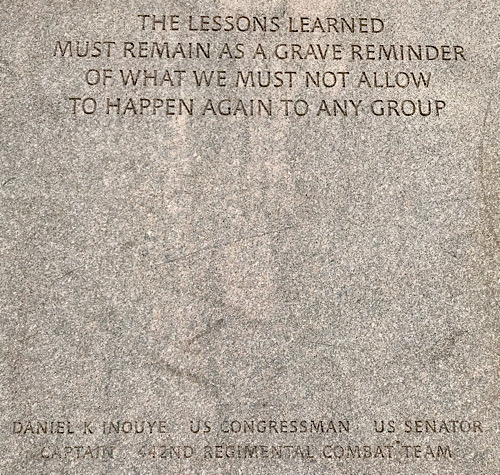
I walk past the Japanese American World War II Memorial on my way to work. This means I mostly walk past without thinking about why it is there. This morning I was moved to reread and remember and ask myself what am I doing about it?
Last week, I used as a theme sukha — ease, comfort, happiness. I was inspired by Lorin Roche’s discussion of translating in his “version” of the Vijnana Bhairava, which he entitles “The Radiance Sutras.” In it he notes that “[e]ven more literally, sukha is (according to some etymologies) composed of su, good + kha, space. A good space.” At first blush, teaching about sukha might seem to be off-topic from my session theme of sequencing principles. The whole purpose, though, of seeking to understand, practice, and optimize our sequencing in time and space on and off the mat is to find just that. It is to be in a “good space,” to feel at ease, whether we are being challenged or delighted.
I found myself contemplating sukha yet further this week (it is a recurring practice and contemplation theme for me — I love Patanjali’s sutra “sthiram sukham asanam”), as I have been observing and helping the foster cats make mine their new home. When we are uprooted or out of alignment, we are not in a good space. It is a struggle to feel happy or at ease. When we find our rhythm again, then ease unfolds.
There is a set of principles that generally works for taking uprooted animals (or people) and helping them feel at home. Part of making them at home is their new person holding him/herself in a “good space” for the newcomers, which indeed helps them find their own, which is its own yoga.
The blessing of yoga for us, and why we take ourselves to challenging difficult places on the mat, is so that we can, by use of intelligent sequencing of practices, techniques, and mindsets, discover how to feel connected to our own spirit wherever we are in time and space — the essence of ease in this body and mind. The more we can do this for ourselves, the more we can do it for others.
This past weekend I went to a group meditation practice with a friend because I was in the mood for companionable silence. I am not formally trained in “mindfulness meditation,” but I attend group practices occasionally and have read a number of books and incorporated aspects of the practice into my own over the years, so I expected to be comfortable attending.
Because I was new to the group, the leader asked me questions about what I experienced after most of the segments of the practice.
After the “meditation” segment, the leader asked me whether I’d had any thoughts. Of course I had thoughts. If not, as I think of thought, I would be brain dead.
For me the question is not whether I had thoughts (I include meditative awareness as thought), but whether I got stuck in dwelling on something from the past or some kind of planning or problem-solving. My training would have me let go of attention on such thoughts to refocus on the chosen focus for my meditation, i.e., the breath or a mantra, but for me, that is not the absence of thought.
Some of the quibble might be semantics. Part may be an underpinning philosophy to a practice that categorizes an ideal of pure awareness/consciousness as something higher or better than human thought.
If you practice or teach meditation, feel free to weigh in.