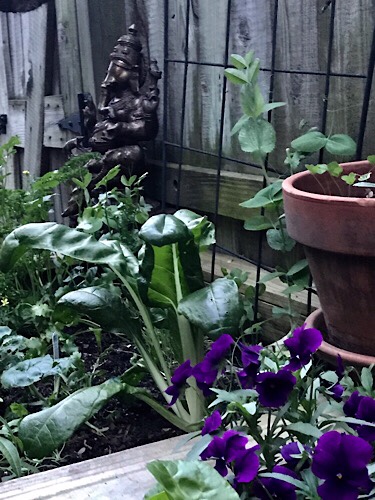
State of the Garden

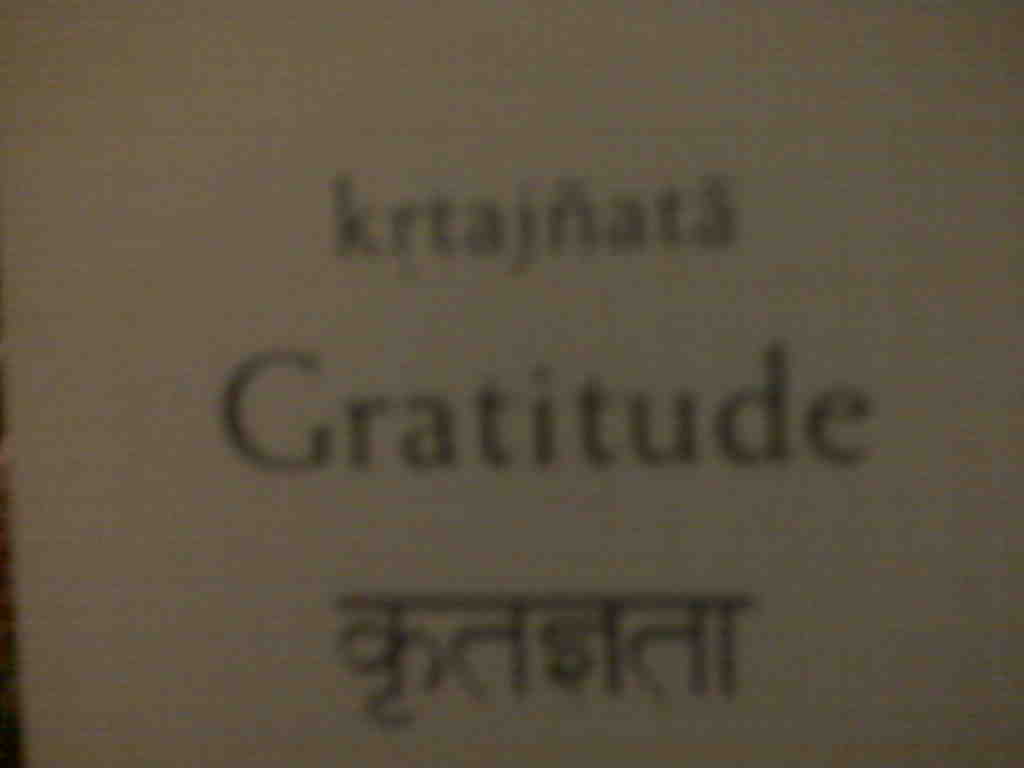
When I get the studio ready for Wednesday night yoga class, I pick a puja card. I shuffle the cards and then pick a card from somewhere in the middle of the stack. More often than not, the card is aligned in some way with the activity, thought, or emotion that is most present in body-mind. Tonight, the card that came first out of the shuffled pack was krtajnata — gratitude.
I am deeply grateful for my teachers, friends, and family–extensively overlapping categories–and wish a happy thanksgiving to all.
Peace and light, E — Posted with WordPress for BlackBerry.
The Self in man and in the sun are one./ Those who understand this see through the world/ And go beyond the various sheaths/ Of being to realize the unity of life./ Those who realize that all life is one/ Are at home everywhere and see themselves / In all beings. They sing in wonder:/ ‘I am the food of life, I am, I am;/ I eat the food of life, I eat, I eat./ I link food and water, I link, I link./ I am the first-born in the universe;/ Older than the gods, I am immortal./ Who shares food with the hungry protects me;/ Who shares it not with them is consumed by me./ I am this world and I consume this world./ They who understand this understand life.’ Taittreya Upanishad, 10.5, trans. Eknath Eswaren.
As one who is immersed in the joy of growing, selecting, creating, and tasting food and studying and practicing yoga, it is no suprise that the Taittreya Upanishad (which Eknath Eswaren subtitles “From Food to Joy”) is one of my favorite readings.
The Taittreya Upanishad explains the five sheaths or koshas that make up the self — the food body, the energy body, the mind body, the intuitive body, and the bliss body. What we take in with our senses and what makes us flesh and blood can, with right observance and practice, lead us to a consciousness of self as joy and spirit embodied. This is the yoga of eating and of food.
For more details on the Taittreya Upanishad, please see Jon Janaka’s article, “I am the Food!”
Other sources:
Upanishads, trans. Patrick Olivelle (Oxford World Classics 1996)
The Upanishads, translated for the modern reader by Eknath Eswaren (Nilgiri Press 8th Printing 2000)
The Ten Principal Upanishads, put into English by Shree Purohit Swami and Wm. Butler Yeats (Faber and Faber, London, Reprinted 1952)
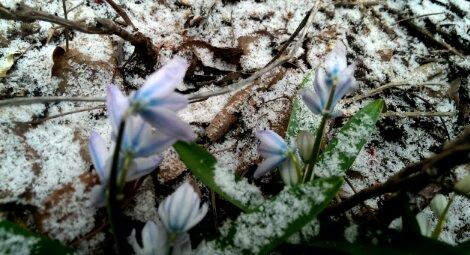
Today’s snow was a soft and beautiful one. Mostly, though, people were complaining that it was still snowy and cold.
With camera in hand this morning, I thought that to have more when we have already had too much makes it hard to appreciate the intrinsic good of a thing. I enjoyed this snow as a reminder of how moderation can enhance pleasure.
I then surrendered to the fact of the snow and to its beauty, letting go of my preference for spring mildness.
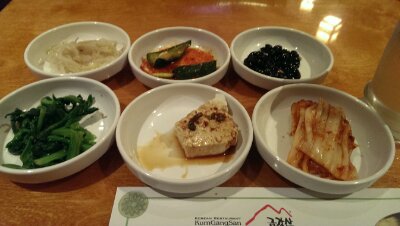
Don’t underestimate the power of comfort.
Here, kimchee with a few bites already taken
Later this evening, before or I after I sit for meditation, I expect to do some restorative yoga.
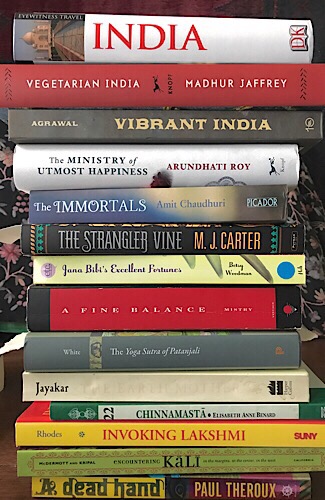 Current stack of to be read in anticipation of upcoming travel. Though I’m on a brief detour into a reread of “Harry Potter and the Deathly Hallows,” which appeared the other day in a nearby “little free library.” The Arundhati Roy is so finely wrought, I can only read a few pages at a time. The Madhur Jaffrey, by serendipity, has a bit about one of places I will be eating.