State of the Garden (Somewhat Myopic View)


Dear Friends,
What splendid fall mornings we are having. The neighborhood dogs are frisking in the park and the fall colors are starting to show. It is time to make tomato sauce and pickled peppers with the last of the summer harvest and continue planting greens (containers are great if you don’t have much space) for some fresh eating through December. Now is also the time to start shifting to a more introspective practice, seeking inner illumation as the days get shorter and the nights get longer.
This Fall, classes will concentrate on refining the principles of alignment to more sweetly and deeply appreciate your own inner light.
Join us any Tuesday night on a drop-in basis at William Penn House — bring a friend for a delightful all levels experience.
It’s not too late to join the Willow Street Fall session — Saturdays at 8:30 level II or, if you need a gentler practice, including a therapeutic focus, try the noon Gentle/Therapeutics class. Drop-ins always welcome.
October Serenity Saturday (October 17th, 3-5pm) is just around the corner. Sign up early to get the Capitol Hill Yoga early bird discount!
Starting to plan the holidays? If you’ll be in town, make sure to plan to join me for the 7th Annual Thanksgiving Day Fundraiser for Oxfam, which will again be at Willow Street in Takoma Park Thanksgiving morning. It is a great way to start the day and bring a focus of gratitude to this day of abundance. As always, in or out of town guests, friends, and family welcome whatever their experience level.
For the Wednesday night practice, October’s charity will be the Whitman-Walker Clinic to honor its work in providing health care in some of DC’s neediest communities and to help send energy for universal health care. I’ve decided that I have so much fun with these practices that in addition to donating all the proceeds, I will donate to attend too!
As always, feel free to email me with questions, comments, suggestions, or just to be in touch.
Info on all classes and workshops at www.rosegardenyoga.com.
Peace and light,
Elizabeth
How do you choose what mudra to use when sitting for meditation? Do you shift depending on time of day, ambient temperature, your mood or physical state when you start out, or do you stick to a single one–perhaps because you were taught that is best?

I came out briefly to sit and contemplate and write in my journal before a staff meeting at lunch time (no lunch provided).
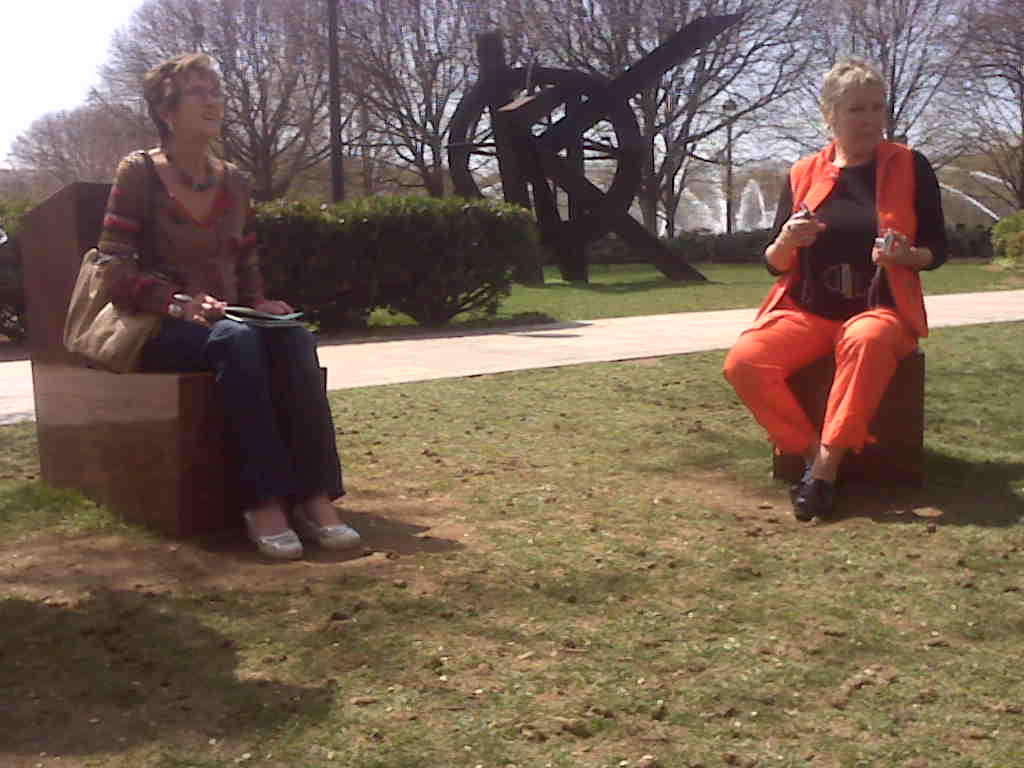
The Scott Burton chairs in the National Sculpture Garden are one of the more delightful places to sit outside near my office.
First, I was joined by several birds. Then some tourists came along. The one with all the jewels sat down at the direction of her friend in orange for a photo. “We’re not allowed to sit here,” the sitter said with a little glee in her voice.
I directed her to the sign near the seats giving permission. This led the photographer both to sit down with her friend, but also to lose any real interest in taking the photograph.
What was it about the loss of transgressiveness that made the photo less desirable? The chairs are the same whether permitted or not. In fact, with sitting permitted, there is more time to explore fully their function as chair as well as their form as art.
This set me wondering about how much our desires are driven by social ideas, rather than needs and comforts.
A father and his son approach the chairs fro the other direction. After reading the sign giving permission to sit, they promptly sat down. The bare statement “granite chairs,” was all that was said before they got back up and went on they’re way.
Peace and light, E — Posted with WordPress for BlackBerry.
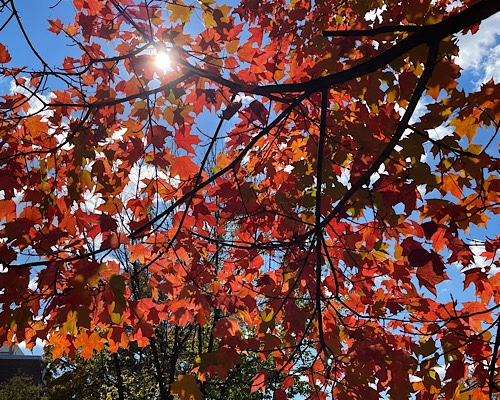
I had to address some stressful/annoying things today. Knowing this, I made sure to take a walk in the bright light.
“It will make you both laugh and cry,” said Josh, who is a long-time neighbor and the proprietor of the newly re-opened West End Cinema, which is currently showing The Kings of Pastry. “I don’t think I will be crying just because a sugar sculpture breaks,” I responded with some skepticism. “Let me know afterward,” he said, and there the conversation ended. I needed to get seated, and he needed to help the next movie-goer.
What I found loveliest about the film — besides getting to surrender to the delicious sensation of being completely awed by the extraordinary technique exhibited — was that there was no competition in the sense of there being “winners” or “losers.” All of the finalists — I don’t think that this is a spoiler — could achieve the designation of “master” if they demonstrate their virtuosity as pastry chefs within a short period of time under intense scrutiny.
The movie, in revealing a little of what it can mean to have the talent, passion, and single-mindedness to seek to be a master of a craft, a livelihood, an art, invited me to reflect on when I have been tested and when I have wanted a certain achievement marked by an outer designation. Undergraduate and law school were highly competitive; by being ranked, excellence seemed to be prized not as much for how it would enable the students ultimately to be better able to serve society and themselves upon having developed a certain required level of mastery, but more for creating a ranking within that segment of society. The dance world, for me, also felt strongly competitive. With injuries early on and having developed the “wrong” body, I could not rise to the competition.
The support, encouragement, and mentoring of the pastry chefs in The Kings of Pastry — although clearly only a select few were finalists — highlighted for me what it can mean to strive for excellence without having it be structured by win-lose/pass-fail competition; it only makes the world of pastry better if more of the pastry chefs are true masters. In this regard, watching the movie led me to think about what it was like to work for Anusara yoga teacher certification in contrast to my earlier education. When I was working for my Anusara certification, the standards for achievement of the “goal” were still very high, but it was not about winning/losing or achieving/failing. It was a period of intense study, practice, learning, and humbling experiences. On being certified, I knew that the efforts to be certified were just the beginning. Part of the reason for being so deeply challenged to be certified, to meet the level of initiation (in Sanskrit diksha), was to see if we would continue studying and practicing at that rate out of love and deep commitment. It took going through the process and addressing all the old emotions and patterns of reaction and response that came up in the context of being tested to help me to start fully appreciating the difference between being in a competition and seeking the best we can be for ourselves and for others in our work and study. When I started to have a lived appreciation for the distinction it carried through to all aspects of my relationships in life.
Without answering them, The Kings of Pastry opened for our own contemplation the questions of what does striving for excellence or mastery mean for the one on the path and for those on the path with him or her? How does coming face to face with an obstacle when being tested or finding out that one has or has not received the public recognition impact the rest of one’s life, one’s sense of self-worth, and one’s relationships with family and friends? It was an sweet act of film-making to bring these questions to the viewer’s awareness in a way that is completely engaging and endearing.
Yes, Josh, I got a little teary-eyed towards the end.