On the Way Home from William Penn House for Tuesday Night Yoga Practice
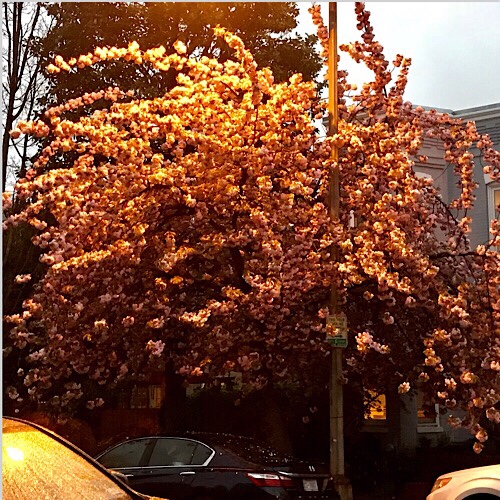
A samskara is generally defined as an impression left in us by a past action or experience. I found myself thinking about the process of samskara yesterday, when I went with long time friends of my family to watch their son taking class at the summer program at the Kirov Academy of Ballet.
I have not watched a ballet class (except on the occasional film) since I was actively studying ballet as a teenager and young adult. I have long been conscious of how ballet imprinted my body image and way of looking at myself, but have not found a space before where I was able to look at this aspect of my history with fresh eyes.
What was different yesterday, was that I was observing with openness. I was sitting with people I have known all my life, sharing their warmth, love, and parental pride for their son, rather than concentrating on my own history. It brought back memories, but not in the same way that sitting by myself or with a girlfriend, watching a documentary has done.
In this open state of reflection, I witnessed something that I knew at some level, but had not given much thought to before: how much having taken thousands of hours of ballet class has informed the way I teach. My tendency in my own practice and in my teaching to see the details of alignment and to try asanas repeatedly until it seems that I or my students have experienced the alignment in the most optimal way for the day is straight out of my experience in ballet class.
Softening and witnessing instead of feeling or judging from past experience gives the possibility of shifting from samskaras, even ones that are very deeply etched into body and mind. Being with my friends yesterday, of course, gave me the joy of seeing the spectacular dancing of these young men and the delight of connection. It also gave me the unexpected gift of a moment of understanding how the Anusara principle of “opening to grace” allows us to shift. When we are open, nonjudging witness consciousness (an aspect of “opening to grace”), that is when we have the possibility with each thing we repeat, to experience it new without being bound by our samskaras.
The other day, an acquaintance whom I met through yoga asked in an email whether I was still into politics or whether I was now more focused on my “inner work.” He lives in suburbia and voted for both Bushes and, at least in the early years, thought this country belonged in the wars in Iraq and Afghanistan. He practices asana and meditation, and eats a vegetarian diet, but he does it entirely for his own health and looks and not out of any evident intention of aligning with the flows and forces of nature or concern for all beings and the environment. For him, politics and yoga and meditation practices have nothing to do with each other.
I think it is wonderful that anyone takes care of their health and diet in a way that maximizes a health and a sense of well-being and minimizes the need to resort to medication and other Western medical care, which is a boon not only for the individual, but for the environment and for society in terms of cost.
For me, though, there is no separation between inner and outer work if one is living in the world and not in the cloister or the monastery. It is true that if one is out of inner alignment or unhealthy, it is not possible to be best aligned with nature, and thus, there is a need to do work for our self personally. But the true point of the practices is to help provide inner quiet, steadiness, and wisdom in our daily lives, which for a householder includes being an educated and active citizen.
Peace and light, E — Posted with WordPress for BlackBerry.

Peace and light, E — Posted with WordPress for BlackBerry.
But the camera did.

Peace and light, E — Posted with WordPress for BlackBerry.