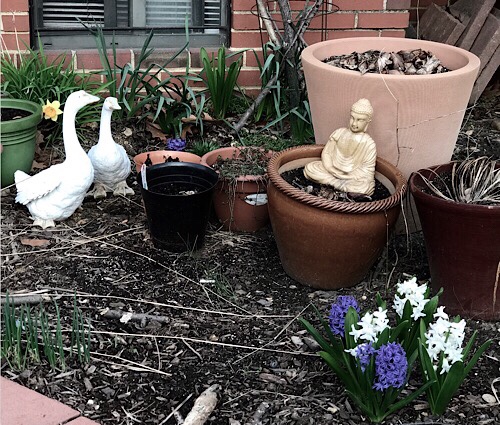
Statuary Around Town
Pride is not just rainbows. It is fighting for and speaking out for justice, support, and nourishment for all.

Whenever I am studying with John Friend, and we are invited to move into balasana I recall as story he told of seeing Gurumayi move into the pose. He told us of the reverence with which she did the pranam — the bowing forward to touch the earth as she went into the pose. I like to start my asana practice with balasana because it reminds me to honor the teachings, the history of the practice, my teachers, and myself for coming to the mat. I think of the name of the pose, and I am reminded of the wonder (abhuta) of being embodied. I think of how children marvel and delight at everything they encounter. It is all new for them, but we can cultivate the sense of everything being new and wonderful. When we cultivate a sense of wonder, it brings us to the other meaning of bala, which is strength. For our lives will be stronger and fuller, if we can approach each pose on the mat, and each moment on and off the mat, with wonder and interest.
Balasana is also a good way to start the practice because it is a sweet, gentle way to open up the hips, groins, low back, and shoulders. It is a good way to shift from more active poses towards savasana because, as a forward bend, it is inward-going and quieting.

Peace and light, E — Posted with WordPress for BlackBerry.
At the weekend workshop in Bryn Athyn yesterday, John Friend reminded us of the scientific fact that our energy flows to where we put our mind. As a physical matter, if we think about our little toe or our tailbone, for example, we will be better able to access it.
As a mental matter, if we think about something we just did or need to do or think we should do, our energy will be diverted to that place.
There are even more profound implications with respect to where we let our mind dwell when we are practicing. Our practice deepens and helps us embody intention (sankalpa). If we dwell on something that is making us angry or suffer while we are practicing, we will actually etch those emotions more deeply into ourselves.
This is not to say that we should not practice when we are suffering or in conflict. Nor does it mean that we should beat ourselves up when “negative” emotions or thoughts arise during our practice. Rather, the awareness of the repercussions of dwelling on and feeding what does not serve is a reminder of the benefits of turning our minds towards the good — perhaps a yearning to be at peace or free from suffering or other positive intention while we are practicing when we are feeling challenged. We use the practice not just to release what does not serve, but choose to refocus our minds so that through the practice we can embody a state of mind and body that better serves us and helps us to respond from a higher place to those things that are painful or hurtful. Ideally, we turn towards what is light, nourishing, and balanced (sattvic), not out of compunction, but because it is more delightful.