Similar Posts

  • | |

    What is Beauty? (and “Ankle Loop”)

    When I was meditating this morning, the last lines of Keats’ ‘Ode on A Grecian Urn’ welled up in my thoughts: “Beauty is truth, truth beauty, — that is all/ Ye know on earth, and all ye need to know.”  How odd, I thought, for this to appear, as if out of nowhere.  I have been contemplating this week on what it means to be refined, but not in the way of an aesthete.  Rather, as I have been concentrating on the Anusara alignment principle of “ankle loop,” I have been thinking about how deepening our practice with repeated exploration and study we are able to refine our understanding and the flow of energy within us so that we can be more connected to ourselves and each other.

    As I understand the essential structure of the Anusara principles, the “loops” are really tertiary principles.  The primary principles are those of “attitude, alignment, and action,” which are the principles of how we practice.  The secondary principles are the fundamental physical and energetic principles — “opening to grace, muscular energy, inner/expanding spiral, outer/contracting spiral, organic energy.”  The loops serve to refine the secondary principles.  Ankle loop, for example, which starts at the base of the shin bone, travels down the back of the heel and then back up through the arch, energizes the foot, lifts the arch, supports our stance and helps us focus muscular energy.  When we are feeling challenged finding as much muscular energy in our feet and legs as would be optimal for a full expression of the pose, we can use ankle loop to refine our understanding and practice of muscular energy in the legs.  Keeping in mind the primary principles of practice, though, the refinements should also always lead us towards the heart and not just get us into details.  Getting more sophisticated and refined, likewise should not lead us to disdain for that which is unrefined.

    Funny, then, that the aesthete’s call to beauty should arise in my meditation while I have been consciously thinking about refinement.  What does it mean to appreciate and study refinements, but still honor and delight in a novice’s full expression of “attitude, alignment, and action” as much as an impeccably aligned and skillful pose that does not reveal a yearning for spirit?  Beauty may be truth, and truth beauty, but what is “beauty?”

  • | |

    Expanding Your Edge

    Thursday night,  I took a dance improvisation workshop at Dance Exchange, the second in a series of three workshops.  One of the exercises we did was in groups of two.  The game was to do simultaneous improvisation.  Without designating a particular person as a leader, each dancer was to try and stay in synchronized movement with his or her partner.   When we were done with the exercise, some of the dancers talked about their goal having been to be in control of the lead or trying to push their partner past his or her edge.  I had been innocently (or perhaps naively) unaware of these dynamics, as I had been seeking to find where the dance could be the leader rather than either partner.

    After the workshop, when I was walking to the metro with the teacher and another participant, both of whom are performers in their 20s, I raised the issue of people trying to push others past their edge (I’d held off raising it in the group as it seemed too many were in a different space).  I said that knowing that my partner was a lot less flexible than me, though lots stronger, and knowing his competitive edge, I never would have tried to push him beyond his physical limits.

    The teacher said he liked being pushed past where it seemed like a good idea; it made him get to another place.  I agreed that it is good to try to expand, to go beyond what we think are our limits.  I have been taught, though, by my teacher John Friend, not to blow past my limits.  Rather, in the practice of Anusara yoga, we seek to be intimately and exquisitely aware of our edge at every moment, and then expand it.  The game with the partner using this paradigm would have been to find the edge and then see if the dance could expand it rather than to try and exert control or see if we could push our partner past his or her limits at our partner’s risk.   When we operate in a paradigm of straining and striving, or we push for control or try to compete with ourselves or with others, that is where we get injured.  I’ve had my share of dance injuries, I added, but to continue dancing through the decades, I cannot be blowing past my limits, though I am still growing.  I was not sure that what I said felt relevant, but I could also tell that it was information that went into the thought mix for later.

  • | | | | |

    “Meeting for Discernment for Peace,” Bhavana, and Heart-Oriented Posturing Language

    On the Friends Meeting of Washington list serve this week, there has been a fair amount of email exchanged about an upcoming “meeting for discernment for peace.”  Very roughly described, a meeting for discernment begins with a period of silent worship in which those present settle into the silence and surrender thought to allow the light of spirit to illuminate a specific subject of contemplation.  The subject of the meeting serves to enlighten both the individuals participating and to further both the business and spiritual state of the meeting as a whole.

    As I read the emails and invited myself to contemplate the questions offered for the meeting (I will not be able to attend because I had previously committed to volunteer work), it led me to think not only about the topic under discernment, but about how similar it seems to me to the yoga practice of bhavana and how bhavana supports the Anusara teaching method of “heart-oriented posturing language.”

    When we practice bhavana ,we invite the fullness of consciousness to illuminate ever deeper levels of understanding of particular teachings from the yoga texts or similar ideas.  It is similar to meditation in that we don’t try to think our way through the concept, but rest with it.  Bhavana  differs from meditation exactly because it is focused on the deepening of a particular concept rather than simply going into the space of meditation as an end in itself.

    Although a meeting for discernment is practiced as a form of collective worship rather than an individual practice, it is much like bhavana, and I brought the Quaker method of resting in the light to reveal deeper insight regarding a concept when I first starting teaching Anusara yoga with its emphasis on having a class theme and using heart-oriented language to invite myself and students to experience a heart quality through asana practice.

    The queries for contemplation at the meeting for discernment for peace, include the following:

    What does it mean to “live in the virtue of that life and power which takes away the occasion of all war?”
    How am I deepening my understanding of peace?
    How am I living into this understanding?
    How do I support others in following peace?
     
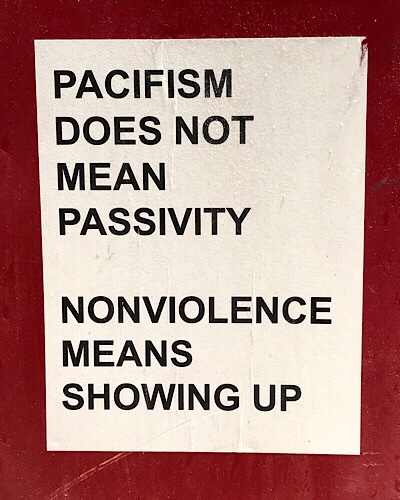
    What can be most powerful about our practice on the mat is bringing what we learn in relationship to our body, mind, and emotions in attempting and achieving poses, off the mat.   As I will be doing myself this week in my own practice in support of my friends who will be attending the meeting for discernment, I invite you, as you are practicing at home after reading this, to observe with love, spaciousness, and humor how you react to certain classes of poses, efforts you make, moves you are able to do or not do with ease.  Where are you in conflict with yourself?  What are you doing to deepen your understanding of how to be at peace with your strengths and shortcomings?  How are you taking the observations on the mat into your daily life?  How do you and how can you better use what you learn to support others, to eliminate the causes of war, and to foster peace?

Leave a Reply

Your email address will not be published. Required fields are marked *

This site uses Akismet to reduce spam. Learn how your comment data is processed.