A Change of Scenery
Today I walked a circuit of the mineral water springs of Saratoga.

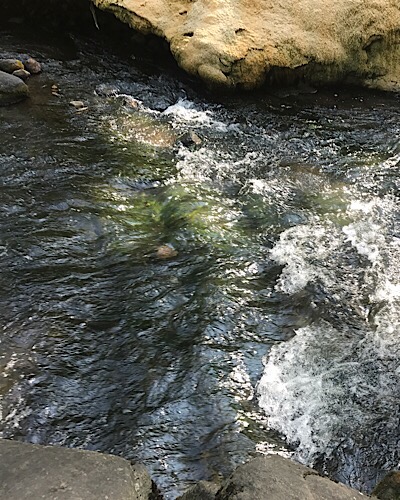


Today I walked a circuit of the mineral water springs of Saratoga.
As those of you who are regular readers may recall, I have been working to use solar energy to provide most of my electric power. The solar installation was complete in late August, and the public utility responsible for changing the meter to reflect the input of my solar energy to the grid advised on September 3rd that the meter would be changed within three to five weeks. Week five came and went. Week six, I wrote to the utility and asked why nothing had been done. My tone was appropriate, and I did not let it upset me, but still I felt the need to take action. I was advised that the metering people would be contacted, and it would be done or I would hear back within the week. Week six passed with not a word. Now it was week seven. I wrote again asking why I hadn’t gotten a response. The answer was that I deserved to be frustrated and should complain to the public service commission.
I filed a complaint; after all, I was directed to do so by the very entity against which I had the complaint, but was advised by the public service commission that it could take 30 days to respond to my complaint. Meanwhile, my house was continuing to be powered by mountaintop coal mining and nuclear power. This wouldn’t do. I contacted my solar contractor and asked for assistance. The solar contractor had connections with the commission. This morning I received a very apologetic call from a supervisor at the electric company. The meter was installed later in the day (although I still need for the electric company to “authorize” “my use” of the meter–not going to try and understand that one). The authorization is supposed to be processed tomorrow.
Here’s where the apparent disconnect between responding “from the highest” and not being a doormat came into play in my mind. The reason I got an immediate response was not the delay, but my documenting the foolishness of having been advised that the next step was to file a complaint instead of having been told the actions that the employee was taking to try and address my concerns. I work for the government. I know that is something that is wholly unacceptable, and my having used the inappropriate response to my inquiry to make sure I got a result will likely result in unpleasant repercussions for the employee.
This situation triggered a memory of an airport episode in the days when I was still flying around the country as a litigator. When nearly everyone else at the airport was traveling for the holidays (it was December 22nd), I was flying out of National Airport to Hartford to take a deposition the next day. I was waiting in a long line to check-in (this was long before the days of e-ticketing), and the airline announced the flight was canceled and that they would be putting all of us on a bus to Dulles airport on a flight that left two or three hours later (it was already the end of the work day). I was a bit cranky, I am sure. I asked in a way that everyone could hear, keeping in mind I had a ticket that could be changed, whether there were flights on any other airlines going to Hartford from National that night. Gosh, apparently, no one had thought of that or was hoping that no passengers would ask for such a response since it would have a cost for the airline. Within a half hour, several of us were re-booked on a flight with another airline leaving from National. No bus. Hardly any delay. A college-aged woman who ended up with the benefit of the re-booking looked at me with her eyes shining, “are you are lawyer?” she asked. I’ve always thought I might have been responsible for changing her life by having not stood for being treated badly, who knows whether it ultimately was for good or ill.
I often hear people saying that speaking up, taking action, refusing to suffer inappropriate, unjust, or unnecessary conduct is “bad.” What is the difference between being passive and responding from the highest? Where do we draw the line?
I am planning to be unwired for the next couple of weeks, though if there is an opportunity for a wireless connection or to use hotel internet, I may check emails. I will be in touch when I go back on-line. In the meantime, this is to wish you the best of holidays.

Peace and light, E — Posted with WordPress for BlackBerry.
When I stepped out of the house extra early to head to a meeting at another Agency, I was greeted by this amazing being suspended on a nearly invisible thread between the house next door and my porch. I hope she spins a web and sets up housekeeping. There are plenty of bugs to eat.

Peace and light, E — Posted with WordPress for BlackBerry.
I spent a delightful couple of hours in the garden with the birds this morning before heading up to teach at Willow Street. I weeded and dead-headed and watered. The birds and I both ate grapes right off the vine. Every year since this vine started to fruit, birds that are not here the rest of the year have appeared for the few weeks the grapes are ripening. I imagine that there is a bird listserve where some bird posts that Goodman’s grapes are ready. Come and get them. Neither my presence nor the cats on the screened porch deters them. The grapes are too delicious for them to allow their natural caution to interfere with immediate access.
Me, I know that I am a spoiled, middle-class urban gardener. If my survival depended on getting the whole harvest (as opposed to a large handful of grapes daily for three or four weeks), I would be fending off the birds instead of enjoying their presence. The squirrels and the tomatoes–that’s another matter altogether.

Peace and light, E — Posted with WordPress for BlackBerry.
For the past few years, my friend X has hosted a Day of the Dead celebration. This year, it had not been in his plans. Enough of asked, though, that he is hosting a small dinner. The Halloween of candy and costumes has not had a big draw for me; it was never made much of in my childhood. Taking the time, though, to sense the thinning between the worlds and to take time to honor my ancestors is of great meaning. Having been privileged to be invited into the festivities of the Day of the Dead has enhanced my consciousness of this time of year.
Today, when I practiced, I first reflected on those friends and family who have left their physical bodies in the past year–some quite significant to me. Thinking of those friends and family led me to think of others long gone in body, but not in spirit, and others who are still living, but with whom the connection remains only in memory. To all, I offered honor and recognition of their part in my being. Of all, like the taste of the sugared skulls that are part of the Day of the Dead, I am consciously thinking some, among whatever memories may arise unbidden, of what was sweet.