Questions Around Town

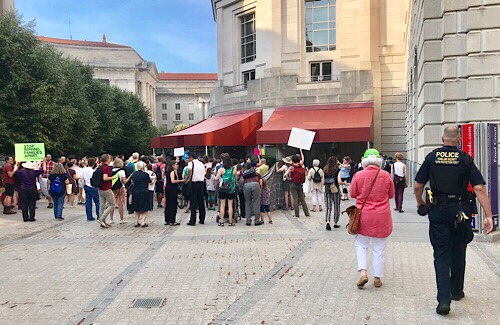
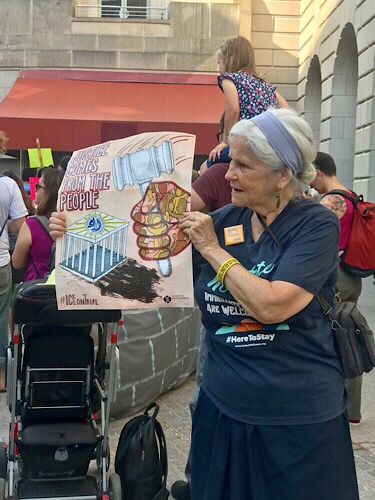
This morning before work, I joined a group of people at the International Trade Center who were speaking out against separating immigrant families at the border. It was already 80F when I left the house at 7:30. It added two miles to my morning walk to join in. I thought about how far these families have walked in desperate hope only to meet such cruelty. What was a little discomfort and arriving at the office a bit red in the face and damp?
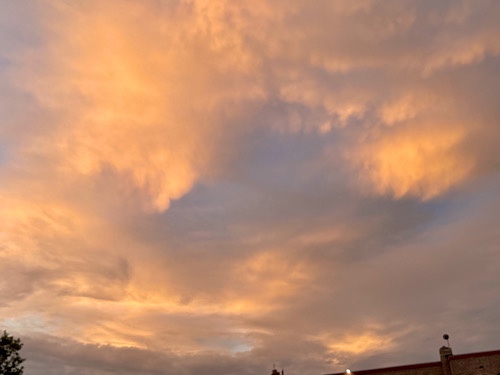
It was gray when I woke and mostly gray—though not raining most of the day. For a few fine minutes the sky called me to watch.
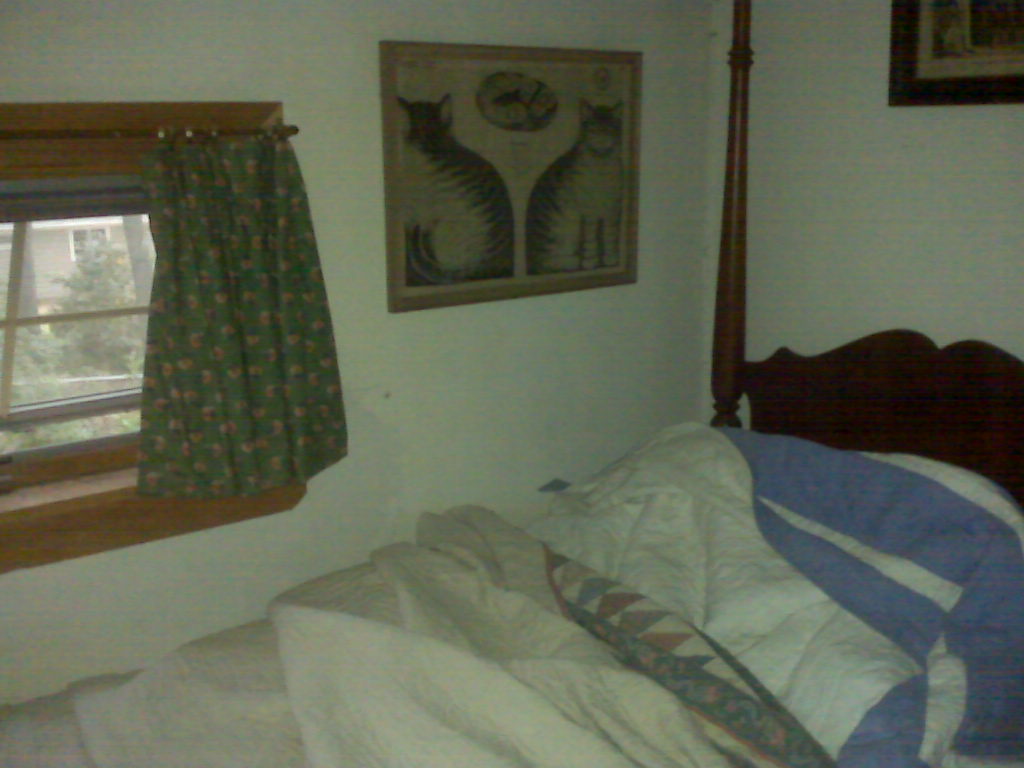
I slept last night in the room that I slept in as a child. My mother now uses the room to store some of the vestiges of her old antiquing business. The carpet, wallpaper, and curtains from the 1960’s are gone, but the bed is the same one in which I had slept. The picture on the wall is a kit for making a stuffed animal that my Grandma Rose had bought me (probably when I was about 8) at the Brooklyn Museum of Art that my mother decided would be better as framed art than a sewing project for me.
The neighborhood looks different–it is far more developed as is everywhere near a big city–but the bones are the same.
It is a challenge not to feel the weight of my history and ancestry when I return. Taking the time to meditate when I woke helped me stay fully in my adult self.
When we meditate, we ideally dissolve our individual consciousness into the luminous spaciouness of universal consciousness. In that space, where we are temporarily not experiencing ourselves as an individual, we are also not experiencing our individual self in the sequence (krama) of time. The luminous spaciousness of meditative consciousness is sequenceless (akrama) and, as universal consciousness, is the place in which the sequences of being in time and space arise.
What I experienced this morning when I meditated was that I did not have to be flooded with the emotions of my, to try to graciously describe, emotionally challenging childhood. In the space of meditation I could bring to my day an acceptance of all of my life and be where I am at present, coming to a place of recognition that although I lived all of my history, it neither defines me nor binds me from expanding into a space of growing love and light.
The philosophy and religion professors with whom I have studied yoga philosophy have emphasized that we need both theoretical study and experiential practice to develop understanding. In that light, here’s the reading line-up (though currently I am slowly making my way through Harry Potter y el cáliz de fuego.
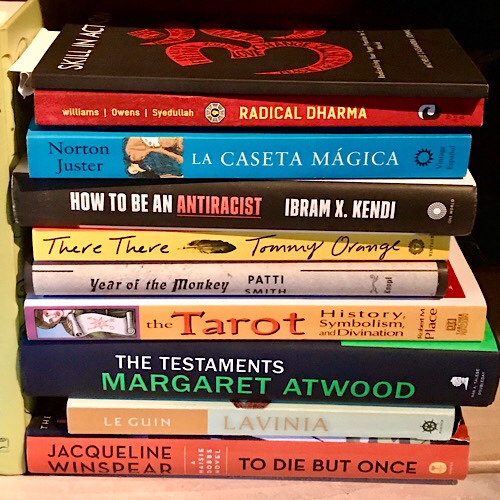
Anyone who wants to or has read anything in this list and is interested in discussing, please let me know.
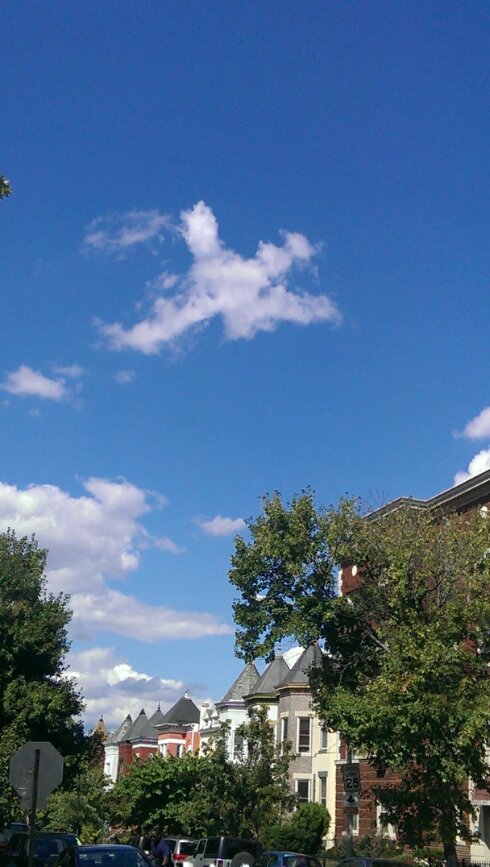
The trishula represents all the philosophical threesomes:
sat cit ananda (being, consciousness, bliss);
iccha, jnana, kriya (will, knowledge, action);
siva and shakti and the dance of relationship between the two.
The me and the you and the us–for where there are two ones there is also the third and all the play (lila) and pulsation (spanda) that is part of the dance cosmic and divine and personal.