Late Afternoon Moon

How is your practice these days, whatever your practice. Now it is even more important than ever.
How is your practice these days, whatever your practice. Now it is even more important than ever.
Yoga clothes–check
Meditation shawl– check
Hiking boots–check
Head lamp–check
Bathing suit–check
Insect repellent– check
Will be on retreat. Not to escape, but to reinvigorate and reconnect so that I can be more fully present and available for work and community and seeking to change what is possible on my return.
No cell phone service until Monday. Will have stories, I’m sure, when I get back.

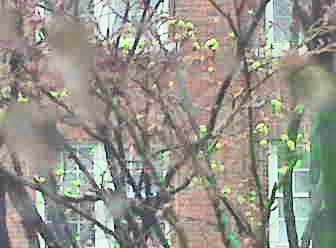
A neighbor who lives in the top floor of the building across the street, and thus has a spectacular view of the maples in front of my house writes:
“The buds on your tree are more numerous than yesterday, and more visibly that color that Joni Mitchell sang about: “just a little green, like the color when the spring is born...” And we’re getting a good, soaking rain. Happy Spring!”
I have heard the song so many times, I do not need to look it up, except to share both with those for whom it is not part of an intimate map of a long ago period and with those for whom it is and who will have, by just seeing the words (and even more so by listening), some upsurge of memories and a revelation of the miraculous play of consciousness.
Peace and light, E — Posted with WordPress for BlackBerry.
One of the primary themes at the Anusara certified teachers’ gathering this week with John Friend has been how discipline and technique serve our yoga. In keeping with the elemental Anusara principles of “attitude, alignment, and action” (iccha, jnana, kriya), the point has not been to emphasize rules for the sake of rules, form over substance, or technique for its own sake. Mastering technique, by itself, will not bring us to the ultimate intentions of yoga: living liberated (jivamukti), experiencing the very wonder, bliss, and dance of being.
But just playing or seeking freedom for its own sake, while we are embodied in human form, will not likely lead us to the most expansive and steady experience of ultimate freedom (svatantra). It is discipline and technique with the constant remembrance of the reaon for being disciplined about how we practice and live that will take us further on the path.
It can be nice, for example to go to a class where there is little emphasis on form, and the call is just to flow and feel. For me, though, because of my physical limitations (degeneration in my spine, old groin injury, etc–these do not define my being; they just inform how I practice), I feel far freer and more able to expand how much I can play the more attention I give to the physical alignment. In such a situation, the rigorous attention to detail is not for the sake of an external idea of what is right and what is wrong. Rather, it is the constant disciplined attention to alignment that frees me to play as free from injury, pain, and fear of injury as is possible in my body.
The discipline then becomes a way of self-affirmation. It is the limitations that lead me to have to focus more on technique than if I did not have the limitations. That attention then provides a ground for a more expansive practice and a deeper appreciation for the beauty of what the practice can offer.