Signs Around Town

Regret nothing.
Regret is nothing.
Regret no thing.
Is regret nothing?
Is regret no thing?
What a shift in perspective we can make by looking at something or saying something or thinking about something just a little differently than we have before.
Regret will undoubtedly arise on its own. But can we ultimately release regret so it is nothing to us and our ability to move on in the best way we can? That is one of our most important endeavors in growing and practicing and engaging life (engaging in life).

Peace and light, E — Posted with WordPress for BlackBerry.
Geeta Iyengar, in Yoga, A Gem for Women, sums up the proper diet according to Ayurveda as follows:
“A balanced diet, in moderation, is the best. Ayurveda says that the stomach should be filled with two parts of solid food and one part of water, and that one part of the stomach should be kept free for the movement of air. Food which is not congenial to the system should be avoided. Too oily, dry, spicy, and sour foodstuff are not good for the system. A diet which is balanced, light, varied, and well cooked is ideal for health.”
In other words, to be healthy, we should eat fresh, varied, well-prepared, tasty food. We should eat with sufficient awareness to know enough the effects of what we eat on our energy level, sleep, digestion, and ability to move and think that we know what is good for our system in small, large, or any quantities (and eat mindfully in accordance with that knowledge). We should not eat to the point of fullness and beyond (this is a common suggestion in the West for losing weight, i.e., stop eating when you are full or right before — think getting away from the unrealistic American portion size). Any other dietary practices should serve to find this place of moderation and enjoyment, the two real keys to health and happiness with and in eating. Diets that take us away from balance will be hard to follow, unhealthy, and cause all sorts of other shifts in our mind-body. What is best for you depends on your own knowledge of yourself and your environment.
When I googled (that should not be a verb) “holiday madness” this morning, I got one million three hundred thousand hits. Yikes! Most relevant websites are about surviving shopping, over-eating, family, and travel. Madness in such a situation is a choice. We can choose what to consume, how much, when, and with whom. It is a choice whether “celebration” requires consumption beyond what our financial, physical, and emotional means permit.
The yamas and niyamas as revealed by Patanjali provide beautiful structure for thinking about the holidays.
Yamas:
Ahimsa–non-harming. Don’t consume more than is harmful to yourself, those who have created what you are consuming, and the earth.
Satya — truthfulness. Be honest with yourself about what is right for you to celebrate and observe and what brings meaning to you as a holiday celebration.
Asteya — non-stealing. Consuming beyond your means, especially financially, is a form of stealing (look at what generated the recession).
Brahmacharya — moderation (aligning with Brahma). Enjoy the offerings of the earth in a way that uplifts rather than sickens or detracts from spirit and self.
Aparigraha — non-greediness; non-covetousness. Enjoy what you have without coveting or trying in a detrimental way to have what others have and you do not.
Niyamas
Sauca — cleanliness, purity. Consume in a way that is healthy for yourself and the planet, that does not create illness, refuse, and waste.
Samtosha — contentment. Wherever you are, whatever you have, whatever is going on in your work and family life, think of that for which you are grateful, that which brings you happiness, and focus on what you have. Contentment is a practice.
Tapas — fire, ardor. Be on fire to practice, to shift, to make this a life-fulfilling year of generosity and compassion.
Svadyaya — study of text, self-study. Take the holidays as an opportunity to deepen your understanding of yourself, society, and your spiritual beliefs and how they interrelate.
Ishvara pranadhana — surrender, recognition of the spirit. Let go a little. Surrender to a sense of fullness. Allow the abundance and recognize it as a wondrous gift. Remember the word “holiday” is really two words: “holy day.” Make this time holy, whether or not you observe a particular religious tradition at this time of year or any other.

The goddess serene, the labor of mundane chores, the violence and turmoil of the coup in progress.
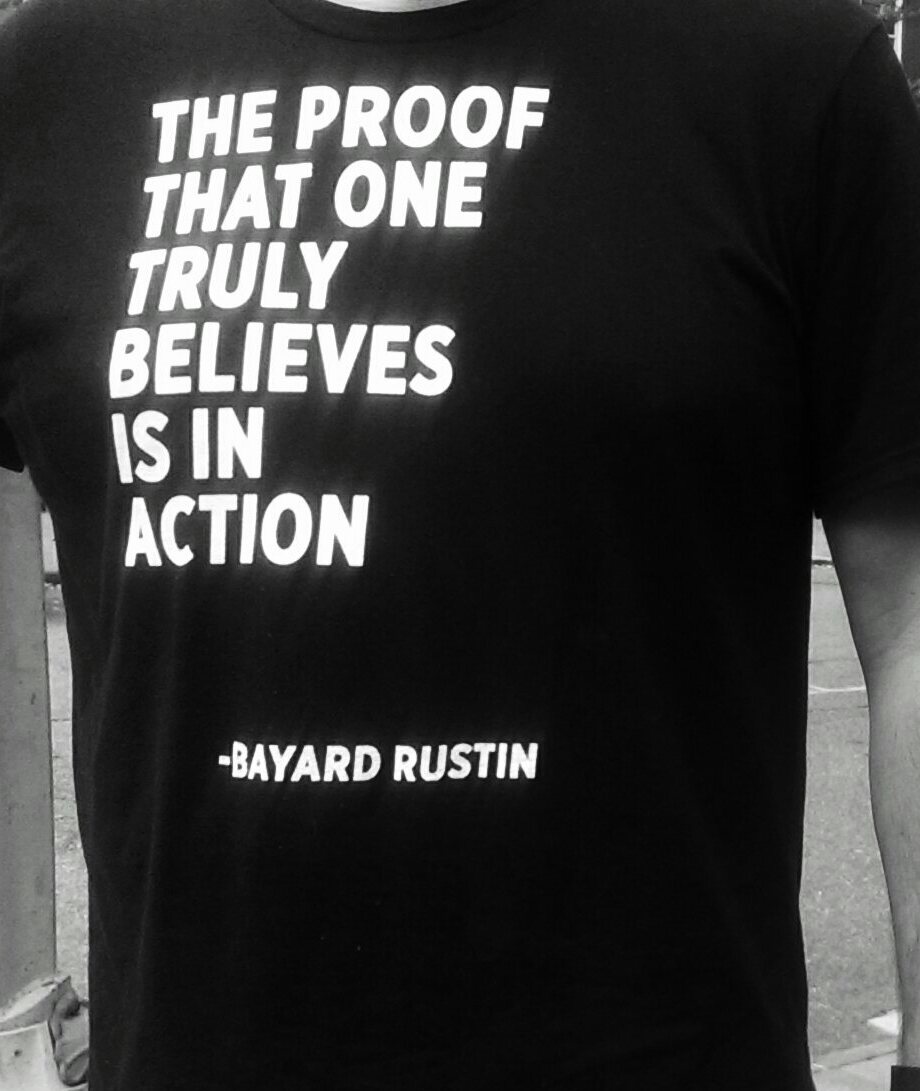
When I was out at lunchtime to run an errand, I crossed paths with the neighbor (or visitor) wearing this shirt. I asked if I could photograph him. He seemed a bit taken aback, but posed for me when I said that I would only photograph the quote. After all, anyone who would walk around Capitol Hill with a Bayard Ruskin quote on his chest would likely want to motivate as many people as possible to think about that quote and act accordingly.