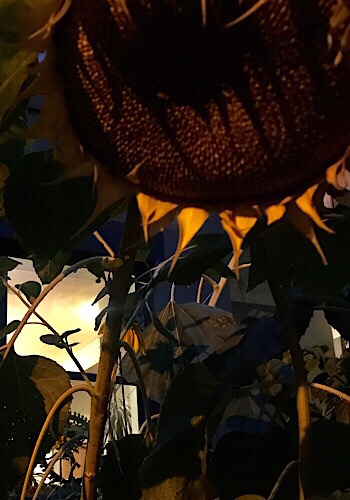
On the Way to William Penn House for Tuesday Night Yoga Practice

The other day, an acquaintance whom I met through yoga asked in an email whether I was still into politics or whether I was now more focused on my “inner work.” He lives in suburbia and voted for both Bushes and, at least in the early years, thought this country belonged in the wars in Iraq and Afghanistan. He practices asana and meditation, and eats a vegetarian diet, but he does it entirely for his own health and looks and not out of any evident intention of aligning with the flows and forces of nature or concern for all beings and the environment. For him, politics and yoga and meditation practices have nothing to do with each other.
I think it is wonderful that anyone takes care of their health and diet in a way that maximizes a health and a sense of well-being and minimizes the need to resort to medication and other Western medical care, which is a boon not only for the individual, but for the environment and for society in terms of cost.
For me, though, there is no separation between inner and outer work if one is living in the world and not in the cloister or the monastery. It is true that if one is out of inner alignment or unhealthy, it is not possible to be best aligned with nature, and thus, there is a need to do work for our self personally. But the true point of the practices is to help provide inner quiet, steadiness, and wisdom in our daily lives, which for a householder includes being an educated and active citizen.
Peace and light, E — Posted with WordPress for BlackBerry.
Ether (akasha) is the fifth of the mahabhutas. In science and perception, it is the space between the other elements, it is that in which the other elements reside. It is to some degree, the critical element of how we are able to perceive the other elements. I find focusing on the Anusara alignment principle of “open to grace” is the best way to experience the element of ether in myself. By softening, opening, and inviting spaciousness, I can better experience the subtle elements and appreciate how it is that I experience them.
The subtle elements or the panca tanmattras are smell (gandha), taste (rasa), form (rupa), touch (sparsa), and sound (sabda). The subtle elements are not what we sense (which is composed of the mahabhutas) nor are the tanmattras our sense organs. Rather the tanmattras are, as it were, the space in which perceptions arise, the ability to be perceived.
The next sets of elements are the panca karmendriyas, the organs of locomotion, which correspond to how we physically move, digest, and change in the physical world, and the panca jnanendriyas, the organs of perception or cognition, which correspond to our sense organs themselves. Our movement in and perception of the world bridges the physical elements, the perceptability of the physical world, and ourselves as physical beings, beings who move in the physical world, and beings who perceive the physical world. All of this, I think of as needing space or residing in space. As I consciously think of space giving a place for the world, my movement in it, and my perception of it, I become more conscious of consciousness. The physical practice of “opening to grace” and experiencing the element akasha makes possible for me in my practice knowing or experiencing a greater consciousness.
To start discovering your own understanding of akasha, try this meditation: listen to the sounds beyond the room without trying to analyze or change them. Appreciate how far in space your senses and consciousness can be. Then bring your attention into the room and hear the sounds in the room. Then open your ears to the sounds within you — your heart beat, your breath. Then open to all the sounds (don’t try to change or analyze them), both those physically far away and those within your own body, and be aware of them as all residing within your own consciousness. Appreciate that your consciousness is as spacious as the world around you and within you. Rest in the space of consciousness.
See whether spending a few minutes using this meditation technique helps you when your day has gotten too busy with work, errands, family or other demands. I find it very helpful.
Have you done your practice (in Sanskrit–sadhana) today, whatever your practice may be?
If you don’t yet have a regular practice, what do you think it would take? I recommend starting small–allow it to be short and what you like to practice, rather than failing because you think it must be challenging or for a longer period of time than fits readily into your schedule.

Peace and light, E — Posted with WordPress for BlackBerry.