State of the Garden
The roses–they are budding. Not just the roses, and not just in my garden.

The roses–they are budding. Not just the roses, and not just in my garden.
When I think of the Anusara principle of calf loop, I think of playing with drinking straws as a child. I’d take the straw out of the glass and bend it back and forth. The straw would end up with a horizontal crease where it was bent — not quite a break — but the place where it bulged at the bend would prevent the straw from serving the purpose of enabling liquid to be drawn up through it. When our knees (or our elbows for that matter) are hyper-extended, I think it disrupts the energy flow from the periphery to the core, weakening the pose, and breaking the integrity of the alignment.
As one whose legs started out bowed (though less after over six solid years of working “shins in/thighs out”), my natural tendency is to hyper-extend. I find that using calf loop, I do not hyper-extend. Calf loop (also called “shin loop”) has us draw energy from the base of the shin, up the back of the lower leg, and loop it through the top of the shin and then back down the front of the leg. We wouldn’t ever start a pose thinking about calf loop, but in the flow of a pose, after the major principles are activated, including muscular energy, we can enhance muscular energy and the integrity of the alignment of the knees by focusing on calf loop. When I practice calf loop, I find that it lifts the calf muscle and draws it more firmly into the top of the shin, and moves the top of the shin forward. These actions do not bend the knee, but firm the muscles behind the lower leg, including the calf and the popliteus (which is the muscle behind the knee that flexes the knee) to the bone.
What is tricky — especially for those who tend to hyper-extend, is that getting the knee in proper alignment feels like bending the knee. If we have been out of alignment, changing our stance will feel strange and perhaps “not right” at first. The sweet subtlety of practice (whether trying to expand our ability to do poses, heal and injury, or live in better alignment overall) is learning what is true integrity in a pose and what is habit, what will serve and enhance and what does not.
During last night’s yoga practice, we were exploring how advanced yoga postures such as headstand drop-overs could have therapeutic applications. If the practitioner is able to do the poses preparatory to the pose (for headstand drop-over to be accessible in a healthy way, the yogi should be able to do dwi pada vipariti dandasana and, of course, sirsasana, in good, easeful, steady alignment), then the pose can be integrating and healing for the shoulders and strengthening for the neck. For those with little cervical curve, really working to lengthen the side body, integrate the shoulders, and radically melt the heart (which is what is necessary to get into the pose), can help develop the cervical curve. Done out of alignment, the headstand drop-over risks the shoulders and neck–the very parts of the body that would be healed and strengthened if the pose were done in alignment–are at risk of injury.
Four or five years ago, I was at an advanced intensive with John Friend where he likened advanced asana practice to digitalis. Digitalis, which is a beautiful flower, is one of the most poisonous plants in the garden. Taken the wrong way, it can make you very sick indeed. Properly distilled and administered in just the right dose, digitalis is one of the most powerful and curative heart medicines available.
When we approach asana, especially the more physically challenging postures, with great respect, care, and discernment, we can not only benefit from its extraordinary healing and life-expanding powers, but revel and delight in dancing in our bodies. If we approach asana without honoring ourselves and the power of the practice, however, we put ourselves at risk and we fail to realize the benefits that are possible.
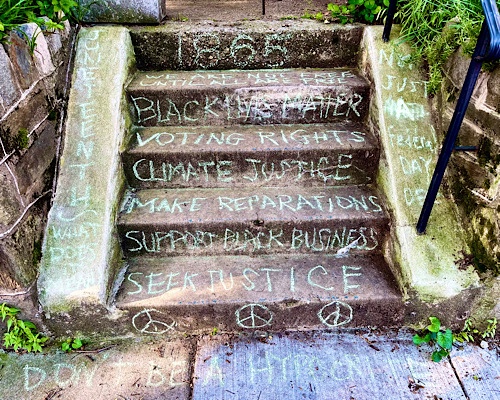
Asteya in Sanskrit means non-stealing and is the third yama of the yamas and niyamas set forth in Patanjali’s Yoga Sutras as a critical part of the path of yoga. White people giving themselves a holiday created by Black people for themselves without both taking action against current injustice and inequity is a classic example of what would be stealing.
Could you give extra support to a Black business today? Donate to a Black-run organization working to fight for civil rights or voting rights or equal access to health care, education, and support services or against police brutality? Give mutual aid? Write to your elected officials about said issues?
We don’t have to do everything every day, but it is not ok to do nothing.