Untitled
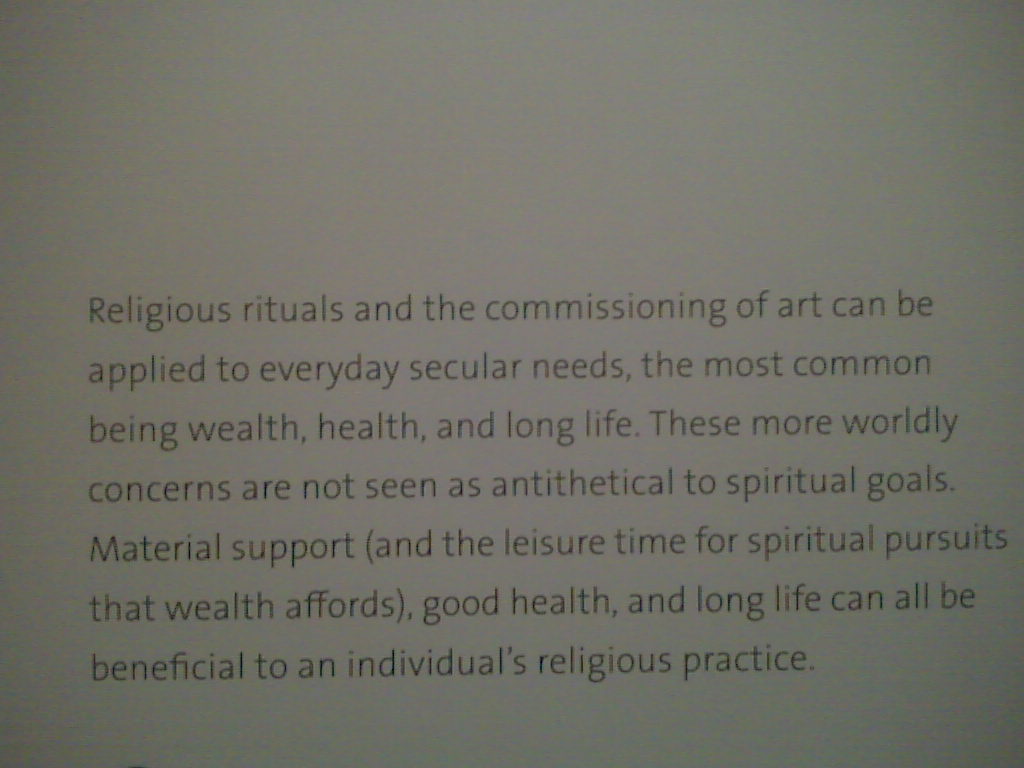
Spiritual pursuit is, in a great sense, a luxury. Without enough time and money for leisure, when and how would we explore spirit? But where else would we find solace if not in spirit when we are suffering from deprivation?
This question becomes even more pointed when we consider it in terms of the curatorial note (Rubin Museum) below. Those who can afford to commission art to further their own spiritual ideals (including prayers for wealth and family) may not be the one percent, but most surely are the ten percent, or any money would all be for food and shelter at the survival level. I would certainly rather see money spent on making art than war, but what about food, education, and shelter for more in society in a way that nourishes the environment? Such a complicated web of questions about individual and collective desire and responsibility in our relationship to each other and the earth past and present when we think of having wealth sufficiently focused to allow individuals to use it to seek religious boons for themselves in the material world.
I say this as one who loves and makes art and engages in spiritual exploration with vacation time and budget, who regularly wonders if that is really for the good of others and not just another way of enjoying what life has to offer the fortunate.
What do you think?
Photo is of exhibit notes at the Rubin Museum in NYC.
Peace and light, E — Posted with WordPress for BlackBerry.

Peace and light, E — Posted with WordPress for BlackBerry.
Tomorrow is supposed to be sunny and unseasonably warm, one of those bright days right when the seasons are changing that bring a giddiness to our hearts and can incite us to premature planting.
The forecast for Saturday is cool and gray, with a high of 54F. Not only will it be a great reminder that the danger of last frost is weeks away, but also of how important patience and preparation are in the early part of the season, so that our gardens will flourish most optimally throughout the season.
Tomorrow is the afternoon and early evening to do a little weeding, to see what is volunteering, to check in the health of your perennials, and to sit with your vision of the garden for the year. Then on Saturday, nurture yourself and nurture nature by bringing yourself and your alignment questions to “Yoga for Gardeners” (to register and/or get more information please visit www.willowstreetyoga.com).
Peace and light, E — Posted with WordPress for BlackBerry.
Krishna Das reminding his listeners the reasons he practices and offers kirtan scrolled across my Facebook feed last week with this quote:
“My path is to be in the living Presence; We have to find a way inside us, we have to find a way to open our hearts, to quiet our minds, to let go our fears and our selfishness, our guilt and our anger and jealousy; Everything is already present in our own hearts; By repeating these Names over and over, we are moving ourselves into that place in us; the Heart in us is deeper than any emotion or psychological issues; I don’t know if there is God, I know there is Love – Unconditional Love and I know I like to be in that love, and that maybe God; all you have to do is look, and chanting remembers us to look.”
I am in a space right now where chanting is serving me to help remember the good, despite all that is going on that doesn’t feel particularly good or hopeful. I don’t believe in “God” as an actual being (though I can no more disprove the actuality than anyone has been able to prove it), and history certainly proves the power of the idea of such a mystical being.
Regardless of whether the very real ideas of God(s) represents an actual being, it has been my beautiful experience–studying with Krishna Das and others over the years–that engaging in practices that turn our hearts towards love and universality helps us be sweet living in relationship to ourselves, to others, and to the ecological fabric of the whole of embodied existence. I chant because calling out the names in their universal multiplicity is a recognition, not dissimilar to what I have found offered in the silent collective worship of Quakers, that everyone has their own individual access to and ideas of the sublime, of the divine, of what brings them to feel a fullness of love.
The shiva-shakti tattvas, the two highest tattvas, are completely subjective. The shiva tattva is, according to the philosophy, the ultimate reality, the pure “I,” undiminished and undifferentiated consciousness. As something purely subjective, it is both everywhere and nowhere, in every being and simultaneously beyond them. It is not dissimilar to Hegel’s Absolute (though I believe Douglas Brooks, who knows far more than I in this area, might disagree with me on this one), which “is and is not,” or Kant’s “unmoved mover.”
Shakti tattva is power — the power to tranform, create, manifest, diversify, cloak. Shakti is the power to become embodied in objective form. Shiva and shakti tattvas are thus inseparable. Ultimate unbounded consciousness and freedom (shiva) only has meaning to the extent the power to move, create, and diversify (shakti) pulses and transforms the subjective into the objective, the unimaginable to the observable.
In our yoga practice and meditation, we seek to use the practices to reveal to ourselves the ultimate pulsation (spanda) between the objective and subjective, the observable and the unknowable, the individual and the completely universal. One way I experience the first principle of Anusara yoga (open to grace), is taking the mat or my seat with an openness to sense and experience this ultimate pulsation (spanda) and play (lila), so that by using my body, mind, and will, I can better recognize the spirit that shines in all of us and use that recognition to inform how I relate to myself, society, and all beings.