Signs Around Town
Does that include bills and advertising circulars?

Peace and light, E — Posted with WordPress for BlackBerry.
Does that include bills and advertising circulars?
Peace and light, E — Posted with WordPress for BlackBerry.
It looks like what was leading to error messages for seeing photos and inaccurate claims my mailbox was full was that I was out of memory for the website.
Overfull, it didn’t tell me what was wrong, but just blocked displaying photos and receiving messages. How often are people like that? When overwhelmed or stretched too thin, it’s possible to see stress and challenge, but not quite what is really the issue.
One of the ways a steady yoga and meditation practice can shift us is to heighten awareness. The error messages we perceive and send are better correlated to the issues at hand.


Peace and light, E — Posted with WordPress for BlackBerry.
Patanjali provides in the Yoga Sutras (2.32) that the second niyama, samtosha (contentment) is an ongoing practice. It is not something that we can expect to arise on its own and if not, lament its absence.
I feel hope, without which it would be hard to experience contentment, too, is something that requires steady practice.
My personal experience is that only thing that gives me hope when I am feeling despondent about the state of things is to do something, whether it is giving resources or time or connecting and expanding community.
What about you?
 Last week, when I said to a colleague, “see you Tuesday,” she replied, “where are you going?” It was as if simply to enjoy where I live or rest or quietly take care of house and garden was not within the range of possibility. Is it that I am somehow not worthy if I have not planned to do something I could talk about when I returned to the office? Or is it that pervasive societal sense that happiness lies only in finding new and more experience?
I think that it is important to have episodic time away from doing. I used to get sick when I’d been running around non-stop with work and errands and exploration, etc. Now I try to take some quiet time at decent intervals. It does not need to be a full day. Just a couple of solid hours without engaging in a planned activity every couple of weeks makes all the difference in my mood, my health, and the quality of my work.
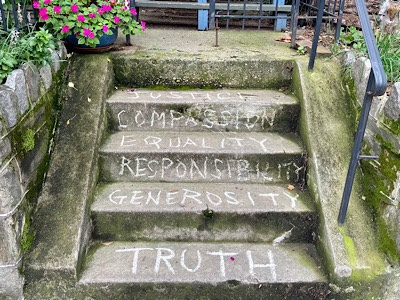
It is good to act consciously, to move and react from a place of sensitivity, discrimination, and understanding. It is good to know both the big picture and the details. When does paying attention and thinking things through, though, become “overthinking?” I think (ha ha) that it is when thinking things through takes us away from the heart, when it desensitizes, instead of assists us in acting with discrimination.