| | | | |

Signs Around Town (and Symmetry)

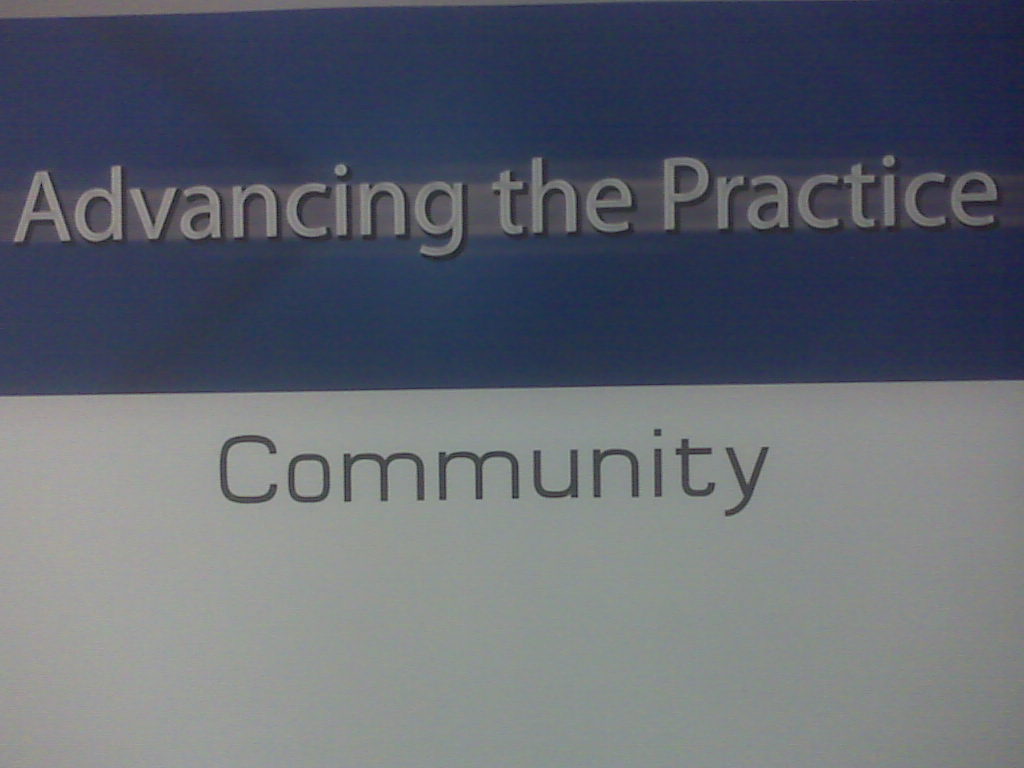
Advancing
The practice.
Community.

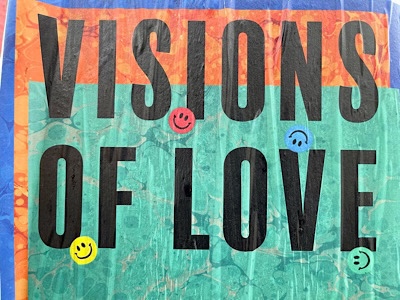
I spied this sign yesterday in the exhibitor hall on the lower level of the Marriott in Woodley Park. I was attending a portion of the 38th Annual Conference of Enrolled Actuaries. (Go ahead: I dare you to put that into your favorite search engine).

Although this sign was to invite enrollment in one of the actuarial professional organizations, it seems most similar to the stated aspirations of various yoga groups and schools.

I’m not surprised by this symmetry. I think that anyone who seeks to live so that employment and dharma (aligned life) are in harmony and who supports, participates, and works in community, is living like a yogin, though perhaps never knowing about or having any interest in yoga per se.

There are many life paths and humanistic and spiritual practices that guide life towards a contented path of service, the true reason, to my thinking, for a steady, long-term yoga practice (including asana, pranayama, and meditation).

I personally find the yoga practices to be among the most helpful ways to engage my body and mind for my health and well-being. Among other things, the practices have helped me listen with open enough awareness to be able to comprehend with my law-trained mind some small portion of the language of actuaries.
Peace and light, E — Posted with WordPress for BlackBerry.
Similar Posts

  • |

    Peacock Pie for Lunch

    I had a work day full of things that it would not be hard to find annoying. I recognized that the challenge I was having with being at peace with my day was not unrelated to the morning news of us lurching closer to nuclear holocaust than ever before in my lifetime.  I took myself to the museum to refresh myself with art–the place I most readily find nourishment and refuge.

  • |

    Sadness (Sukha hara, dukha hara)

    Last night I was feeling deeply sad not having Becky with me any more.  The first week, I was telling myself how lucky I was to have had her for so long, that she lived a long, happy, well-loved life, and that it was truly time.  Then I threw myself into work, errands, the garden, etc.  This week, I have been filled with a deep sense of grief and loss.

    Classical yoga would have us try to transcend the pair of opposites — pleasure and pain.  Tantra would have us experience the full range deeply, knowing it is all part of the play of being manifest in human form.  I have been thinking about my teacher, John Friend, who often talks of the intensity of grieving for loved ones who have died, because of having loved truly and fully.

    Thinking about Becky, this chant started repeating itself in my head (I have it recorded by Dave Stringer):   “sukha hara, dukha hara, hara, hara Shankara.”  “Hara” is an epithet of Shiva, from the root word to bear away or destroy.  “Sukha” means ease; “dukha” pain.  “Shankara” is another epithet of Shiva in benevolent form.  I think of this chant not so much a call to have Shiva energy destroy or remove both pleasure and pain, but rather a  reminder that both pleasure and pain are integral parts of our experience of being.  Recognizing that grief and loss are as much part of our own humanity as love and pleasure, helps remind me of my own connection to spirit.  It ultimately inspires me to try and live in a way that is more benevolent and generous, and to respond with the most light, whatever I face.  (This of course is a life work).

    I would not give up the full and wonderful years of companionship I had with Becky and her sister Henrietta (and others who I have loved) just to avoid the grief of loss.

  • | | |

    The Svadharma of the Pinky Toe (and Radical Affirmation)

    Svadharma, from sva (self) and dharma (duty) means our personal path, duty, calling, or place.  The principle of svadharma is a significant teaching in various yoga texts, such as the Bhagavad Gita, especially emphasizing the importance in acting in accordance with one’s caste (for example, Arjuna needing to act in accordance with his dharma as a warrior) or one’s sex (consider Sita’s role in the Ramayana).

    Extrapolating this teaching and taking it onto the mat, during one of the practice sessions the previous week at the Certified Teachers’ Gathering, John Friend said that “every part of the the body has its own svadharma to increase the pranic flow.”  He then said that if you just took a photo of the feet of an Anusara yoga practitioner in any pose, you should be able to see that the whole body was fully engaged and active.  John Friend’s teaching here was not just using the yoga philosophy as a catalyst to better understand the body.  By using the principle to illuminate the practice, the practice reflectively illuminated the principle itself, without denying or denigrating its original context or getting bogged down in its historical baggage of perpetuating the caste system and demarcated, subservient roles for women.

    Thinking about the svadharma of the pinky toe has no such baggage.  The pinky toes are homely looking things, they do not fit well into most women’s shoes, they rather painfully bump into things, and they are hard to move independently.  They are not essential for living and do not have the emotional charge of the heart and brain, the exquisite connection to the world of the sense organs, or the connection to life itself of the lungs.  Despite this, the call to lift and spread the toes, to draw the pinky toe toward the heel, or the hip happens just about every time I go to the mat in my practice or teach a class.  Activating the pinky toe by opening it and spreading it apart from the other toes is a conscious act of opening that helps hug the shins to the midline.  In hugging the shins in by means of activating the pinky toe, the yogi on the mat can then safely move the thighs back and apart, creating an expansion of the pelvic floor that provides room for more strongly tucking under the tailbone to access core power.  The pinky toe thus is an important part of our practice, even if we could manage to get by without it.

    But the svadharma of the pinky toe on the mat is not just to be able to help us access the movement of “shins in” so that we can better do “thighs out,” although that is an important physical part of its essence.  The toe does not move on its own.  We have to start by bringing our awareness and consciousness to the toe.  Part of the pinky toe’s svadharma, then, is to invite the infusion of consciousness to show how full participation of even an apparently insignificant part of the body can lead us to a better understanding and personal experience of the pulsation between reaching out and hugging in and affirming ourselves.   By intentionally bringing our awareness to the power we can unleash in the pose by the movement of the pinky toe, we bring the opportunity for greater strength, expansion, and flow of energies.  This is why, I think, John Friend suggested that by just seeing the toes we should be able to know the engagement of the whole body and mind in a particular pose.

    As a practical and therapeutic matter, recognizing and bringing into play the svadharma of each and every part of the body serves to help us increase the flow of energy and expand our range of movement.  In addition, activating the parts of the body that are inclined to slack (for example, the pinky toe or the adductor and abdominal muscles) will bring ease to the muscles that tend to overwork to compensate, such as the neck and low back muscles.  We are not just stronger and more flexible when every part of the body does fulfills its svadharma, but we eliminate much pain and suffering.  (More to come on this particular concept in other posts.)

    Off the mat, when all parts of the whole are fully conscious of and know their svadharma, the whole will itself have more consciousness, more light, and better experience the bliss of being.  It is easy to see, without judgment or question, that the pinky toe cannot do the work of the heart, although when the pinky toe is working it can help contribute to an integration of mind and body that will further the opening of the heart and thus the whole person.  Finding our svadharma as a whole person within society does not have to be about conforming to preconceived social norms that no longer serve.  The better we are able to understand where we are in time, space, and the interconnected web of being, though, the more fully we can participate in leading society itself to a more conscious and light-filled place, just as bringing our conscious awareness to the actions of the pinky toe can do the same for us as individual yogis on the mat.  When we recognize and live out our true svadharma as such, we radically affirm ourselves, the community, and the very essence of all being.

Leave a Reply

Your email address will not be published. Required fields are marked *

This site uses Akismet to reduce spam. Learn how your comment data is processed.