Assorted Deities

From the perspective
Of the gods and of science
One life is but ephemera,
However much loved.

Peace and light, E — Posted with WordPress for BlackBerry.

Peace and light, E — Posted with WordPress for BlackBerry.
What if we were to cease to think of discipline as constraint, as punishment, as something confining and unattainably rigorous, something satisfying only in having suffered for gain? What if we were to understand it, as Swami Chidvilasananda, suggests as discipleship, a cleaving to the path out of the exquisitely blissful yearning for the light? Such discipline is, I think, what is the true practice of brahmacharya — aligning with the divine.
It was such a beautiful day that I spent as much time as possible walking in the neighborhood. That walking is “good for me” was just an incidental benefit.



This morning, a friend suggested that if he took into account the needs of others when making plans, all he would be doing is serving others, and he would never get to do what he wants. “Why would I want to do that?” he asked.
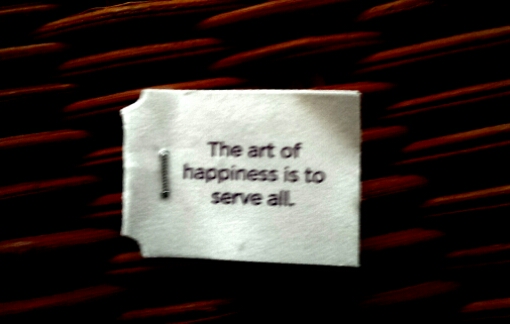
I think that’s a common enough question in this society. By uncanny coincidence, the teabag I selected right after the question was posed suggested a possible answer.
As we are taught by the stories of the monkey deity Hanuman, whose main characteristic is a longing for devotion that he demonstrates (while still being utterly himself) through service (seva) cultivating mindful relationship is the highest service to our own self and not just to those with whom we are in relationship.
To take care of our selves can be done with consideration of others without sacrificing our own needs. The answer, I think, is in how we assess and balance our own needs. For me, when I consider the impact of my planning on others with whom I am in relationship as well as my own needs, for example, of freedom, autonomy, and personal delight, I am also considering my needs for companionship, mutuality, connection, and respect. If I completely privilege the former, I may be neglecting the latter and vice versa.
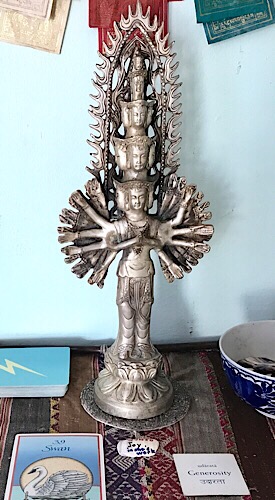
Avilokitesvara– god(dess) of compassion had one head and two arms. Zhe didn’t have enough ears to listen to all the stories of suffering, so one of the buddhas busted one head into eleven. Avilokitesvara’s two arms broke from the weight of helping, but instead of two arms broken and worn out, two arms broke into a thousand arms.