| | | | |

“What Is It?”

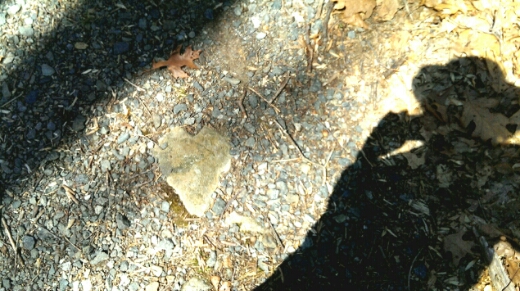
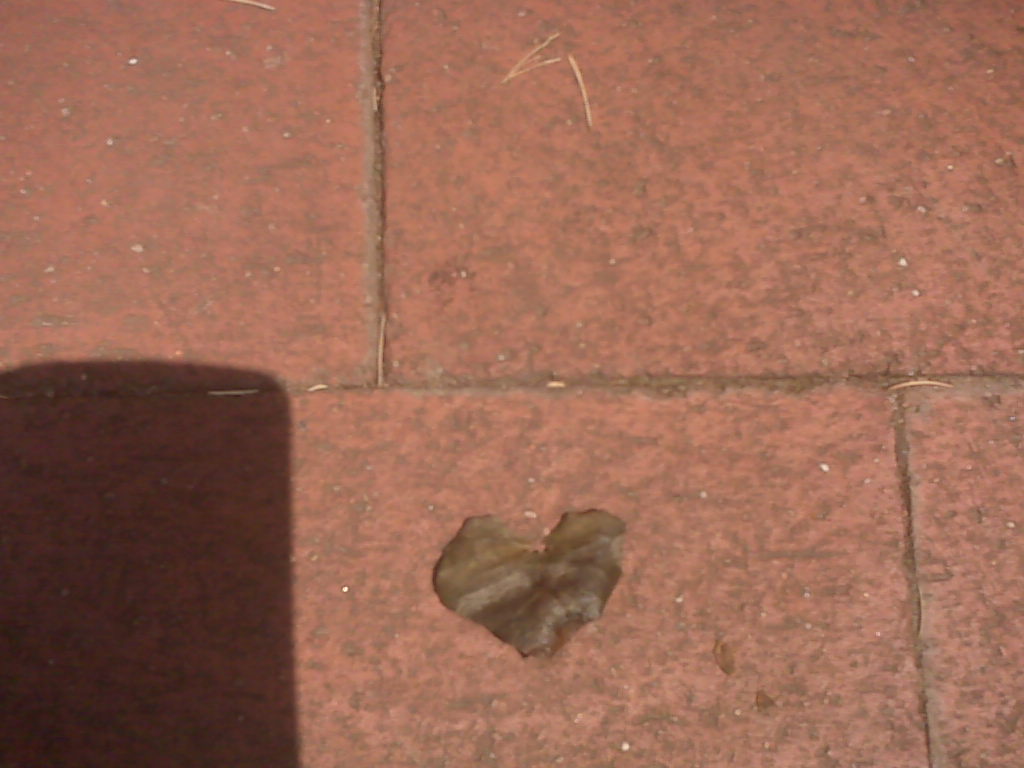
As I squatted on the brick sidewalk to take this photo during my lunch time walk, a nice-looking older man stopped and asked “what is it?” He was quite tall and standing at an angle that would not have showed the shape as well as from where I was positioned.

“Stand on this side; what do you see?” I asked. He looked from my perspective. “A leaf,” he said with a quizzical expression, wondering why a dessicated bit of English ivy would have captured my attention sufficiently for me to take a photograph.

“Look again,” I suggested. “Can you see anything else?”

“Ah,” he said with delighted recognition: “it’s a heart.”

“Yes. I see them and other interesting shapes in all sorts of things–litter, blackened chewing gum, the pavement itself.”

“Everything has more than one form,” he rejoined. “You are blessed.”

And thus we went our separate ways, having brightened our day with this small connection. If he lives in the neighborhood, no doubt we will recognize each other enough from this encounter, at least to smile and say hello.
Peace and light, E — Posted with WordPress for BlackBerry.

Similar Posts

  • |

    No. 9

    Friend, yogini, and neighbor Jess will be performing a Beethoven program with the Capitol Hill Chorale this weekend.  A friend asked if I wanted to have dinner on Sunday, and I suggested we instead go to the Atlas Theater to see the concert.  “Great idea,” replied my friend, “I have a friend in the Chorale, too.”  Support the local arts, businesses, and friends, and get entertainment that doesn’t require getting in a car (or at least a very short ride) or a plane.  Come join us!

  • |

    September Newsletter (web version of e-newsletter)

    Dear  Friends,

    Even in this hot, dry week, three weeks before the formal start of autumn, the harbingers of seasonal change are coming.  When I sit to meditate in the morning, it is still not quite light out, the scent of the leaves starting to change is evident when the wind blows, apples and winter squash are gradually replacing the summer fruits at the fresh farm market.

    Fall tends to be a busy time of year for us as a culture, and my calendar is chock full with work, workshops, plans to visit friends and family, volunteer work, and the offerings of our great city, but it is always important to take time to pause and enjoy the sweetness of being.  It is just when things are at their busiest, that it is most important to carve out the time for some yoga.  I’ll be doing lotsof my own study and practice to make more joyous offerings for you.

    William Penn House on Tuesday nights continues to be a welcome haven for regulars of all levels and more occasional visitors.  Drop in and join us any time.  More info on my website at www.rosegardenyoga.com.

    My Willow Street classes of the Fall session start on Saturday, September 25th — flow (level 2+) at 8:45 am and gentle/therapeutics at noon in Takoma Park.  It is always great to register for the full session to help get the benefits of the regularity of class every week, but drop ins are always welcome.

    If you have been curious about the gentle/therapeutics class or have friends you want to introduce to the class, please join me at noon on Saturday, September 18th, when the class is offered as part of Willow Street’s free class week.  More information about free class week and the regular session and workshops are available on-line at www.willowstreetyoga.com.

    Mark your calendars for upcoming workshops:  Hanumanasana:  Nemesis No More, Saturday, October 16th and Thanksgiving Day Fundraiser for Oxfam, both at Willow Street Yoga, Takoma Park.

    Hope to see you soon in person and virtually with the blog (it’s now way easier to subscribe to the blog; just a few clicks from the home page) and on Facebook.  As always, feel free to email me with any questions, comments, or just to connect.

    Peace and light,

    Elizabeth

  • |

    “Stabilize the Periphery; Move from the Core” (and blogging)

    For the past week, I have been contemplating, practicing with, and teaching the axiomatic sequenced alignment principle of Anusara yoga “stabilize the periphery; move from the core.”  It means exactly what it says.  We stabilize the outer edges of the pose (feet, hands, head) and move from our core to get into the full expression of the pose.  For example, have you noticed how often the yoga teacher will have you put your hand on your hip when you are first in a standing pose and working the alignment of the foundation and core body?  Only when the central alignment has been reached, do you extend the arm and hand to complete the full form of the pose.  The reason Anusara teachers are taught to use this technique is that it stabilizes the periphery, so that the students can concentrate on the major alignment and then move from the core.

    Off the mat, this principle means to me that we start with our overall goals and needs and the essential principle of trying to move from and respond in the highest before getting distracted by the details of whatever is going on.  As I contemplated and taught the principle this week, I found myself thinking and talking about lots of different examples on and off the mat.  The central idea was there, and then as the classes progressed, depending on the level and the students, I wove in illustrative examples that made sense with what was happening in the classes.

    I found myself struggling, though, to write about this principle.  I had too many different things I wanted to explain about how it helps in yoga asana both as an important therapeutic practice and as a way to expand one’s core abilities.  A plethora of examples of how it works off the mat came to mind.  To write coherently when one has limited space/attention span of reader/number of words, one has to first stop getting into the details and start with the central theme.  Then it is necessary to flesh out the central theme with very select details that enhance the understanding of the central premise.  The writer chooses not to scatter the central theme into so many details that the central point is obscured or lost in the details.  My struggle to write about this principle served then as a perfect example to myself about the very principle about which I was choosing to write.  I needed to “stabilize” the details, so that I could express coherently the core principle.

    Do you have good examples of how applying this principle has helped you on or off the mat?

Leave a Reply

Your email address will not be published. Required fields are marked *

This site uses Akismet to reduce spam. Learn how your comment data is processed.