Similar Posts

  • | |

    Spring Cleaning (and Path of Sadhana)

    For the past couple of weeks, I have been spending as much time as possible in the garden.  When it is too rainy or cold to be in the garden, I have been doing indoor spring cleaning.  As the days get noticeably brighter and longer, it is delightful to see the new growth in the garden and to polish my treasures and make room to use and enjoy what I have.  I’ve been noticing how the first major activities in the garden make a mess.  Inside, activities such as cleaning out the refrigerator and the closets also makes things seem messier before they they get cleaner.  I’ve persisted, though, and now the garden is teeming with visible new life, unencumbered by the detritus of dead growth on the perennials or spent annuals from last year.  With things I do not need given away or repurposed and things clean and repaired, I can more easily use and appreciate what I have in the house.  It seemed like quite a mess for a while, though, when I was taking things off of shelves and out of drawers and closets in preparation for cleaning.

    There can be phases in our sadhana –both asana practice and meditation and related practices — where all the practice seems to be doing is bringing up old stuff.  It seems like we are more physically or emotionally challenged than we would have been if we weren’t practicing. The thought may cross our mind that we would be happier just going to the movies and going on an eating tour of Italy.

    Although sometimes strong reactions can mean that a practice is not right for us (at a certain point in time or not at all — similar to a reaction to food), it can also mean that the practice is doing the equivalent of spring cleaning.  Part of sadhana is learning how to react in a more optimal way to what manifests and arises from our practice.  When a host of old memories or emotions arise or we press up against our limits by digging in deep physically to find where and how to rearrange our bones, muscles, sinews, and energy channels to clear an old injury, we have an opportunity to clear out and let go to make room for new growth.  We don’t have to shove the stuff back into our mind-body closet or leave it where it obstructs new growth.  The old patterns and memories come up in practice so we can either release them or change our relationship to them so they can become something that serves instead of weighing us down.

    When I get into one of those messy spots, I remind myself how good I feel when I’ve done my spring cleaning, and I try to keep going forward, doing the best I can with the teachings I’ve been given.  I admit that it is easier to persist because I love the actual activity of the practices (though the ones I need to do most can be the ones that are not my favorite, but that’s a whole other train of thought).

  • | |

    Yoga of Eating Part I (what it is and what it isn’t)

    Yesterday, a former student of mine stopped me in the hallway at Willow Street and asked whether the “Yoga of Eating” workshop I will be leading on June 13th  will cover Ayurveda.  “I will mention it,” I said, “but I will not be teaching it.”  I didn’t have time to explain further because I was about to lead class.  As far as I got was to add that I was not sufficiently trained to teach it.

    Ayurveda is a wonderful science, and I honor and respect my yoga friends and colleagues who study, practice, and teach Ayurvedic principles.  Ayurveda is a much broader discipline than yoga, though, and is really medical practice rather than yoga.  Asana are among the practices that might be recommended by an Ayurvedic practitioner for a client or patient, but eating in accordance with the Ayurvedic principles is not the same as bringing yoga to how we eat.  For me, many of the principles of Ayurveda I have read or been taught are useful, but it has not resonated for me as a governing system, just as I do not believe in applying all of the principles of Western medicine to how I heal and nourish my body.

    Bringing yoga to my eating, like bringing yoga to all of my life off the mat,  is both simpler and harder than being taught a science such as Ayurveda with fairly clear, but quite complex, do’s and don’ts and then following them.  For me, practicing the yoga of eating, is practicing conscious eating.  It is practicing reverance and moderation.  It is balancing nourishment and pleasure.  It is knowing deeply when the will to eat is serving us or getting in our way.  It is both simple and subtle.  It is easy to say, but deeply challenging and sometime complicated to practice — just like practicing the Anusara yoga principles of alignment.

  • |

    on the train

    I am on Amtrak heading to the Anusara teachers’ gathering in
    Morrisville, NC. The train is surprisingly crowded and not surprisingly a whole different vibe than the train to NY.

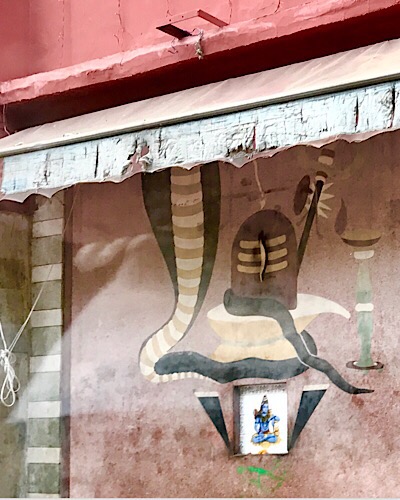
    By day we will be practing and gathering in a hall at a Hindu temple. The grounds are reported to be beautiful and welcoming. By night, those of us who don’t have local friends will be staying at hotels off the highway with cable TV that usually serve the visitors to the big university ball games and events. We’ll then all be driving back and forth to the venue and out to eat.

    I find it of mild interest that I spend more time in cars and more time in a place with TV when I travel to study yoga than at any other time during the year.

Leave a Reply

Your email address will not be published. Required fields are marked *

This site uses Akismet to reduce spam. Learn how your comment data is processed.