| |

Starry Nights, Tantric Yoga, and Pratyahara

On my previous visits to Sedona in the past year and a half, the moon has been full or nearly full each time.  Even though there was little light from man-made sources, the bright light of the moon illuminated the sky enough that the stars were outshone.  This trip, though, there was only a sliver of a crescent, and then, no moon at all.  In the absence of the moon, the stars blazed forth in all their glory.

I recently have been contemplating how the practice of pratyahara (usually translated as withdrawal of the senses) fits into a tantric yoga path. Pratyahara is the fifth limb of the eight-limb path of raja yoga, see Patanjali’s Yoga Sutras.   In classical yoga, the aim of yoga practice is to transcend the body-mind, and the eight limbs provide the means for that transcendence.  It fits within that paradigm to withdraw from the senses to move towards meditation.  In tantric yoga, though, the aim is not to transcend or quell the body-mind, but to understand that the body-mind is an emanation of spirit and to live ever more full of the light of spirit. The senses are not something to be transcended.  Yet we still practice pratyahara on the tantric path.Why is that?

I think that in order to remember our own light, we sometimes need to choose to withdraw from the potentially constant stimulation of our senses; we need to pick darkness and quiet so that we can better discriminate between being delighted and inspired by the senses and being bound by craving stimulation of the senses.  If we get completely bound up in the senses and seek only to get more and more stimulated, we will forget the fullness and light of spirit.  We choose, therefore, at times in our practice, to diminish outer sensory input so that the inner light can shine more brightly.  When we return from the inner light to go back to the senses, we are then better able to appreciate the wonder of what our senses bring to us.  It is not unlike how we get to witness the extraordinary magic of the stars when we take ourselves away from the light of the sun, the moon, and the city.

Similar Posts

  • | | |

    Message From a Teabag

    image

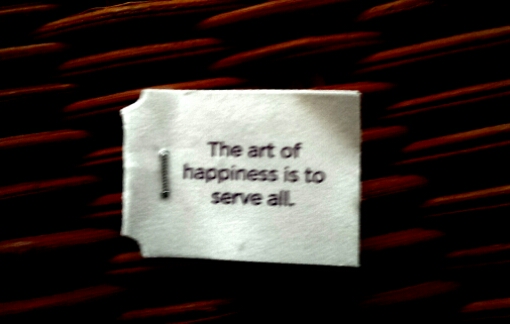
    This morning, a friend suggested that if he took into account the needs of others when making plans, all he would be doing is serving others, and he would never get to do what he wants.  “Why would  I want to do that?”  he asked. 

    I think that’s a common enough question in this society.  By uncanny coincidence, the teabag I selected right after the question was posed suggested a possible answer.

    As we are taught by the stories of the monkey deity Hanuman, whose main characteristic is a longing for devotion that he demonstrates (while still being utterly himself) through service (seva) cultivating mindful relationship is the highest service to our own self and not just to those with whom we are in relationship.

    To take care of our selves can be done with consideration of others without sacrificing our own needs.  The answer, I think, is in how we assess and balance our own needs.  For me, when I consider the impact of my planning on others with whom I am in relationship as well as my own needs, for example, of freedom, autonomy, and personal delight, I am also considering my needs for companionship, mutuality, connection, and respect.  If I completely privilege the former, I may be neglecting the latter and vice versa.

  • Dharma without Karma (Please Vote Next Tuesday)

    It’s no surprise:  I find myself more and more consumed by thought and activity regarding the state of the country and what I can do as a citizen (including voting) to make things better.  As I seek to stay engaged, but grounded and without anxiety, I find solace of the teaching in the Bhagavad Gita that true yoga is action without attachment.  To be detached is not the same as withdrawing from action.  In fact, the Gita suggests that the path of action is better than the path of renunciation.

    What is actionless action?  Given the Gita’s fundamental premise that we must act in accordance with our duty (what that means is the subject of much debate that is beyond a simple blog), actionless action does not mean disengaging from the process.  It also does not mean not caring.  Rather, it means that we should act fully in accordance with our principles (which principles should be shaped by the yoga guidelines of non-harming, truthfulness, non-stealing, alignment with nature, non-greediness, cleanliness, contentment, fervor, self-study, and surrender), but with the mental understanding that we are ultimately not in control of the outcome.  We act because not to act is a cop out.  We offer the fruits of our action to forces beyond ourselves.  We act out of love — not selfish love for personal gain — but with loving gratitude for being able to act at all.  We engage fully and then still seek to be free of being unsettled by either pleasure or pain from the outcome.  Whatever the results, we keep acting, we keep doing our duty, fully and with loving engagement.

    See:  BG IV.19-20:  He whose undertakings are free from anxious desire and fanciful thought, whose work is made pure in the fire of wisdom:  he is called wise by those who see.  In whatever work he does such a man in truth has peace:  he expects nothing, he relies on nothing, and ever has fullness of joy.  (trans. Juan Munoz)

    He who has abandoned all attachment to the fruits of action,/ Always content, not dependent,/ Even when performing action,/Does, in effect, nothing at all./ Performing action with the body alone, / Without wish, restrained in thought and self,/ With all motives of acquisition abandoned, He incurs no evil.  (trans. Winthrop Sargeant)

    P.S.  I will have voted in the morning and will be teaching at Wm Penn House on Tuesday so come join me resting in yoga before going home to watch the returns.

Leave a Reply

Your email address will not be published. Required fields are marked *

This site uses Akismet to reduce spam. Learn how your comment data is processed.