|

“Green” Party Planning and Going

Live Green has put together a short and simple list of suggestions for a greener holiday party.  Not throwing the party yourself and know your hosts will be using disposable cutlery, napkins, and cups?  I’ve been bringing my own napkin and carry cup to parties for years, just as I bring them on trips and around town.  Some people think it’s weird, but a surprising number comment that they think it is a great idea.  And people are always grateful when I bring a healthy, vegan or vegetarian food item as my offering for a potluck.
Similar Posts

  • | | |

    Square Dancing (and Spacial Awareness)

    Last night, I hopped on the bus and went from Capitol Hill to Columbia Heights to go square dancing. I haven’t square danced since elementary school, when we had two week sessions every year from third through sixth grade (I doubt, somehow, that they are still teaching square dancing as a needed physical exercise these days). It was interesting how much of the kinesthetic memory was still there, but it would not have mattered if I had not remembered. There were a lot of beginners, and the emphasis was on enthusiasm and enjoyment, not on getting it exactly right.

    One thing that was noticeable about both the complete beginners and those who were very interested in demonstrating that they could do fancy variations was how little awareness there was of how those dancers related to the room as a whole or their squares. Even if there was some awareness of their partners, the beginners were to busy trying to figure out what to do at all to be able to think outside themselves or their partner, much less outside of their own square to the relationship of their square to those around them. Those that were eager to demonstrate their prowess took up as much space as they wanted to do their own dance, making it so that others had to move out of their way.

    The truly skilled and aware dancers fostered the fullness of the dance, mindful of their own technique, their relationship to their partners and squares, and how their square fit into the dance hall as a whole, thus optimizing the freedom of the flow of the dance for everyone.

    I think this dynamic in the dance reflects how we want to live as an individual within the fabric of being. If we are sluggish with ignorance, we will trod on others, when we could have a better relationship by making the time and effort to learn how to live more rightly and in alignment with the whole. When we just strive to show how great we are, heedless of how we impact other beings, we also disrupt the flow of being. To be truly engaged in the wondrous dance of being in a way that makes not only our own lives fuller, but enriches and enhances life around us, we must not only study and practice for ourselves and develop sensitivity and awareness in our intimate relationships and our relationships to our family and community, but also understand and act from a cognizance of the flow of life and energy outside our immediate world.

    Peace and light, E — Posted with WordPress for BlackBerry.

  • | | |

    State of the Garden

    I was staying at a retreat center in Peru on 9/11. I was not with anyone else from the United States. I remember at the first meal after the planes hit, another guest suggesting that the United States deserved it. I also remember the brief moment of gathering sympathy that, as a country, we threw away with the aggressive response.

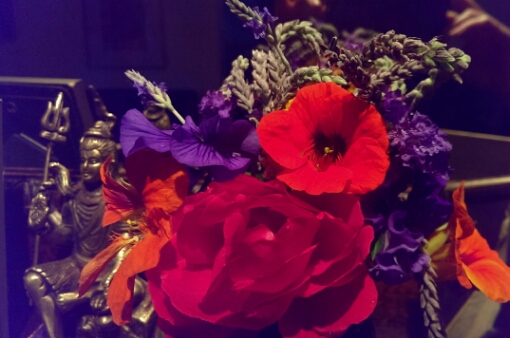
    The best thing about the retreat center was that instead of tea bags, every morning there were fresh herbs from the garden for tea. I continue to make my tea that way as much of the year as the garden is able.

  • | |

    Simulcast, Drama, and Perception

    Last night I went to see the National Theater UK’s  simulcast (tape-delayed) of Helen Mirren performing in Ted Hughes’ translation of Racine’s Phedre at the Shakespeare Theater.  The tragedy of Phedre is misinformation, misguided helpers, and passion that has gone beyond sweet engagement to maddened attachment.

    A stage production is intimate and designed for the small audience of those present in the theater.  When it is merely filmed (instead of being turned into a movie), it sometimes feels forced because it is watching a film of a stage production, instead of being invited in as one is when one is either at the stage production or the filming is done as a movie, which is designed to include the viewer in a manner for the film.

    What was hard about watching the filming of the stage production, was being forced to have the camera’s and director’s perspective; there was no ability to turn my head and shift which part of the stage to give my attention.  At the same time, I felt appreciative of the miraculous offerings of technology:  the filming made something that is usually limited to those who can afford theater of that extraordinary quality and who are able to be in a certain place at a certain time available to tens of thousands around the globe, including me and my friend.  In that way, the filming both took away the intimacy of being physically present, but simultaneously created a unifying experience for a much bigger group of people.

    I was inspired to think about the limitations and differences among the perceptions of the characters, of the critics (talking about the play and the film), of the smaller, elite audience (the actual theater goers’ — I’ve been at that theater in London), of the technologically broadened audience, and of mine in response to the essence of the tragedy, the story and substance of the play, the delivery of the play, and my own life as informed by the play.

    It seems an interesting lesson on many levels on how we can choose to live with our passions, how we can react to limits and changes in our ability to perceive our own selves and the world around us, and on how and what we invite in through the doors of our perception.

Leave a Reply

Your email address will not be published. Required fields are marked *

This site uses Akismet to reduce spam. Learn how your comment data is processed.