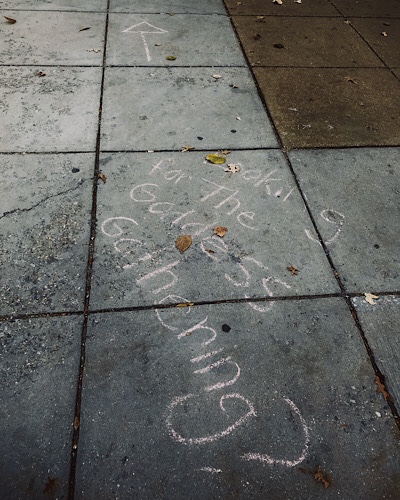
Happy Thanksgiving (and some self-massage techniques)

I wish you all a day in which you recognize and celebrate inner and outer abundance.  Show your body how grateful you are for taking you around in this life-time with a few minutes of self massage (and share with your friends and family).

First, take care of your feet–those of you who are regulars know the routine (sorry no pictures).  Then, with reverence and gratitude for the practices, the earth for supporting you, and what and who brought you to the mat, come into balasana (child’s pose).

In balasana — you can also do this sitting in a chair at a desk or table; just put your head down the way you did in elementary school — leaving your elbows and forehead resting on the floor or table, bend your elbows so that you can massage your upper back, neck, and head without having to use the muscles you are massaging to massage them.

Try squeezing the back of your neck.

Or finding some spots that would benefit from giving gentle pressure and motion.

Massaging the scalp usually feels good.

When you are done with the self-massage in child’s pose, come up to vertical to sit on your heels.  Then dig your fingers into your hair or the scalp and squeeze.  This will help get energy flowing and brighten your day.  (Be careful:  doing this too frequently might give you big hair.)

Similar Posts

  • | | |

    Green Tomatoes

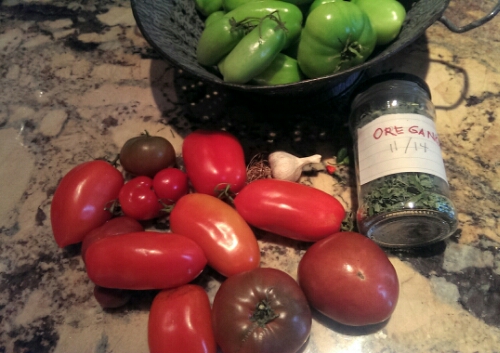
    All the tomatoes were picked green. Those that are red changed color, but did not otherwise ripen. Still, cooked for a long time in the slow cooker with lots of red wine, they will make a fine sauce. 

    I am reminded by the tomatoes, I was reminded at a yoga workshop with Elena Brower that I attended this weekend, a really good question is what are you going to do with the resources you have?

    image

  • |

    Prakriti, Purusha, and the Three Gunas

    After the five mahabhutas (great elements), the five tanmatras (subtle elements), the five karmendriyas (organs of action), and the five jnanendriyas (organs of cognition or sensing), come the three antahkaranas (internal organs).  The antahkaranas are manas (mind), buddhih (intellect/intuition), and ahamkara (ego, sense of self as an individual).  These 23 tattvas describe the objective world and our place in it as manifest physical beings and as beings who sense and think about our place in the physical world.

    The next two tattvas are more in the subjective realm:  purusha (nature) and prakriti.  In the classical system, the 23 described above plus purusha and prakriti are the sum of the tattvas.  In that system, prakriti, is interpreted as “spirit.”  It is not the world spirit or the transcendent spirit, but more our individual spirit.  Nature is divided from spirit and all of the objective world and individual spirit are different from “Atman” or “Brahma” what is real.  In Kashmir Shaivism, there are another 11 tattvas — the six kanchukas (cloakings or coverings) and the five suddha tattvas (pure elements) that describe the relationship between the individualized, diverse, perceptible and perceiving realm, and the purely universal.

    Purusha (nature) is a name or way of looking at the 23 earlier described tattvas and prakriti describes the sense we have of there being something more that is unifying and universal among all that is manifest, but still from the perspective of our own individual perception.  When we look at nature (purusha) from a more universal perspective, we look at it from how it behaves generally, how it moves, and what moves it, as we look at the laws of nature of physics.  In yoga, nature is described from the perspective of the three gunas — tamas, rajas, and sattva.

    Tamas is dark, dormant, inert, and heavy. Rajas is fiery, energetic, and impassioned.  Sattva is pure, clear, and light.  From a classical perspective, tamas is a state we need to transcend to connect to spirit, rajas is the motivating energy that helps us move past tamas to a sattvic state.  From the tantric perspective that underlies the Anusara principles, we recognize that tamasic qualities are part of nature and we embrace it where it leads us to a place of balance.  At night, for example, it is better to be still and dark for optimal sleep.  In this latititude, gardens need a period of dormancy in winter to thrive.  When we are sick or exhausted, restorative postures may be more healing and balancing than would be power flow or even meditation.  When tamas is out of balance, though, we are sluggish and slothful.  We can be stuck in our ways — ways that are unhealthy for ourselves or the planet.  We then need to cultivate more rajas.  We use fire and passion to transform, to find new ideas, to shift our behavior, to find discipline.  If our bodies are weak or inflexible, rajas helps us activate our practice to build power.  The rains and warmth of spring make the garden grow.  From this perspective, being light and pure based on particular dietary and behavioral strictures is not necessarily the ideal.  Rather being sattvic is being in optimal balance; it is knowing ourselves well enough to know when darkness, earthiness, and stillness or light, activity, and “spiritual” practices best serve ourselves, other beings, and the earth.  Being sattvic is being clear enough in the multi-faceted relationship between the world around us and our own mind, body, and spirit that our sense of spirit in all things and ourselves is unsullied, and illuminated.

  • |

    Notes on Practicing

    On Friday, on the cusp between late afternoon and early evening, a friend, who has been under significant stress, came over to hang out for a while. I brought my friend up to the yoga studio, invited putting legs up the wall (vipariti karani), which invitation was accepted. To create more ease, I took a folded practice blanket and rolled about a third of the way and placed the rolled part under the neck, with the unrolled portion under the head, to support the cervical curve. Then I offered the placement of soft weight (in this case, buckwheat-filled, silk, travel meditation pillows) for grounding on the soles of the feet. With the placement of the first, came the involuntary sigh that sounds like a “yes.” I asked to be sure and added the second. With the assurance that I would return soon and staying in the pose was entirely voluntary, I then went to feed the cat and then rejoined my friend in the pose.

    As the day was one of the really hot ones and even in the house it was 79F, we then just massaged our feet and practiced moving our toes before we moved from practice to sharing food. Having never been asked to move her big or little toes independently of the others, my friend discovered how delightful it can be to pour one’s focus into something so small and notice also what else in the mind-body is responding to the attempts.

    When I am working on alignment of my body (into shapes or controlling movements), that is all my mind is doing. While I appreciate focus on alignment is not for everyone, the structure and focus are soothing for me. What about for you?

  • | |

    Worrying (and the kanchukas)

    This morning, woken by the purring cat from an anxious dream in which I was not doing enough to make things better (I am not making this up), my first thoughts were of escalating war in Afghanistan and deepening economic crisis at home.  It felt almost strange and abstract to be worrying about these things from my warm comfortable bed.

    I think worrying can have a positive place in our lives.  If we just get worried or anxious about things and get trapped in not doing or growing or reaching (both inward and outward) for a sense of connection and spirit, then worrying will cloak or limit us.  If we recognize worries as showing us limitations, then we can use them to grow and change and spur us to action.

    After the 25 tattvas describing the physical world and our being and understanding of the world that correspond in both the classical and Kashmir Shaivist systems, are Kashmir Shaivism’s six kanchukas — cloakings or coverings.  The kanchukas are niyati (limitation of place), kaala (limitation of time), raaga ( attachment), vidya (limitation of knowledge), kalaa (limitation of action), maya (illusion of individuality/manifestation).

    From a tantric perspective, experiencing ourselves as thinking, individual beings in the manifest world, constrained by time and space, only binds us if we think that is all we are.  If we get completely entangled in these constraints, then our sense of spirit is cloaked, just as if we get stuck in worrying, instead of using worries as a spur to work for change, we become miserable.

    I meditate and practice asana, as taught by my teachers, to reveal the restraints of physical being as only part of my being.  Spiritual practice can serve to enable us to experience freedom of heart and mind, to bathe in the bliss of the essence of ourselves that is universal and unconstrained by the limitations of individual manifestation.  The point of these practices not to escape our individual selves or to gratify them (that would still be “cloaked”), but to find the strength and stability to serve better and to work for a world in which all beings have an equal chance to seek the spirit and experience the bliss of connection.

  • | | | |

    Autumn Greetings–Web Version of E-Newsletter

    Dear Friends,

    Yesterday, after I was done working and back on my personal computer and before I went to lead the Tuesday night yoga practice at William Penn House, I wrote to President Obama.  I write to the President and others in power on a not infrequent basis.  How can one not participate in the conversation if one spends so much time engaging in energetic and spiritual practices that reveal at an elemental level just how intertwined and interdependent we are with each other and the environment?

    I told President Obama that I would be one of the over 800,000 workers who would not be permitted to work while work needs to be done and probably not get paid if we were furloughed due to an impasse on the budget.  I wrote that I’d rather he stand strong on the Affordable Care Act and a budget that takes care of the environment and those in need and emphasizes diplomacy over military action even if that might mean I would be furloughed.  Relatively easy for me to say.  By good fortune, I have not had any major family or medical expenses that would significantly impact savings and budget.  By careful planning and persistent living within my means for all of my adulthood, it would be some time before I would be seriously detrimentally impacted by not working.  I know that many of my colleagues have family or health challenges that would make the loss of even a few days pay a significant budget issue.  My heart goes out to them, and I hope that they are speaking out about how the situation impacts them and that it doesn’t come to that.

    Considering the issues presented by the budget impasse led me to contemplate again how we decide when and and in what manner to weigh in on decision or action by the communities of which we are a part.  I’ve also been asking myself how do we find the most insightful and generous balance of self and collective interest and live most gracefully in these turbulent and frightening times.  How do we best engage and also take care of ourselves?  It would be pretty great to have a diet steady in healthy nourishment, enough sleep, love for ourselves and our loved ones, fulfilling work, basic safety of life and limb, access to healing when we are sick or injured, sufficient education to make informed decisions as to our own and our collective well-being, and the will, time, and opportunity to take care of our body and mind through meditative and physical practices or otherwise that suit our temperment and physical make-up.  It would be even greater if the hundreds of millions with whom we are in relationship also had these things.

    Most of us don’t have all of these things, even those of us fortunate enough to have them if we made different choices.  How do we find more energy to act and engage in a way that supports the healthiest outcome for all when our own well-being is strained by repeated challenges and how we deal with the limitations of time and space?  For me dealing with my own recent challenges, yoga asana is feeling especially good right now.  Asana feels embracing, energizing, grounding, balancing and is definitely helping me make it through the day.  I hope that whatever life is bringing you at this time you are making time to practice and that what you’ve studied and what you are practicing serve you well.

    For the company and the encouragement, to learn new skills and to refine basic ones, and to support those in need in a unique way, please come join us when you can for the all-levels Tuesday night group practice at William Penn House.  Since late this summer, 100 percent of the proceeds go directly to support William Penn House’s workcamp program–a wonderful model for service (in yoga — seva),  On Wednesday nights, a small more experienced group also gets together with me to practice in my home studio.  Email me if you are interested.

    For those of you who like to plan ahead, I want to let you know that the annual Thanksgiving Day Fundraiser to benefit Oxfam is back on Capitol Hill this year, and I am delighted that William Penn House is hosting the practice:

    When:  Thanksgiving Day, Thursday, November 28, 2013. 

    Location:  William Penn House, 515 East Capitol Street, SE, Washington, DC  20003.

    Time:  10:00 a.m.-11:15 a.m.

    Yoga Details:

    • All levels class.  Just how we will align and flow to get the energy moving and supporting us will depend on who comes and how many, but be sure that it will be designed to be simultaneously soothing and energizing to help you bring your best self to the formal start of the winter holidays.  Alternatives will be provided for those working with challenges of embodiment.  Advanced variations may also be offered to expand the experience of the abundance of the day.
    • For Most Ages–Children old enough to pretty much stay on their own yoga mat and enjoy trying the grown up poses–depends on the child–are welcome, and then it’s  all ages up from there.
    • Props.  We have plenty of blocks, straps, and chairs; a modest supply of blankets; and a limited number of loaner mats.  Please bring your own mat if you have one and any other props you may need (such as multiple blankets).  Donations of your no longer used props are welcome.

    Benefit for Oxfam:  Suggested donation $20.  As in most of the previous years I have offered this class, I will collect checks made out directly to Oxfam, America (preferred) or cash; you could also make an on-line donation before the class.  I will then forward 100 percent of what is contributed to Oxfam, America.  I also will match any individual donations over $20 up to $200.  As always, the amount is suggested; whatever is within your means is a sufficient amount.

    No Advance Registration.  Just show up at the door.  Though I enjoy the spontaneity of teaching whomever appears, the more the advance knowledge I have of who plans to attend and how many, the better I can design the class to suit more of your needs and desires.   I welcome your letting me know by commenting on the Rose Garden Yoga page on Facebook or by sending me an email (click here to go to the welcome page of the blog and then click on “contact Elizabeth”).

    I look forward to practicing together or otherwise being in touch and hope that all of you are as well as is possible.

    Peace and light,

    Elizabeth
One Comment

Leave a Reply

Your email address will not be published. Required fields are marked *

This site uses Akismet to reduce spam. Learn how your comment data is processed.