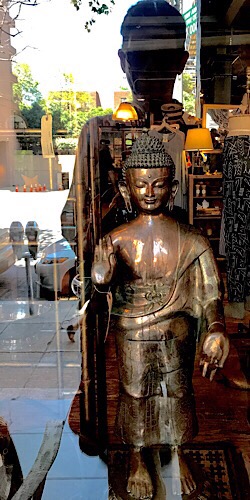
Thanksgiving

As I prepare to lead the annual yoga fundraiser for Oxfam and then celebrate with friends the abundance of my life and my gratitude for all I have, I contemplate this writing of Swami Chidvilasananda:

Revere food as God.  Revere your own body as a temple.  Observe restraint and practice reverence.  There are so many great treasures and miracles within you, so many magical possibilities inside you.  Through discipline, you can make them manifest for you, and in this way, you can make the earth a greater paradise.  Give this earth the opportunity to feel that she is blessed, that she is happy to have you, that she is grateful for your presence on this planet.

The Yoga of Discipline.

I wish all of you the happiest of Thanksgiving days.  May you feel abundant and may you share your abundance.
Similar Posts

  • |

    Sukha (the why of sequencing and the foster cats)

    Last week, I used as a theme sukha — ease, comfort, happiness.  I was inspired by Lorin Roche’s discussion of translating in his “version” of the Vijnana Bhairava, which he entitles “The Radiance Sutras.”  In it he notes that “[e]ven more literally, sukha is (according to some etymologies) composed of su, good + kha, space.  A good space.”  At first blush, teaching about sukha might seem to be off-topic from my session theme of sequencing principles.  The whole purpose, though, of seeking to understand, practice, and optimize our sequencing in time and space on and off the mat is to find just that.  It is to be in a “good space,” to feel at ease, whether we are being challenged or delighted.

    I found myself contemplating sukha yet further this week (it is a recurring practice and contemplation theme for me — I love Patanjali’s sutra “sthiram sukham asanam”), as I have been observing and helping the foster cats make mine their new home.  When we are uprooted or out of alignment, we are not in a good space.  It is a struggle to feel happy or at ease.  When we find our rhythm again, then ease unfolds.

    There is a set of principles that generally works for taking uprooted animals (or people) and helping them feel at home.  Part of making them at home is their new person holding him/herself in a “good space” for the newcomers, which indeed helps them find their own, which is its own yoga.

    The blessing of yoga for us, and why we take ourselves to challenging difficult places on the mat, is so that we can, by use of intelligent sequencing of practices, techniques, and mindsets, discover how to feel connected to our own spirit wherever we are in time and space — the essence of ease in this body and mind.  The more we can do this for ourselves, the more we can do it for others.

  • |

    The Man Who Would Not Be Pope (Habemus Papam)

    I used to go to the movies several times a month.  As independent cinemas closed and viewing opportunities moved in-home (where I don’t have a television), my desire to go to the movies ebbed.  In the past year or two, I am lucky if I see a movie once every several weeks, preferring to spend my time in practice and study or conversation.  I still keep my eye out for a film that looks like an invitation to beauty or engaged thinking.  I was called earlier this week to see Habemus Papam by this:

    “The unanswerable question at [Habemus Papam’s] heart is this: How does a leader hold onto his sense of self when the job he is about to take both demands and denies his own humanity?”  Michael O’Sullivan for the Washington Post.

    Habemus Papum is at one level a small story; it is just a few days in the life of a select group of individuals.  It is rendered with charm and love, but it asks some very big questions and ones highly relevant to any who contemplate (in this country that makes a cult of celebrity and celebrities in politics and spirituality and not just on stage and screen) what it means for an individual or a ruling body to have or to seek leadership, power, or worship, or to be given it in greater quantity than the one(s) on whom they are conferred can handle.

  • | | | |

    Bare Bones of the Trees (and Pratyahara)

    One of the things that I appreciate most about winter is being able to see the bare articulation of the shape of the tree in the absence of its leaves. A dormant tree looks very different from a leafless, lifeless tree. The dormant tree still has a vibrancy to it.

    As I enjoyed the beauty of the trees in Stanton Park this morning on my walk to work, I thought about pratyahara (withdrawal of or from the senses), which is the fifth step of Patanjali”s eight-limbed path of yoga and the bridge between life and physical practice (the first four limbs consist of ethical observances and restraints, asana, and breathing practices) and meditation. I have been led to contemplate the practice and meaning of pratyahara since the last meditation retreat I attended.

    From a renunciate perspective, pratyahara entails withdrawing from that which stimulates our senses. A renunciate would simplify and restrict what he or she takes into his or her system to free the mind from stimulation and make it easier to go into a space of meditation.

    Being careful to eat lightly, avoiding the stimulation of electronic entertainment, finding a quiet place to sit, and shutting our eyes before we begin meditating is part of the practice of pratyahara that all of us who practice meditation do as a matter of course.

    From a tantric perspective, I think pratyahara fits into our practice a little differently than for someone seeking to be on a reunciate path. We may definitely choose to minimize undue or excessive stimulation because certain types or amounts of stimulation feel out of alignment with our practices. For me, more than a certain amount of sense stimulation and certain types of stimulation can numb my celebration of and experience the spirit. Refining what I take into my system so I feel better able to live fully and celebrate and see the play of consciousness is different than renouncing objects that stimulate the senses or sense impressions themselves, as being less real than spirit. It is not renouncing things as unreal; it is picking and refining what to experience to better recognize and remember spirit. For the great siddhas, withdrawal from stimulation would not be necessary because they do not lose sight of spirit by either the cravings of the senses or being overwhelmed by reactions to stimulation of the senses.

    The trees seemed to me this morning to help elucidate this principle. The trees aren’t acting out of ego or greed or yearning to find happiness from the outside because of an emptiness on the inside. They are always open to the light and the rain. In winter, when they are dormant, they are not reaching for the light and rain or hungering for spring. They are there in all of their beauty open to receive nourishment when it comes. In spring, when the leaves start to bud and open, it is because of the light and the rain, but the essence of being a tree does not change or get distorted by going inward and resting or by opening to burgeoning growth.

    When we can simply open to all that is around us as spirit (beyond my capacities except at the rarest of times), then we can be open to the fullness of what stimulates the senses and still be practicing pratyahara. As long as we are swayed from the recognition and delight of spirit by stimulation of the senses, then we need to practice withdrawing on a grosser level to help us find the space of still being where we can be in the world of the senses without being tangled up and bound by it as such.

Leave a Reply

Your email address will not be published. Required fields are marked *

This site uses Akismet to reduce spam. Learn how your comment data is processed.