Patanjali’s Yoga Sutras

  • |

    Advice Around Town (and Aspects of Sauca)

    image

    Surely, given some of the promises of hatha yoga–health and longevity–making disease prevention into a spiritual practice would be efficacious. 

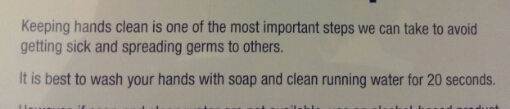
    It amazes me how few of my colleagues follow this simple tip, though there are signs everywhere.  What would be a better motivator than scientific evidence that washing your hands well helps keep you healthy?

  • |

    Signs Around Town (Seasonal)

    As I was noticing the decorations going up around the neighborhood about witches, ghosts, vampires, and ghouls, I found myself reflecting that as in the cultures that brought us Halloween, Indian folk tales are replete with stories of yogis who are practitioners of black magic. Even Patanjali, in his Yoga Sutras, warns that the practices (sadhana) must be for the purpose of uniting with spirit and not for attachment to the idea of developing supernatural powers.

    Peace and light, E — Posted with WordPress for BlackBerry.

  • | | |

    Found Exhortation

    A number of years ago I had a conversation with a cherished friend and co-worker who is no longer in this body. I was explaining to her the yoga practice of samtosha (contentment), which is one of the five niyamas that make up the second limb of the eight-limbed path of yoga set forth in Patanjali’s Yoga Sutras. My friend said it felt like a great revelation to think of contentment as a practice. She had thought of it as a state you were either lucky enough to have — or not.

    Many states or characteristics or attitudes that we tend to think of as only being innate characteristics or good fortune can be cultivated.

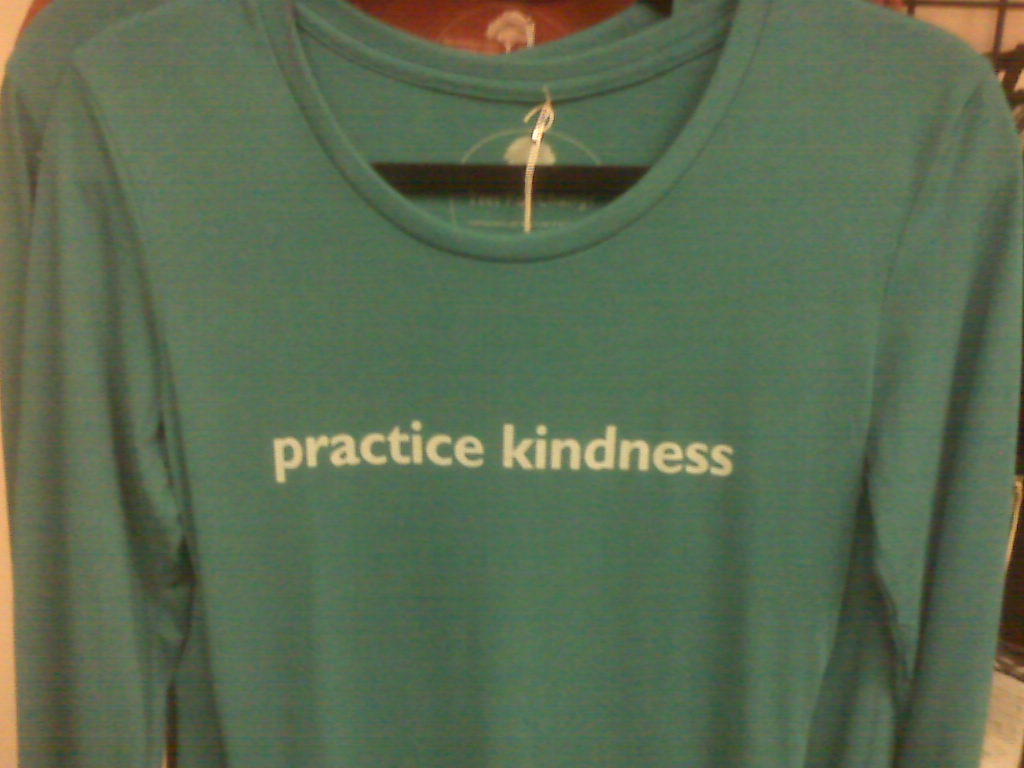
    Wearing an exhortation on a t-shirt might not necessarily be my style, but I do agree kindness is worthy of cultivation when it does not happen spontaneously.

    Peace and light, E — Posted with WordPress for BlackBerry.

  • | | |

    Quote of the Moment (and Happy Birthday Anusara)

    Today is the 13th anniversary of Anusara yoga being officially named Anusara yoga. I am filled with love and gratitude for John Friend and all my friends and teachers who are sharing this extraordinary practice.

    In thanks for the delighted and celebratory invitation to the practice, which for me is a hallmark of the Anusara offering, I share this quote:

    “The more the yogi practices, the more visible everything becomes (yavad idam sarvam drstam).” Vedavyasa, quoted in David Gordon White, Sinister Yogis.

    Peace and light, E — Posted with WordPress for BlackBerry.

  • | | | | |

    Living Mindfully in a Heat Wave, Ahimsa, and “Opening to Grace”

    Ahimsa, which is the first of the yamas in Patanjali’s Yoga Sutras, and thus is the first practice or principle of the eight-limbed path, is usually translated as non-violence or non-harming.  Over my years of practice and study, I have read and heard many versions–some general, some personal beliefs–as to what it means to practice nonviolence as part of a path of yoga.  As I watch the way people around me are behaving and reacting to the heat and drought, I thought about how, for me, the practice ahimsa is as much about seeking to be in alignment with the movements and shifts around us that we cannot change as about refraining from specific acts of violence (though that is obviously a basic element).

    In terms of aligning with the world arounds us and the cycles of our own body-mind, when we are sensitive to what will best serve our own self while having the least impact on the environment, we are practicing ahimsa, in other words, “opening to grace.”  How does practicing ahimsa by behaving mindfully incorporate many aspects of the Anusara first principle of opening to grace? Opening to grace, as a practice principle, invites us to be open, sensitive, spacious, and radically affirm what is so that we can expand, shift, and serve ourselves and others in the best way possible under the circumstance. To be open in this way, try not to rage at the heat–or whatever is your weather. Soften, listen, and mindfully discover how you can live at your fullest, kindest, and most generous with what you cannot change.

    When the temperature soars above 95F for days in a row, it is an act of violence to rage against it or to consume outrageous amounts of fossil fuels to cool our businesses and homes enough to wear warm clothes, sleep under blankets, cook and eat hot foods, or do an athletic asana practice or workout (lest we feel that we are not fulfilling some externally motivated personal notion of fitness–having external notions of how we should look, act govern us without accepting the actual situation is its own form of violence against ourselves) that we would not do if we could not artificially cool our environment.

    Perhaps I have no call to speak on this: my central air conditioning is on, though I’ve been keeping it between 78-82F and I have been moving, dressing, and eating in a way that honors the fact that those temperatures are as cool as it is going to be until the heat wave breaks. Some might argue that using any air conditioning or even an electric fan or a refrigerator is doing excessive harm to the environment. That may in fact be true, but asking for more than we can do just makes things seem impossible, and then we are less likely to make any shift at all.

    Peace and light, E — Posted with WordPress for BlackBerry.
  • | | |

    “I Don’t Care If It Rains or Freezes…” (and freedom from the pairs of opposites)

    When I was walking into work in the cold rain this morning, the song “Plastic Jesus” arose in my head.  I thought that I didn’t know many of the lyrics, but when I got back and checked for recordings to see just how much I was missing, I realized it was because there aren’t many lyrics.  Here is Paul Newman singing it in Cool Hand LukeThe Levellers have a great cover (with some variations on the lyrics–listen carefully), as do the Flaming Lips.  The original is harder to find.

    With it’s gentle tongue in cheek message, the song invites us to contemplate the real purpose of any spiritual practice (including the yoga — see, for example, Patanjali’s Yoga Sutra, at 2.46-2.48):  to be sufficiently full of love and devotion and recognition of spirit, that we are not ungrounded or driven to suffering when faced with discomfort or inconvenience.  And if we get really good, freedom from suffering in the face of true pain, loss, and outrage.  That is, of course, a key reason for practicing.

  • | |

    Starry Nights, Tantric Yoga, and Pratyahara

    On my previous visits to Sedona in the past year and a half, the moon has been full or nearly full each time.  Even though there was little light from man-made sources, the bright light of the moon illuminated the sky enough that the stars were outshone.  This trip, though, there was only a sliver of a crescent, and then, no moon at all.  In the absence of the moon, the stars blazed forth in all their glory.

    I recently have been contemplating how the practice of pratyahara (usually translated as withdrawal of the senses) fits into a tantric yoga path. Pratyahara is the fifth limb of the eight-limb path of raja yoga, see Patanjali’s Yoga Sutras.   In classical yoga, the aim of yoga practice is to transcend the body-mind, and the eight limbs provide the means for that transcendence.  It fits within that paradigm to withdraw from the senses to move towards meditation.  In tantric yoga, though, the aim is not to transcend or quell the body-mind, but to understand that the body-mind is an emanation of spirit and to live ever more full of the light of spirit. The senses are not something to be transcended.  Yet we still practice pratyahara on the tantric path.Why is that?

    I think that in order to remember our own light, we sometimes need to choose to withdraw from the potentially constant stimulation of our senses; we need to pick darkness and quiet so that we can better discriminate between being delighted and inspired by the senses and being bound by craving stimulation of the senses.  If we get completely bound up in the senses and seek only to get more and more stimulated, we will forget the fullness and light of spirit.  We choose, therefore, at times in our practice, to diminish outer sensory input so that the inner light can shine more brightly.  When we return from the inner light to go back to the senses, we are then better able to appreciate the wonder of what our senses bring to us.  It is not unlike how we get to witness the extraordinary magic of the stars when we take ourselves away from the light of the sun, the moon, and the city.

  • | |

    Samtosha (and the “Founding Fathers”)

    I am subbing Fusion Flow tonight up at Willow Street. Natalie, for whom – am subbing, has been teaching the yamas and niyamas this session. She asked me to cover “samtosha” tonight.

    In contemplating this principle of practice again (it is high on my contemplation list), I thought of the what was drafted by the “Founding Fathers.” We are not guaranteed the right to happiness, but the right and freedom to pursue it.

    That leaves open the question of what is happiness and whether and how to pursue it. It contains, I think, a hidden agreement that to keep the right open to all that happiness cannot be realized by the acquisition of external power and things that will prevent others from having the same freedom.

    When I get caught up in our current societal vision of what we are supposed to have or be, a reminder that “samtosha” — contentment — doesn’t just happen, but is a practice, always regrounds me. I choose to come back to a space of gratitude, and my my whole self eases. I return to a place that serves me and enhances my own freedom to find happiness, while bringing me to a place that is aligned with that freedom growing for what and whom I touch.

  • | |

    Sauca (Another Perspective)

    My friend and Willow Street colleague Natalie Miller taught a lovely class on Monday night, using sauca as her theme.  She said that she had recently read a book that described the yamas as things we do to be better persons, but that the niyamas were precepts for our spiritual practice to lead us better on the path.  In that sense, she suggested, sauca is about clarity or purity of intention.

    What I love about contemplating and practicing with these concepts is that they are so pregnant with meaning; they have so much to offer wherever we are in our life and on our individual path of spirit exploration.  The more we contemplate and visit and practice and discuss, the more we will discover both about the meaning of the concept and about ourselves.