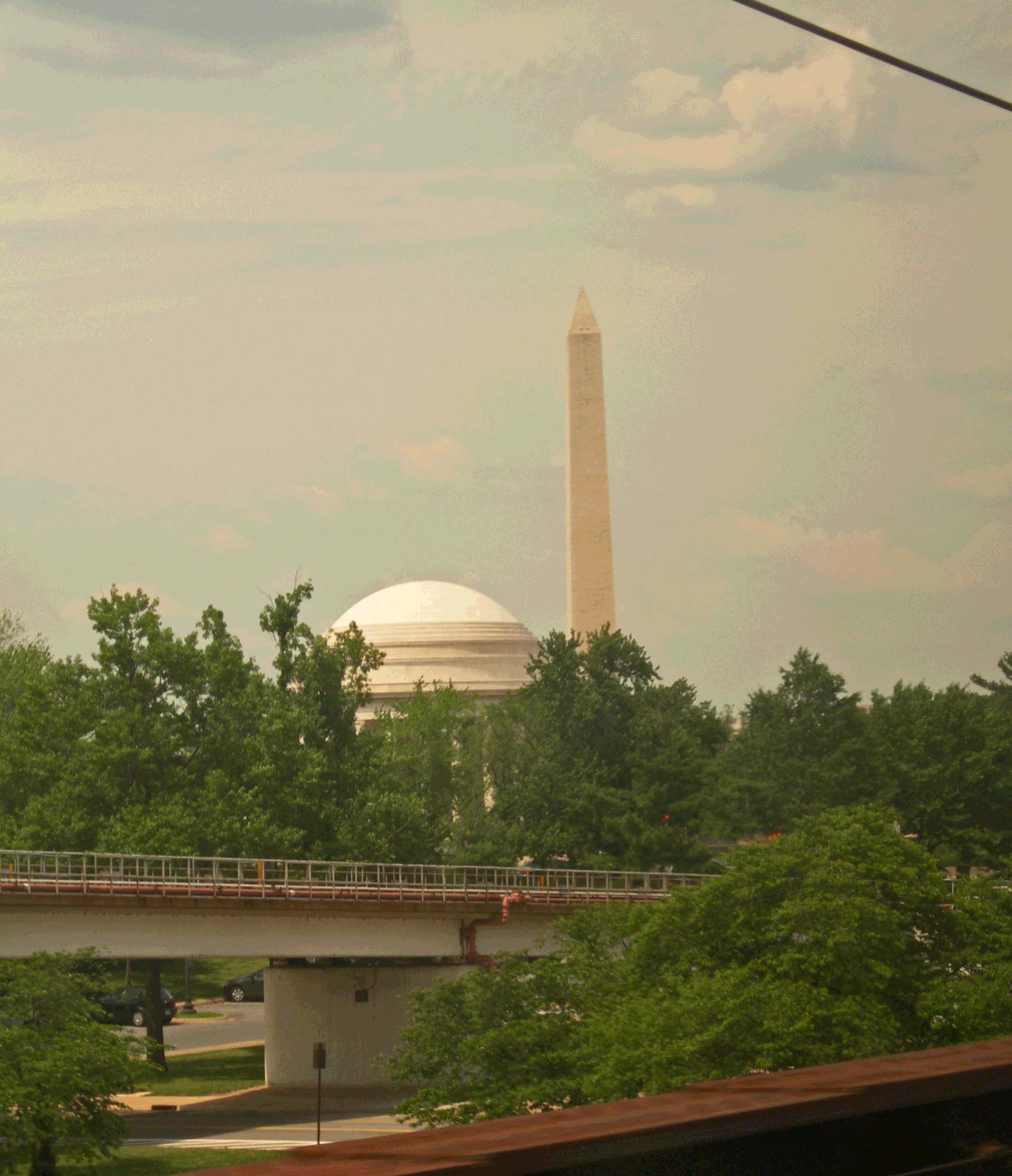
Train Ride Home from Teachers’ Gathering (Cary, NC to Washington, DC)
preparing a capable vessel
to remember, to recognize,
to dance with, to love
the shimmer, the
vibration, the very
pulse of being.


preparing a capable vessel
to remember, to recognize,
to dance with, to love
the shimmer, the
vibration, the very
pulse of being.
When I pause to think about it–something I try to do consistently with the fruits of technology–it is an extraordinary marvel that I can be telling stories to the world from a little device I am holding in my hand, one that also has let me speak and exchange notes while I am away from home with friends, colleagues, and business connections.
What I cannot do (more likely because I haven’t yet learned how than it is not possible) is to be my usual careful self when posting entries. I have not done hyperlinks to attrbute my sources, nor have I spell-checked. At home, I would not hit the “publish” button without doing those things.
Under the circumstances of being away from my regular computer, my library, the ability to check my references, and to provide proper citation, but being brimful with enthusiasm for being with my teachers, colleagues, friends, and the practices while I am at the teachers’ gathering, it seems better to post than not, using the means at hand. I sacrifice some of my usual discipline to share the joy.
All of life is like that. We may have ideals of what is proper, what are our standards for appearance, for work, for sharing a meal or our homes. When circumstances limit our ability to meet our own standards, it is part of the yoga to see whether the standards are binding us or serving to help us better connect. I believe that we should always strive to be more precise, more technically accomplished, better able to convey a sense of grace and beauty. But that effort should not cut us off, bring us to a halt, disempower us, prevent accomplishment of things. Most of all, it should not deaden a sense of spontaneity of gesture–the part of art and relationship that reveals our true spark.
One of the primary themes at the Anusara certified teachers’ gathering this week with John Friend has been how discipline and technique serve our yoga. In keeping with the elemental Anusara principles of “attitude, alignment, and action” (iccha, jnana, kriya), the point has not been to emphasize rules for the sake of rules, form over substance, or technique for its own sake. Mastering technique, by itself, will not bring us to the ultimate intentions of yoga: living liberated (jivamukti), experiencing the very wonder, bliss, and dance of being.
But just playing or seeking freedom for its own sake, while we are embodied in human form, will not likely lead us to the most expansive and steady experience of ultimate freedom (svatantra). It is discipline and technique with the constant remembrance of the reaon for being disciplined about how we practice and live that will take us further on the path.
It can be nice, for example to go to a class where there is little emphasis on form, and the call is just to flow and feel. For me, though, because of my physical limitations (degeneration in my spine, old groin injury, etc–these do not define my being; they just inform how I practice), I feel far freer and more able to expand how much I can play the more attention I give to the physical alignment. In such a situation, the rigorous attention to detail is not for the sake of an external idea of what is right and what is wrong. Rather, it is the constant disciplined attention to alignment that frees me to play as free from injury, pain, and fear of injury as is possible in my body.
The discipline then becomes a way of self-affirmation. It is the limitations that lead me to have to focus more on technique than if I did not have the limitations. That attention then provides a ground for a more expansive practice and a deeper appreciation for the beauty of what the practice can offer.
When I first got to my room on the fourth floor of the hotel, the airconditioner was straining noisily, and the room was very stuffy. To My great delight — the windows not only open, but have screen and look out onto an unveveloped tract of land with trees higher than my window. I immediately opened the windows and let in the smell of fresh air and the sounds of the forest. There is occasional car noise, but it is muffled by the sounds of wind and rain in the trees.
I thought this morning how often I end up in an office building or hotel where the windows do not open. That cutting off access to the realities of nature, of what is greater than our little world, in order to have a controlled climate seems like much of modern life.
Many I know do not even notice that the windows do not open. Others of us, see the windows and want to know what is outside and to be with the greater energies. We seek to oprn the windows and know. Those who are able and so moved and who are able — rare beings — leave behind the buildings and go entirely on the renunciate path. The rest of us who live the life of householders, seek to have windows that open and spend time each day breathing in the sweetness of what is greater.
I am on Amtrak heading to the Anusara teachers’ gathering in
Morrisville, NC. The train is surprisingly crowded and not surprisingly a whole different vibe than the train to NY.
By day we will be practing and gathering in a hall at a Hindu temple. The grounds are reported to be beautiful and welcoming. By night, those of us who don’t have local friends will be staying at hotels off the highway with cable TV that usually serve the visitors to the big university ball games and events. We’ll then all be driving back and forth to the venue and out to eat.
I find it of mild interest that I spend more time in cars and more time in a place with TV when I travel to study yoga than at any other time during the year.
This week I have been working on twists both in my own practice and in my classes. In so doing, I have been thinking about the difference between turning around or doing an about-face and staying steady and true to oneself, while truly being open to another perspective.
In order to get into twisted and bound asanas, it is critical to be steady in your place and to use the three self-affirming elements of muscular energy — hugging into the midline, embracing the muscles to the bone, and drawing from the periphery into the focal point — to be able to revolve on the midline and open the heart to a new direction.
The same is true off the mat. If we just flip our position or turn an about-face, we are not grounded or reliable. Inside the beltway, for example, I’ve heard people saying they think McCain and Specter should be voted out of office because it is not clear where they stand. Their positions seem more about expediency than about a steadiness of conviction, coupled with an openness to listen to and work with others with differing views.
Ideally, we want to embrace ourselves, our history, and our nature, and be sufficiently comfortable and secure with ourselves that we can hear others. Even if it feels convoluted or binding to open to true listening, by reaching while staying steady, we can better have compassion and recognize the light and humanity in those with whom we disagree. By doing so, ultimately, just as we create greater strength and flexibility by practicing twists, we experience a greater openness of spirit with respect to ourselves and all around us.
This is a big part of my current practice, and perhaps one of the very hardest. Steadfast commitment to a balance of steadiness and openness makes possible, I think and hope at this point in my practice, radical affirmation of the good in everything.
says the man next to me with a slightly interrogative inflection, while we are both looking at a photo of Dylan taken by Alan Ginsberg at the show of Ginsberg’s photos at the Nat’l Gallery. He is a beefy guy with a crew cut, wearing chinos and a polo shirt. He looks like he’s maybe one of the thousands of police officers from around the country who are here for “Police Week.” Lots of police wives are taking a break from the demos and competitions to look at the impressionist and modern paintings from the Chester Dale Collection. Maybe he just got a little farther west than he had intended.
I smile at him in a way that I hope seems welcoming and open, yet does not actually convey agreement with his statement. I wonder how he felt about the photos ofd the Orlovsky brothers. I am at the exhibit on my lunch hour for the first of what will likely be a number of visits.
The Beats are an important part of my identity. My parents met in Greenwich Village in the late fifties — my mother dabbling as an artist, my father involved in peace activism, the places they frequented also frequented by the beats. My great Aunt H’s favorit book in those days allegedly was “On the Road.”
As a teenager, I relished and romanticized this part of my history. In so doing I read widely not only the writings of the Beats, but also what they were reading, which included the great Hindu and Buddhist texts. To want to discover the illumination of the Beats was to explore Eastern philosophy and mysticism and to meditate and practice yoga.
“No,” I thought to myself, “I’ve never connected the word ‘strange’ to Bob Dylan. Maybe when I get home I”ll play me some before I sit to meditate.”
One of the aims of yoga, according to Patanjali’s classic eight-limbed path of yoga, is to be free from being torn between the pairs of opposites — pleasure and pain. We cannot be free if we are always grasping at pleasure or acting to avoid pain. From a tantric perspective, we are not trying to disengage or transcend body and mind and the natural arising of pleasure and pain, but we still want to be engaged without an attachment or aversion that leads us into entanglement and suffering rather than towards openness and light.
One of the kleshas (afflictions) is dvesa, which can be translated as hate, dislike, abhorrence, enmity, avoidance. Why wouldn’t we want just to avoid something that we dislike? Sometimes we have no choice, and one of the benefits of yoga is helping us make peace with having to face or be engaged with things that are painful or distasteful.
I often hear students say, “I hate [insert name of pose].” Last night, I heard it twice. I am no stranger to the “I have to go to the bathroom poses,” the poses which are so challenging or uncomfortable, that I feel the need to leave the room. One of the most profound ways I have grown with yoga, though, is staying present for the poses that did not initially appeal to me, usually those that pushed my fear, trust, strength, anxiety, worthiness buttons. One of the obvious superficial benefits of staying present and practicing the “I hate” poses is that they can yield an extra sense of accomplishment when we get them. We can also learn more about our friends and colleagues by starting to understand why the poses are the ones that naturally draw them and thus expand our perspective on the fullness of life.
For example, arm balances are still most challenging for me, partly because I am more flexible than I am strong, and partly because I am fearful of falling. I’ve started to appreciate how another person could be drawn to them for the exhilaration, the rush of danger, the excitement, the challenge, the very topsy-turvyness of the poses, although those aren’t sensations to which I am naturally drawn. But I have learned how much practicing arm balances fuels the energy in my core and heart and when I get them, what it must feel like to fly.
The teacher’s duty (and I have been blessed with wonderful teachers who have given me this gift) is to offer the full range of experiences (within the parameters of the class level, style of yoga, and class description), so that every student gets to practice both favorites and least favorites. This is not so much to make sure that every student gets a favorite sometimes and so is happy in the class when the favorite shows up, but so that the students are invited to be present, grounded, and open to his or her own light through the full range of delights and challenges. On a day when I just get my favorites, I feel like I have been to the spa. The real pleasure from yoga has been from the challenging poses over the long term. It has been steadily coming to the challenge that has started easing my reactions off the mat to the inevitable challenges, pain, and losses of a full and active life. In being less reactive to challenges, I also find I crave specific pleasures less, and so enjoy the pleasures that come all the more.
Yoga home practice challenge: pick one pose for which the phrase, “I hate…” usually proceeds it and make it an element of your weekly home practice for a month. Witness your reactions on and off the mat. Enjoy what happens next time the pose comes up in a class. Maybe the phrase “I hate” will stop arising as soon as you hear the teacher name the pose.
Last night, after yoga class, I went with a couple of students to the new Italian restaurant at Eastern Market, Acqua al 2. I’d been shown the inside before it opened, but this was the first chance to go and eat. A long-time neighbor, yoga student, and friend is the mom of one of the co-owners and has known the other owner since childhood. The co-owners were both were raised in the District and have returned after college, along with many of their friends to live, and work, and be with family. I went to eat with the eagerness of knowing my friend and her family better and supporting them, more than for the purpose of needing to be one of the first to check out a new dining opportunity on the Hill, although that was certainly another pleasure.
As we planned the dinner (we have been awaiting the opening for some months and talking about going since then), I thought about how different it is to go to a business where I feel a connection to the proprietor or the workers. I felt more open to what would be there, more joyousness at its very existence, and a yearning to find it wonderful and be supportive. When the business is run by a stranger, or even more removed, some corporation whose duty is mostly to shareholders, the natural forgiveness for quirks that we have for those we like, welcome, and love is missing, and we ourselves miss out the essence of true relationship. Getting to share this new place with my friends was a superb reminder how important is community and how we can support it and cultivate it.
What a delight that, even as a NY-bred food snob, I can cheerfully recommend the restaurant. It is larger than most restaurants on the Hill, so it does not feel like a neighborhood-style Hill restaurant. but I think the neighborhood was ready for something larger. The atmosphere is lovely: communal seating in front near the bar for those who have forgotten to make reservation (yes, you already need them, unless you are coming after 9 [kitchen serves until 11]), spacious, pleasantly lit, comfortable tables, and a great mural on the outside, which transforms a concrete wall a foot along the side of the restaurant into a view of Florence.
We started with the “zuppa del giorno,” which yesterday in keeping with the unseasonably cool weather, was a warm bread and tomato soup that was a rich and flavorful concoction. Given the lateness of the hour, we didn’t have the entrees (though I’ve heard good reports). We shared at our table for three, the pasta sampler (for two), which was five different vegetarian pastas of the chef’s choosing, and the salad sampler (which you can get as all vegetarian if you ask). We each had different favorites of the pastas, but all were good and very classic in preparation and presentation. The salads were light and fresh, with an emphasis on bitter greens, which I like, and were an excellent foil to the rich pastas. The pastas came out one by one, giving an opportunity to have two or three bites to savor, with then a little wait in between for the next one. This was not a meal to be hurried; things come at a European pace. I was too full for dessert, but my friends insisted. The cheese cake is the kind that is more like mousse than the heavy American cheese cake and my companions raved. I had a fruit tart that was well-prepared — most of which I took home. I will enjoy eating it today after speaking on a telephone seminar with people I know are asking challenging questions.
The restaurant is still getting its rhythm. It was packed with lines out the door even at 8pm on a Tuesday night just two weeks after its opening, which is no doubt inviting the staff to live up to intense challenges. The food is sure to be good, and if you go with the generosity you would have for family and friends starting out on a new venture, you will have a delicious experience.
Note: Plenty of vegetarian options with the pastas and salads, but it would be harder to find vegan on the menu (given that it is a Florentine restaurant). My only wish based on last night’s meal, is that the restaurant would use more environmentally friendly containers for taking things home. Right now, it is using foil trays with a plastic cover, so if you anticipate bringing part of a dish home, try to remember to bring your own carry container.
When I have not looked at my email for several days, I am faced with dozens of emails in my two regular accounts, plus the spam folders. The first thing I do is see what in the spam folder is not spam. In doing that, I give some attention to everything in the folder. Then I go through my in box to figure out what should have gone to spam. Then I delete the spam. Then I decide what emails from list serves there is no point in reading because if I have not read them immediately, I will have missed the letter-writing, petition-signing, event-going, offering-enjoying that is described in the email. Those get deleted without being opened. There is another level of emails that I open, but just skim. Then I either delete quickly or leave to be read after I get to the important stuff. Then there are the personal and business emails that I want to read and require my attention. I look at them to see if they need immediate attention or can wait.
The thoughts that arise during meditation have a similar filter. Some are spam. There is a certain almost mesmerizing quality about the quantity and array of the thoughts, but I just let them go — returning to my mantra or the breath because the mantra is far more delightful than the thoughts. Other thoughts, I acknowledge, but leave for later (i.e., the proverbial “to do” list), again finding more delight in the spaciousness and light of meditation. Sometimes particular thoughts relevant to my practice and very being will start resonating in the light itself and becomes messages. These thoughts sometimes dissolve again into the light of meditation and do not come with me from the session in a tangible form. Others stay with me and give me fruit for contemplation, for investigation and study, for illumination of my day, or for discussion with others for further refinement.
Always, though, there is an acceptance that thoughts will arise as inevitably as one with multiple active email accounts and many list serves will get email. The practice is learning which thoughts I should give heed, which to discard, and when and how to listen to those that will serve and inform.