A Nice Request Best Honored

Blossom Restaurant, Chelsea
Contemplations on readings and yoga philosophy.
Blossom Restaurant, Chelsea
Spiritual pursuit is, in a great sense, a luxury. Without enough time and money for leisure, when and how would we explore spirit? But where else would we find solace if not in spirit when we are suffering from deprivation?
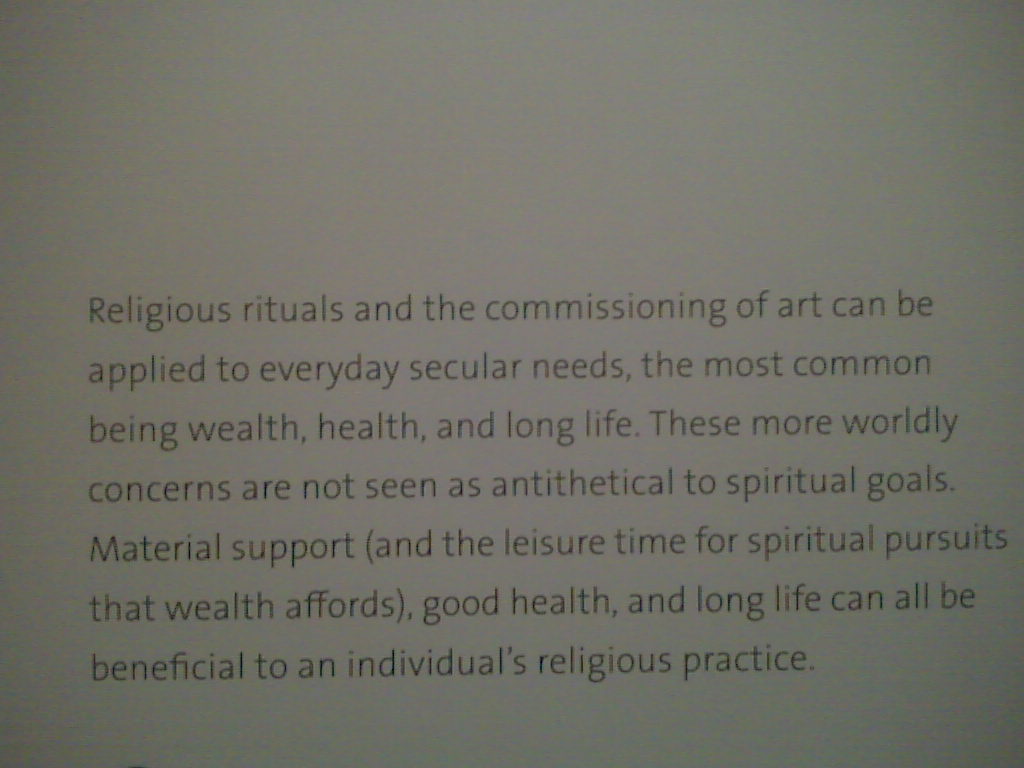
This question becomes even more pointed when we consider it in terms of the curatorial note (Rubin Museum) below. Those who can afford to commission art to further their own spiritual ideals (including prayers for wealth and family) may not be the one percent, but most surely are the ten percent, or any money would all be for food and shelter at the survival level. I would certainly rather see money spent on making art than war, but what about food, education, and shelter for more in society in a way that nourishes the environment? Such a complicated web of questions about individual and collective desire and responsibility in our relationship to each other and the earth past and present when we think of having wealth sufficiently focused to allow individuals to use it to seek religious boons for themselves in the material world.
I say this as one who loves and makes art and engages in spiritual exploration with vacation time and budget, who regularly wonders if that is really for the good of others and not just another way of enjoying what life has to offer the fortunate.
What do you think?
Photo is of exhibit notes at the Rubin Museum in NYC.
Peace and light, E — Posted with WordPress for BlackBerry.
I was not able to attend the mid-week intensive in New Jersey with John Friend. It was hard enough to make room in my schedule for the weekend workshop.
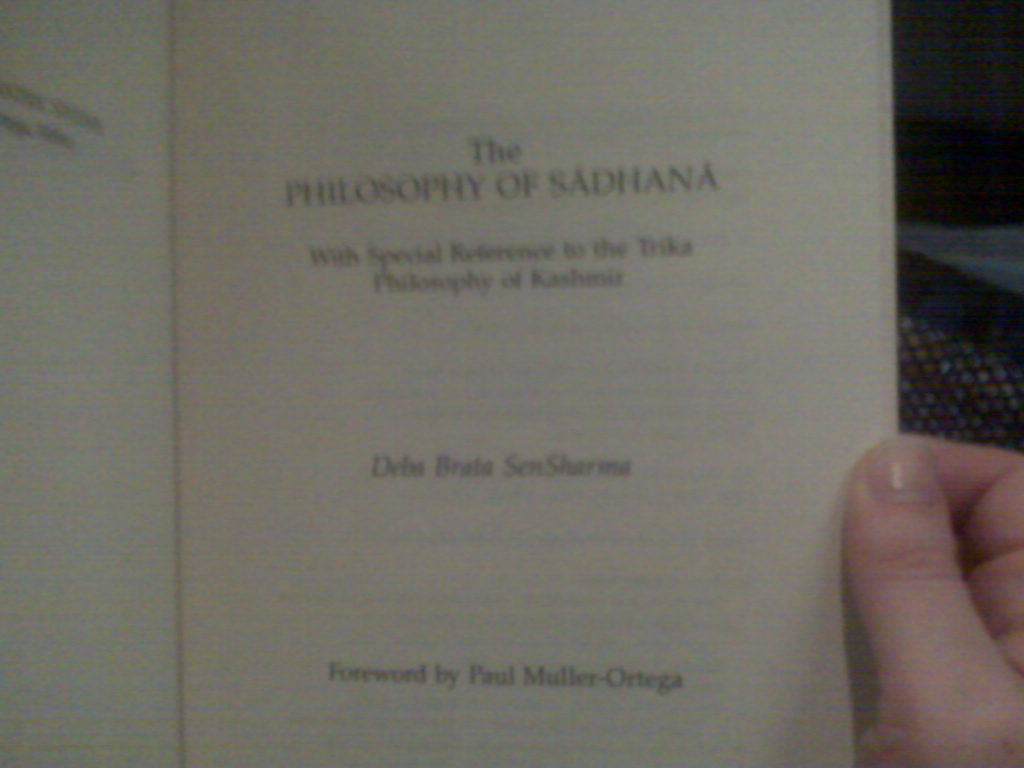
I can, though, be with my teacher and friends not just in spirit, but in intention. Knowing that the focus of the intensive was sadhana (practice), I selected The Philosophy of Sadhana to read on my way to the weekend, so that when I arrive I can be more in alignment mentally with those who already have been immersed this week in deep study of what sadhana means for ourselves and in community. Choosing to study in a way that connects us with our friends on the path, even when we cannot physically be present with them is, of course, one of the ways we support relationship in sadhana.
Peace and light, E — Posted with WordPress for BlackBerry.
After 27 hours, plus or minus a few minutes–but who is counting–service was restored to my Blackberry this morning. The reason I had a Blackberry instead of an IPhone in the first instance was because I preferred CREDO (which donates a percentage of profits to causes I support) instead of giving money to political candidates I oppose as do Verizon and AT&T. CREDO now has Android-based phones, which offer all sorts of exciting features that are really quite mind-boggling, if I stop to think about it. I have never been one, though, to give up something that still works fine, just because I could get something newer and more exciting.
It is interesting to see the articles and comments on the internet about the worldwide Blackberry outage. Much is being said about how this outage will tip users over the edge and send them out to buy another phone because of outrage because of the loss of service. Others note their attachment to the Blackberry and say they will get over the outage because of their attachment. Still others note that doing without email on one’s phone for a day or two is just not a big deal, and they, on their high horses, post mocking comments at the crackberry addicts.
I most certainly noticed how accustomed I am to sending and receiving communications with my handheld when I didn’t have it for a day not by my choice. My other computers (plural is not a typo) were readily available, so it was no big deal. If I were to lose service when on the road and expecting to meet other people with whom I had not made prior specific arrangement, as is the case for tomorrow and the coming weekend, I would have had to make some shifts. It would have been annoying, though, and would not have felt like the end of the world or a cause for outrage (there are just too many other things more worthy of outrage).
The episode did leave me thinking about our dependence on technology and how that dependence has shifted both for the good and bad how we relate to our family and friends and the tens of millions with whom we are connected in the ether; how we are attached to our habits and our expected ways things should work, and whether we get stirred up when things don’t go according to plan, desire, or expectations; and how a steady practice of non-attachment can help us open to make the best of things.
Yes, I looked at the latest phones offer out of curiosity, but no, I won’t be getting one just yet. My three-year old BB is working just fine for now.
Peace and light, E — Posted with WordPress for BlackBerry.
I walked over to the Capitol building at lunchtime to see the rally in support of the Jobs Bill. As I approached, attendees were chanting “jobs not war, jobs not war, jobs not war, jobs not war, jobs not war, jobs not war, jobs not war, jobs not war, jobs not war….”
The act of chanting gathered the energy together. The chanting empowered those at the rally to deepen their resolve. In this instance, their resolve was to seek in an ever more coordinated and expansive way a shift away from war and big finance and to community, environment, education, and infrastructure repair and development, employing the millions who have been out of work in this double recession. Chanting also helped bring the message into the conscious awareness of those hearing the chant, which in its simplicity served as a sign post both for the more elaborate meaning and for a more universal call for unity and change. This power to work both within and without with chanting at a rally can give a taste the powers attributed to the yoga practices of mantra repetition (japa) or meditation with a mantra. Just how mantra and chanting work is a curious and wondrous matter, but it is hard to think of a culture that has not spontaneously used chants for both individual and collective worship and power.
I am in the middle of reading a book about a movement/organization centered on one of those forms of meditation that was brought to the West by an Eastern spiritual leader and drew millions of followers around the globe in the 1960’s and 70’s and beyond. One of the things in the book reminded me of something said to me several years ago by a long-time practitioner of a similar practice, with a different leader. This practitioner had said, as if he had discovered an actual truth for his meditation practice, that he had learned from the organization and movement that as long as one meditated, it was OK to be a jerk. At the time, I had two reactions: (1) surely that cannot be right; and (2) it is such statements that make people at best skeptical of meditation and the kind of people who invite others to meditate.
What triggered this memory was a statement in the book, attributed to the spiritual leader, that it does not matter what you do to make the world better if you are not also working on yourself.
Taken literally, I suppose someone who behaves like a jerk and an irresponsible and callow citizen could use it to feel good about himself for meditating and continuing not to care about relationships to others and the planet, but I do not think that was the intent of the teaching.
The yoga teachings require us to work on ourselves, which includes how we are in relationship to the world. If we are trying to “do good” for the world, but still treat ourselves and our intimates badly, we will not be the best we can be because we will still be far from individual enlightenment. In that limited sense, it does not matter if we are a “do gooder,” but only in that very limited sense. Also, if we slip up and do something jerk-like, it is said that a guru (for those that have one), like a true friend or loving family member, would not reject a sincere devotee for the slip-up, but would just point again to where the practitioner needs to go on the path. The enlightened guru would still see the good in the devotee, however much work might remain for him or her.
If we act like jerks and irresponsible and uncaring citizens we are not seeing the divine (whatever that means to you) in all beings and acting in recognition of that universal divinity, which is the point of the practices. We are also building up negative karma that imprints itself and makes our spiritual work that much more challenging. But we are not booted off the path, and we are still worthy of love if we slip up. Thus does it not matter; but truly, it matters a lot.

Peace and light, E — Posted with WordPress for BlackBerry.
Earlier this week I was talking to a long-time friend of the family (my father has known him and his wife for over 60 years; they have known me since I was riding around in the womb). My parents had sent me an email while I was on the meditation intensive with Paul Muller-Ortega last month, to tell me that our friend was in intensive care recovering from an operation. I waited until I knew he was home to call because it can be so tricky to get the right time at the hospital. When we spoke, I told him that my father had said that his intrepid cheerfulness was a complete inspiration. “What choice do I have,” he asked, “what can you do when you wake up in intensive care on your 82nd birthday, but look for the gift it will have to bring?”
In the past several weeks, a number of other friends and family members have been seriously ill or lost loved ones or home or work or more than one of these. The outrageous suffering from a seemingly relentless series of natural disasters and war and the financial crisis is a staple in the news. In trying to stay present for my friends and community, while still taking care of my own needs and emotions, I found myself led to practice bhavana on (deeply contemplate) the first sutra in Patanjali’s Yoga Sutras: atha yoganusasanam–now begins the practice of yoga and how it relates to the Anusara first principle of “opening to grace.”
Teachers and commenters say of the Yoga Sutras that it was not meant for beginners, but was meant for students who have already established a practice and reached a level of initiation (diksha) that established they were ready to be given the teachings. I have also often heard said that one is drawn to the practices because of other experiences in this or a previous life; in some sense, the first time we show up, we are not a beginner and are ready for the teachings. Whatever knowledge and skill we bring to our studies and practice on any given day, they start new. They are starting “now.”
Now begins the practice of yoga (yug)–of uniting ourselves with each other and with spirit and linking our mind and body one-pointedly to the fullness of the teachings. The teachings are methods for knowing and experiencing this perfect union. In that regard, I think that an essential element of the teaching conveyed by the Anusara first principle of “opening to grace,” is this now, this beginning anew both to know what already is in our hearts and to learn how the practices can make it ever more accessible, whether we are beginners to what we understand to be yoga or meditation or have been practicing seriously for years. We want this “now” in every moment. As we get more skilled, and part of developing our skills is challenging ourselves deeply in the controlled environment of class and our own practice so that we will spontaneously open to grace in the moment when, as my friend said, there is no viable choice but to be cheerful (to “open to grace”).
The “now” of Patanjali, the practice of “opening to grace” in Anusara yoga, is a way to teach those of us (like me) who do not otherwise learn or intuit from living itself that there is no viable choice other than cheerfulness in the face of the most difficult of challenges. The “now” conveys that it is now time to go deep, time to expand understanding and practice, time to discover truly how the practices can connect us to spirit and alleviate suffering. Now is the time to be and to learn better how to stay grounded in and connected to the flow of energies, not just so that you can face what you yourself might be experiencing, but also to have ever more space for love, compassion, support, and service for others who are in need. Now is the time to open to grace.
 Photo from exhibit in San Francisco on the 10,000 year clock project.
I have been indulging in reading the thriller Angelology (complete with stories of angels and the war between good and evil), which I picked up at the Books for America shop in Dupont Circle a couple of weeks ago for the kind of night of reading that is the equivalent of a night of watching television if I had a television. Relatively early in the book, a professor says to one of the brilliant students who is a central character to the plot: “I have found that our texts will speak deeply to someone or they will say nothing whatsoever. It depends upon your sensitivity toward the subject. The mind and spirit become ripe in their own fashion and at their own pace. Beautiful music plays, but not everyone with ears can hear it.”
This statement encapsulated the ongoing thinking I do about my attraction to yoga and the tantric philosophy. I was contemplating especially deeply this week on my return from California, with no particular insight arising, what has drawn me in to this world of meditation and yoga. What am I doing, having been born in New York City and working as a civil servant in DC, coming from atheist Jewish grandparents and converted to Quakerism parents, finding such joy in learning Sankrit chants and working with energetic principles described in these ancient and medieval Indian texts? I do not doubt that the practices resonate and the texts speak to me and that the attraction is energetic, just as we are drawn to certain tastes and colors and entertainment and people and no interest arises from others. I just wonder why these practices and texts and not something else and why they hold me to such a degree that I am moved to teach them.
The two books I read while I was traveling to California (San Francisco for the delight of it and Lucerne Valley to study with Paul Muller-Ortega): Home of the Dancing Sivan, India in Mind.
The first I picked to bring because it was one on the bibliography Paul has given us to read that I had not yet read and was also something that I wanted to read in anticipation for my planned trip to to Chidambaram in December. By coincidence, while we were on this intensive, Paul showed us a video of a ceremony at Chidambaram, so I was glad to have read the book on the way there. The second, I picked up recently at the Bryn Mawr Lantern Bookshop, where I do regular volunteer work. India in Mind is an interesting collection–well-known Western voices writing about India, but collected by Pankaj Mishra, an Indian author who lives part of the time in London. Much in the collection I have read before, but the editing gives a very interesting perspective on how we in the West have related to and imagined India. More reading in preparation for my upcoming trip and for my continuing exploration of what has drawn me to the yoga over these many decades.
The five books I bought while in San Francisco (the first three from my every year or three pilgrimage to City Lights Bookstore; the last two from a used bookshop in Hayes Valley near Yoga Tree’s Hayes studio):
The Essential Tagore (a large and beautiful collection), Great Tales of Jewish Fantasy and the Occult (fantasy and magic from my ethnic heritage–why just concentrate on other cultures such as India?), White Hand Society (more on Allen Ginsberg and Timothy Leary, which ties in at a deep level to my Westerner’s understanding of Eastern mysticism); Wintering (I was captivated by Sylvia Plath in my teens and 20s; it looked like a nice book), The Violent Foam (wonderful and profoundly important poetry).
Last week, when my friend Suzanne and I were walking out of the Conservatory of Flowers in Golden Gate Park to catch the bus back downtown, we came across an island of dahlias in the middle of the parking lot. We were filled with excitement and joy at the outrageous effulgence. In the past, I’ve never had any particular feelings one way or the other about dahlias, though I knew that gardeners can get completely obsessed with them. This exuberant showing gave me a flash of insight as to why dahlias can inflame passion and dedication. It was a sweet reminder always to be open to new wonder, even from things we have previously experienced and thought we knew.