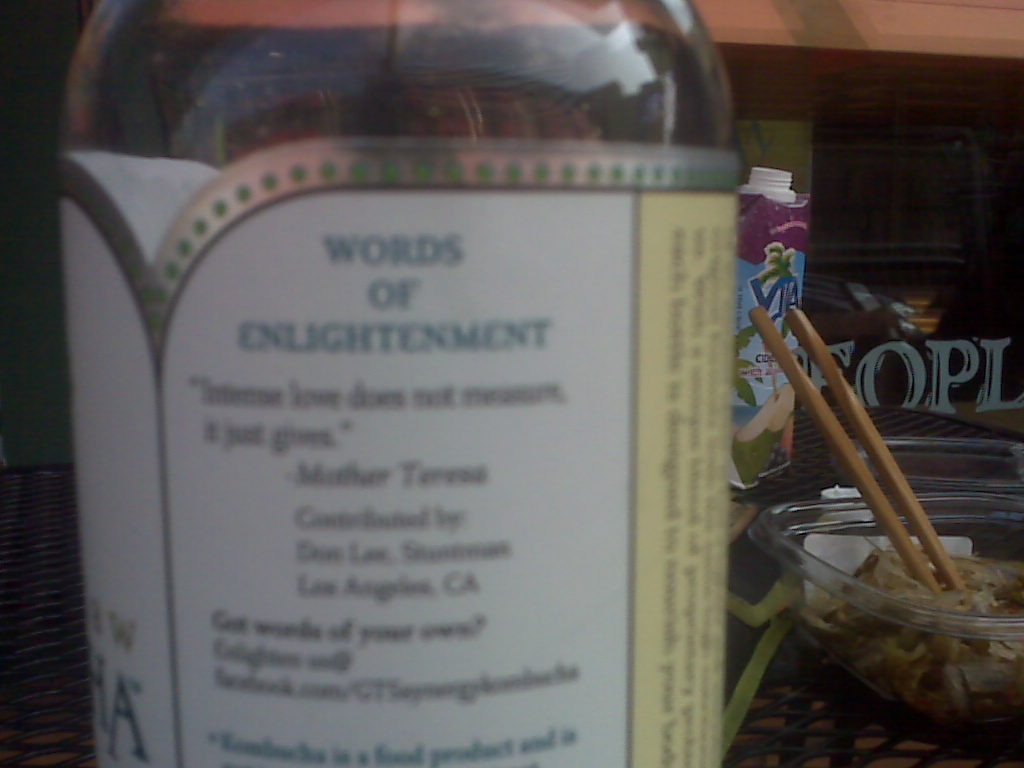
Found Exhortation
Peace and light, E — Posted with WordPress for BlackBerry.
Contemplations on readings and yoga philosophy.
Peace and light, E — Posted with WordPress for BlackBerry.
Much is made by Westerners of the exhortation in Eastern practice to be in the present moment, but it often is used as justification for a feckless disregard for others, for our history, and for our own power to change and grow.
Being fully in the moment at all times (easier said than done) by virtue of the fullness of presence itself, leaves no room for belaboring the past or being anxious about what might not come to pass, which is wonderful indeed.
To be truly present, though, to live in the “now” is an artful dance. It requires being fully in the moment, while simultaneously honoring and learning from the past and taking responsibility for the future. It is thus that we live best–both recognizing ourselves as beings in the fabric of space and time, yet simultaneously experiencing the universal joy unbound by the limitations of space and time. This is, I think, the ultimate point of the practices.

Peace and light, E — Posted with WordPress for BlackBerry.
Last weekend, I went with a friend to see The Steins Collect at the Metropolitan Museum. I made a special effort to see the exhibit because of the incredible impact on art and culture that the Steins had by virtue of their collecting. Many of the paintings in the exhibit were familiar; I’d seen them before either at the Met for those from its own collection, at other museums, or in books. Some, which have ended up in other private collections or in the collections of museums that I have not visited, were completely new to me.
Among the paintings in the exhibit is Picasso’s Boy Leading a Horse (which, as you can see from the link, the MOMA website currently indicates as “not on view”). I’ve seen the painting many times before at MOMA. The shift of location and context shook up my perceptions of the painting, and I indicated that to my friend. Another woman who was looking at the painting too engaged in the conversation. “It seems wrong here,” she said. “It’s a different view,” I replied. “It is disconcerting, but seeing it in different light, context, and company is enabling me to see new things in the painting and to find a more enhanced appreciation.”
I have been thinking this week, and talking about it in my classes, how a change of context can bring us new vision. How often, when things just keep going in a set pattern, do they collect dust and cobwebs (literally or figuratively)? I asked my therapeutic students whether they had preconceived notions about various challenges of embodiment, especially the chonic ones. Do you see them as part of your identity, something that causes you pain instead of giving you the joy of movement? What if you embraced being ever more conscious of alignment instead of being conscious of pain and limitation (and learning better and sooner when you cannot get out of injury without outside help)?
What of it? What of the change of perspective? After all, things get rearranged for us and the dissolution can be gradual or violent or something of both and be something of greater or lesser magnitude. Times of flux and dissoluti9on are the perpect time for questioning, for new vision, for discovering new ways to experience what had become too familiar, for seeing how one might wish to shift one’s own perspective for the good, to know and take responsibility for one’s own place and piece of this relationship to whatever it is that is shifting, dispersing, or dissolving., to seek to become unbound from the habitual binds of whatever invisible clothing we might be wearing.

Peace and light, E — Posted with WordPress for BlackBerry.

Peace and light, E — Posted with WordPress for BlackBerry.

Peace and light, E — Posted with WordPress for BlackBerry.
Peace and light, E — Posted with WordPress for BlackBerry.
The sky was a very pretty mixture of blue and fluffy clouds this morning. The first photo I took did not have the Capitol in the corner because the sky was just a little more lustrous and variegated facing more west than south. Although I chose to allow the Capitol into the photograph, it is fairly clear that I was photographing primarily the sky and not the Capitol.
I see people photographing the Capitol almost every day. What is around it usually is of no moment. The point is, for one reason or another, to document being in the presence of the Capitol. It is only the postcard/calendar/art photographers who care what is going on in the sky for purposes of the overall composition.
I wondered whether readers would think that the scene would be prettier if it had mountains or a stream or a lake instead of a building in it. Would they think the sky unworthy of notice if underneath was a parking lot? How much do we judge something by its surroundings? Are we able to see the beauty of the sky regardless of the scenery in which we are standing?

Peace and light, E — Posted with WordPress for BlackBerry.

Peace and light, E — Posted with WordPress for BlackBerry.