The Spell Check Alternative for Satcitananda
is catsitting. Hmmm.

Peace and light, E — Posted with WordPress for BlackBerry.
is catsitting. Hmmm.
Peace and light, E — Posted with WordPress for BlackBerry.
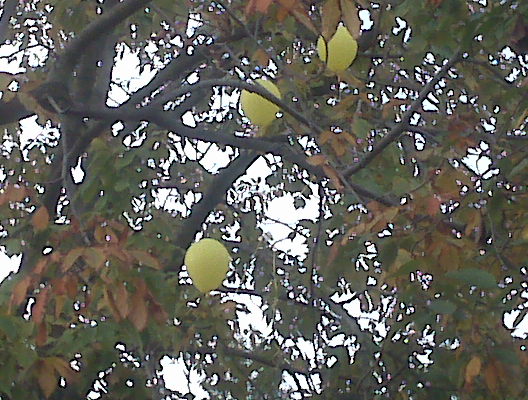
Snagged in the trees were
Balloons that escaped skywards.
Or were they released?
Peace and light, E — Posted with WordPress for BlackBerry.
The other day in group practice, someone said they wanted to work on a particular pose; another teacher had people working on staying present with pain.
I questioned whether they should trust someone who suggested that they intentionally put themselves in a painful position and then stay there to learn to be with pain.
I questioned whether creating and staying with pain was in any way healing.
I questioned what they meant by pain. I think it is useful to stay with discomfort, for example staying safely with a strong posture that requires muscular and attention effort to maintain.
But pain is an effective warning system. If the pain is sharp or abrupt or sudden or is in tendon or ligament, etc, there will be no benefit to overriding your body’s message to stop.
Better to build strength of attention and focus and body and then apply the practices when life supplies pain that you have no choice but to remain until it heals.
Last week the supplemental electrical panel necessitated by living in “this Old House” was installed. The existing panel did not have room for the solar panels to be connected.
Today, the DC Building inspector came, inspected, and gave approval (conditional on contractor sending photos of the roof). Last step is to get PEPCO to come and change the meter. That could take a couple of weeks. Meanwhile, there is no rain in the 15-day forecast. Best start doing the rain dances.
When I prepare to teach a workshop, I usually do a fair amount of background reading in addition to preparing the asana practice and contemplating the theme. Right now, I am getting ready to teach a workshop on the hidden powers of hanumanasana (See Workshops page for more info). A few weeks ago, I came across a tattered 1987 edition of an Indian publication of the Ramayana by Chakravarti Rajagopalachari. I was planning to read other works about Hanuman, but thought that I must be meant to read this one.
It is an interesting little book. Chakravarti, also known as “Rajaji” was the first Indian governor-general of India and a close compatriot of Gandhi. The work is interesting from a historical perspective. It was first published in 1951 in Tamil and then translated from Tamil into English. The purpose of the work was to make the Ramayana accessible to those who were not educated in Sanskrit and philosophy. Although purportedly for children, it obviously had appeal for a wider audience (the 1987 edition I found was the 25th). Rather than a translation, it is a retelling of the story, filled with homilies and somewhat paternalistic commentaries. Although because it is faithful to the story it still has the relentless sexism of the original, Rajaji does tell his readers in his commentary that the commonly held belief (supported by the language of the Ramayana, which is regarded as a religious text) that a woman has sinned or is shamed if “a villain behaves like a brute” to her is just wrong.
What was most interesting to me about this particular telling of the Ramayana, aside from its historical and social context, was how it resonated with my Anusara studies. When Hanuman first battles the demons, Rajaji says the demons “showered missiles on him which mostly glanced harmlessly off his adamantine frame.” Rajaji uses the word “adamantine” to describe Hanuman elsewhere in the work. Here, Hanuman is adamantine because his devotion and steadiness make an energetically impermeable boundary. Hanuman is able to love deeply and to engage in battle fully, but is protected from the inside out by his practice and his devotion. John Friend speaks often of using one’s practice to become “adamantine.” He suggests that the practice of opening to grace, and then pulsing a perfect balance between drawing in and reaching out energetically (muscular and organic energy), gives us an adamantine core that enables us to be open to a full range of experience without being harmed by negative things. I have experience myself from six steady years of Anusara practice, how the principles can indeed help me be open, while keeping negative energy from invading my space.
A used copy of this edition would likely have been around when John Friend was traveling in India when he first went to the Siddha yoga ashram. Did reading this particular edition lead him to use the word “adamantine” in the context of his teaching of the energetics of asana? I do not have an answer to that question, nor should I conjecture. What I do know, is that regardless of how I feel about some of the exterior social influences and teachings of the great Indian texts (think how I might feel about the Spanish Inquisition as it relates to the Bible), there is much to learn about meditation, yoga practice, and personal integrity interwoven in the stories.
Other readings:
The Concise Ramayana of Valmiki by Swami Venkatesananda (much more scholarly — the translation you would read if you were taking a university course, but didn’t know Sanskrit)
The Ramayana retold by William Buck — easy to read; like reading a novel-length fairy tale rendition for adolescents (changes the ending to make what happens to Sita more palatable)
The Ramayana — A Modern Retelling of the Great Indian Epic by Ramesh Menon. Great novel. Cannot recommend highly enough, but probably won’t resonate as much unless you are familiar with the Ramayana and other Indian epics and philosophy.
The Monkey Grammarian by Octavio Paz, trans. from the Spanish by Helen Lane. From the back cover: “Hanuman, the red-faced monkey chief and ninth grammarian of Hindu mythology, is the protagonist of this dazzling prose poem — a mind journey into the temple city of Galta and the occasion … to explore the nature of naming and knowing, time and reality, and fixity and decay.”
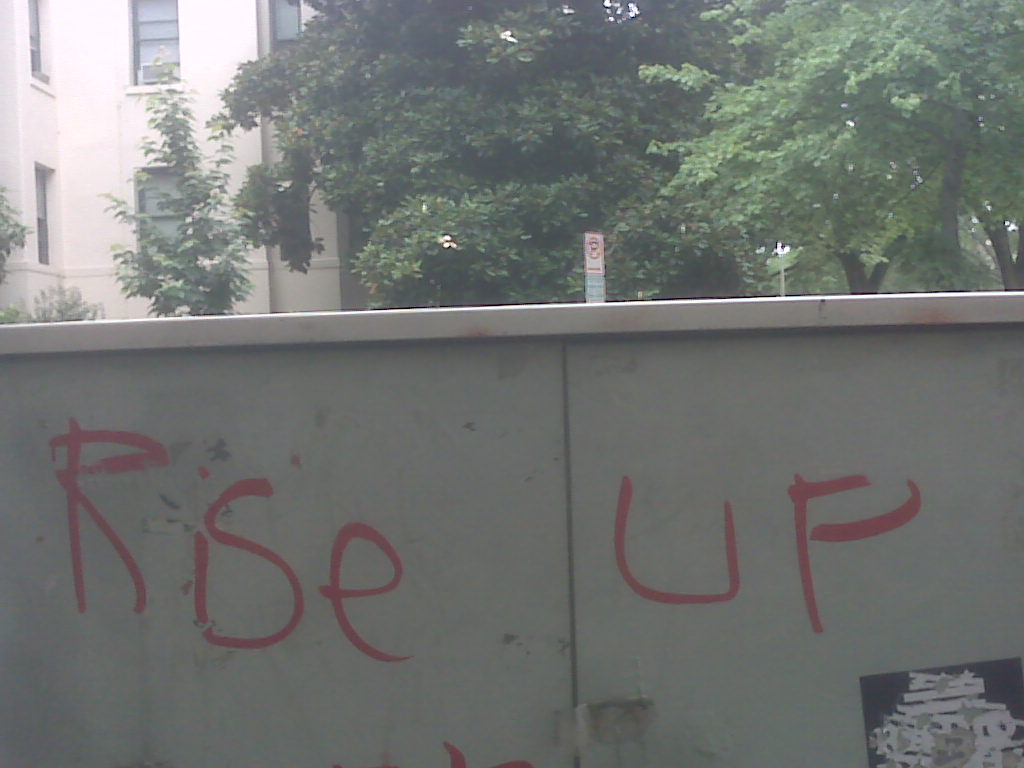
The artist who penned this exhortation here was highly unlikely to have intended it to have anything to do with “udyamo bhairava“–roughly, the upsurging of capitol “C” Consciousness. Siva Sutras I.5.
But if one were in the mood, one (not an academic, though), might suggest that the exhortation to rise up to one’s fullest potential, to refuse to be shackled by the oppressiveness of certain socioeconomic circumstances (I leave what those might be to your experience, knowledge, and education), as an example of one of the infinitude of ways Consciousness likes to upsurge itself towards itself.
Peace and light, E — Posted with WordPress for BlackBerry.
