| |

Artha, Kama, Dharma, Moksha (and Politics)

Last night, Paul Muller-Ortega, as part of the introductory talk for the meditation intensive, spoke at some length about the principles of ardha, kama, dharma, moksha.

As I have written about before, in the classical yoga view, it is the renunciation of the first three–material well-being, love and relationship, and right work or path, that leads us to the fourth–liberation. From a tantric yoga perspective, it is living and having the first three from the perspective of illuminated wisdom and discerning (viveka) insight (pratibha) that makes us free (jivanmukti) in this life.

One of the most exquisite things about a steady practice and study, is that each time we revisit a core concept, we hear and understand new aspects to bring into our lives.

When speaking of approaching these elemental aspects of human being, Paul noted that ardha includes not only material well-being, even wealth, but also the power that wealth brings and how we use it. Although he only mentioned that briefly amidst several other concepts, it really resonated with the current state of my being in relationship to the world and our country.

I have been contemplating deeply about wealth and power in this time of budget debate, and how they can and should be used to bring nurture, peace, and health to the maximum degree possible. (You might guess that I don’t think increasing spending for war and decreasing spending for education and health is going to bring us freedom).

Thinking about the power of money as part of our contemplation of our material well-being is something of critical importance at this time. If we shun or disdain in our minds wealth and power while still yearning for our own comforts, than we have lost an opportunity to bring the yoga principles into our lives as optimally as possible. (Of course, grasping and coveting money and power is completely destructive of the possibility of happiness, but most of us think about that, and it is why some say they are bad — money being the root of all evil, etc.).

If we are really in the world and want to be happy and to share and spread happiness, while living in accordance with the principles of the yamas and niyamas, especially the yamas: ahimsa, satya, aparigraha, brahmacharya, asteya (non-harming, truthfulness, non-greediness, aligning with spirit, and non-stealing), that is when we will start opening up the possibility of true living liberation.

Imagine, instead of thinking about material well-being as a “guilty pleasure” thinking of ways in which you can use your own well-being (and work through your practice to discover greater health and strength) to be a voice and power for good in your own individual way.

Peace and light, E — Posted with WordPress for BlackBerry.

Similar Posts

  • | | |

    What Difference Does Lobbying Make (and Svatantriya)

    The tantric yoga philosophy ascribes the characteristic of svatantriya or ultimate freedom to the energy that infuses all of us.  We all want to be free, but when we get stuck in our embodiment, forgetting that we ourselves are manifestations of spirit, then we lose sight of our true freedom.  To find our own freedom of spirit, we need to be disciplined, to practice, to study, to live in a way that brings us into better alignment with ourselves and world with which we are inextricably interconnected.

    In this country, one of our principle ideals and buzz words in dialogue about how we should live is freedom.  What can so often be forgotten in this dialogue, though, is that freedom is a contract.  To be in a society where all have the opportunity to experience freedom, we need to agree, with discrimination (viveka) to certain limitations (for example, we agree to stop for red lights so that we can be free to drive and walk without a constant risk of being hit in crowded city).

    Granted, I am grossly oversimplifying here, but part of the great losses of freedom we are currently experiencing is the abdication by individuals of the responsibility to shape the agreement to maximize our collective freedoms.  Like the agreement with ourselves to practice steadily to experience inner freedom, we need to stay engaged, even when it seems impossible or deeply frustrating, in order not to lose sight of the ideal entirely.  Here’s some information from FCNL on why it is important to lobby despite how fruitless an act it may appear to be.

  • | | | | |

    Happy New Year–Breaking Open (web version of e-newsletter)

    Dear Friends,

    Midnight of the new year found me sitting in a hotel room near the Chidambaram temple at festival time engaged in intense conversation while listening to wild music and chanting and the cracks and explosions of fire crackers.  Quite a change from my long-standing practice of making a healthy meal, doing a long yoga practice, taking a hot bubble bath by candlelight and going to sleep well before midnight so that I can start the year rested and refreshed (an excellent way to spend New Year’s Eve if you haven’t tried it).  Though I did not start this new year well rested, I wouldn’t have traded the experience I had for the world.  Sometimes we need to radically break out of our old patterns to discover how much we can expand.

    One of the practices at the temples we visited on the India Pilgrimage with Douglas Brooks is to take a coconut and break it open.  The coconut symbolizes your head and all the preconceived notions and rules we set for ourselves that bind us into our old habits.  The symbolic act of breaking open the coconut is to remind us that we sometimes need to break ourselves open in order to get at the true meat of our existence and to drink the sweet nectar of life.

    Many times during the trip I thought about my first experiences attending “Advanced Intensives” with John Friend.  I, like many others I know, showed up at my first Advanced Intensive wondering how I got there, asking myself whether I was worthy, and worrying that I was in way over my head and would get injured.  Though I have now been to a number, each time I still have had to practice with both an absolute willingness to be open to the possibility of expansion while being impeccably mindful of my own limits.  It is a subtle dance of consciousness, and part of the learning is finding the exact balance point where we can both break out of our preconceived limitations and still honor that we in fact have some.

    I approached going to India with much trepidation.  A friend whom I met in Peru and who I later visited in South Africa, having seen my emotional reactions to the deep poverty of developing nations had warned me off of India.  As one who likes things to be quiet and clean and thrives on healthy meals and regular sleep, I knew India would be physically and emotionally challenging.  But I wanted the visions.  I wanted to see and experience its very “otherness,” its beauty, and the source of the yoga teachings.  I packed my bags with emergency supplies, some of which I turned out to need, some of which served others on the trip, most of which I ended up donating to a village that the trip helps to support.  I had to ask people to help me (one of my hardest practices) by being close when we were in dense crowds.  I confess that I wore earplugs when it got really loud in the temples, which it does.  And having prepared and taken care, I was exhilerated.  I experienced radically more with my heart getting fuller and fuller in a short time than I thought ever possible for me.  Like discovering one can do a wild yoga pose that one thought totally out of reach and then sensibly stopping before blowing past physical limits, I broke myself open and was able to drink deeply of the nectar.  And yes, I did actually hurl a coconut to the ground to break it.  And yes, it took two tries.

    I was lucky.  This time, I got to choose when and where to break open the coconut.  Sometimes life does it for us and then we have the choice either to despair or to rise to the occasion.  This year, I invite you to the yoga to find where you can break open and find ever more sweetness, nourishment, and delight than you ever dreamed possible.  For me this includes not just the exhileration of advancing the intensity of poses, but the deepness of meditation, the precise use of alignment for therapeutics to better experience life, and the emotional depth of a long restorative practice.

    Come join me as regular classes continue at William Penn House on Tuesdays, invitation group house practice for charity on Wednesdays, and gentle/therapeutics at Willow Street on Saturdays at noon in Takoma Park.  All info on the classes page of the web site.  Mark your calendars, too, for:

    Finding the Warmth Inside: Relax Into Optimal Alignment with Anusara Restoratives, Saturday, February 25 2012, 2:30 PM – 5:00 PM, Willow Street Yoga, Takoma Park Studio, $35.00, click to Register Online or download a paper form to bring to Willow Street in person.  After a little gentle stretching and self-massage to bring awareness to the breath and body, we will enjoy the exquisite application of Anusara’s Universal Principles of Alignment to restful and supported restorative postures to release old patterns and invite in the new to find greater ease of body and mind. A great workshop and practice for all levels.

    I have been sharing photos and experiences of India on the blog (if you have missed them, do check them out and enjoy).  Some of you have asked how you can subscribe to the blog in addition to the newsletter.  Please just click here and follow the instructions to get the blog posts by email.

    I look forward to seeing you through the new year and sign off expressing my ever growing love, appreciation, and gratitude for all of you and the deepening and expanding connection through the yoga, neighborhood, and all that life here in DC and in the greater yoga community brings us.

    Peace and light,

    Elizabeth


  • | | | |

    Signs Around Town

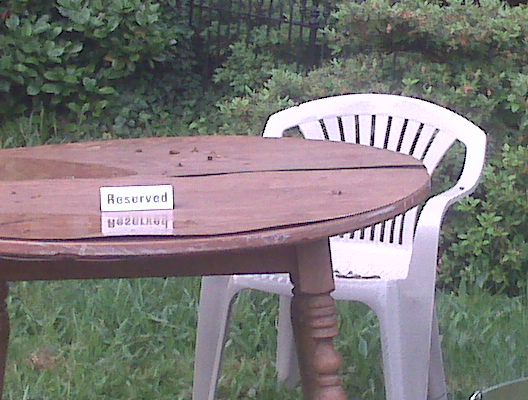
    I love this piece of yard art (assuming it was intended to be art).

    Do you have places that you have reserved for yourself that perhaps would be better abandoned? Are there places and spaces where you could grow and explore that you shy away from because of the emptiest of signs or rules?

    Just asking (I know I do, if I am being honest with myself).

    Peace and light, E — Posted with WordPress for BlackBerry.

2 Comments

  1. Thank you Elizabeth for writing this.

    What Saint Paul wrote to Timothy was this (I Timothy 6: 6-10) NRSV (and right after telling slaves to be content with their lot and be good slaves):

    “Of course there is great gain in godliness combined with contentment; for we brought nothing into the world, so that we can take nothing out of it; but if we have food and clothing, we will be content with these. But those who want to be rich fall into temptation and are trapped by many senseless and harmful desires that plunge people into ruin and destruction. For the love of money is a root of all kinds of evil, and in their eagerness to get rich some have wandered away from the faith and pierced themselves with many pains.”

    He tells us next to “shun all this; pursue righteousness, godliness, faith, love, endurance, gentleness…to keep the commandment without spot or blame until the manifestation of our Lord Jesus Christ.”

    The rich are commanded “not to be haughty or to set their hopes on the uncertainty of riches, but rather on God who provides us with everything for our enjoyment. They are to do good, to be rich in good works, generous, and ready to share, thus storing up the treasure of a good foundation for the future, so that they may take hold of the life that really is life.”

    St. Paul has a strong ascetic streak throughout his writings. He expresses value for this world as preparation for the next. He anticipated the immediate end of this world entirely. Our Paul (Muller-Ortega) approaches desires differently – even differently than how you expressed in your reference to the Yoga Sutras.

    It is the distinction made in tantra that there is an ascetics path and a householders path. On the ascetic path, Kama (desire) is to be annihilated, except for the desire for god. On the householder path, our Paul has promoted a tantric view that desires are to be fulfilled. But then there is the concept of refined desires, the product of a refined heart. In the end both Pauls come near in their assessments of the content of right desire, but the Dharma is different.

  2. Hi Elizabeth!!
    Suzanne Lynch posted your piece on facebook.
    Just a friendly spelling correction… the word is “Artha” not “Ardha” …. LOVE your writing!! keep up the great work, and sharing from the richness of your consciousness!
    All love to all of those with Paul this weekend!!

    Margaret Pitkin
    (Certified Anusara Yoga Teacher, VT)

Leave a Reply

Your email address will not be published. Required fields are marked *

This site uses Akismet to reduce spam. Learn how your comment data is processed.