| | | |

Cherry Blossoms at the Japanese Memorial (and Abhuta)

When I was walking home in the gray chilly day, astonished and awed by the beauty and effulgence of the cherry blossoms as if experiencing them for the first time though I have been witnessing them blossom here for over 25 years, I thought about the principle of abhuta.

Abhuta, which means wonder, is one of my favorite sanskrit words. It is one of the important aspects of the Anusara alignment principle of “opening to grace.” When we approach things freshly and with wonder, then we will not only experience more delight in our daily lives, but we will be more open to learning something new from what we experience over and over again, both on and off of our mat.

Peace and light, E — Posted with WordPress for BlackBerry.

Similar Posts

  • |

    Change of View (and the tree rebate program)

    In October through early November, I have autumnal color right outside my bedroom window as the red maple in my front garden and the sugar maple in the tree box right in front of it, blaze into glorious color.  Through the winter, the view is decidedly urban.  I look right out at the apartment building across the street and must keep the venetian blinds down for privacy even during the day.  If we get snow or an ice storm, I look out at branches gilded-jewel like with winter frost.

    Only two weeks ago, there was only a hint of red and green on the two maples.  Now they are in fresh, full leaf.  Not only is my yard shaded, but my view is changed and my privacy veiled by a curtain of leaves.

    These trees cool my house and the street, help make the air more breathable, provide needed habitat for birds, and give me the pleasure of their beauty.  If you have space, consider planting a tree.  Extra bonus, the District has extended its rebate program for planting trees on private property.

  • |

    Nyaya of the Rosebud and the Rose

    As I walked through the neighborhood for the past couple of days, going from one place to another, I have seen hundreds of rosebuds. In enjoying the exquisite form of the buds before they open, I thought about the teaching I have heard from Paul Muller-Ortega of the rosebud and the rose.

    The buds are lovely ad perfect in their on right, and at some level, we hate to see them go. But the rosebud itself must dissolve or be destroyed for us to get the rose. The transformation into the full-flowering of the rose requires the dissolution of the bud.

    So too, with everything in life. When we can fully appreciate this cycle of dissolution as part of creation, we will be less attached in a way the leads us to be bound up in grief and loss, and instead find a fuller appreciation of whatever beauty is present in where we are in the cycle.

    Peace and light, E — Posted with WordPress for BlackBerry.

  • | | | |

    Potage D’Ete Au Mid-Atlantic (and jivan mukti)

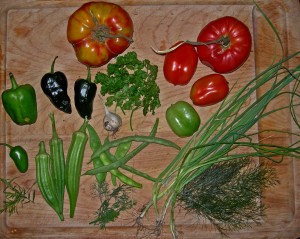
    potage Could not resist the french name.  More fun than summer local vegetable stew.  An alternative name could be:  how to make three okra and six beans into dinner for two.  Or maybe four.  When I was out in the garden this morning, I simply picked what needed to be picked.  Featured here:  three okra, six beans, one jalapeno, two ancho chiles (one partly dried on the plant), two large tomatoes (both of which are only partly viable), two ripe and one green (fell off while I was picking the ripe ones) roma tomatoes, one very small garlic clove, baby leeks, garlic chives, tarragon, parsley, dill, and herb fennel.  Serve over quinoa, couscous, rice, or pasta, and it is easily a meal for two.  Add some red beans or other dried beans, and it could be dinner for four.

    One of the things I like about eating from the garden is the necessity of being creative.  Cooking from a cook book, who wants an ingredient list this long?  I could also be disappointed that no one of my plants is giving me enough to create a dish out of mostly one or two ingredients.  If I were getting these ingredients from the store, I would get more okra or beans or peppers.   There is a great joy in finding a sense of abundance and sparked creativity and celebrating pleasure, art, fulfillment, delight, offerings with what we have been given, whether it is the food from our garden, our bodies, our talents, our families, or the time and place into which we were born.  In finding the highest sense of abundance and creativity within our limitations, we are truly experiencing the yoga concept of jivan mukti, living liberation.

  • | |

    Hard Freeze Forecast (Heyam Dukham Anagatam)

    My favorite sutra in Patanjali’s Yoga Sutra’s is, II.16, “heyam dukham anagatam.”  This translates roughly as “the pain that is yet to come can be avoided.”  What does this have to do with a forecast of a hard freeze?

    My chard, beets, and turnip greens are still flourishing.  They can manage with a night or two in a row in the high 20sF, and that is all we have had so far.  The forecast for later in the week, though, is for the first true cold snap since 1994 (you may remember that as the year when lots of people’s pipes froze).  My winter garden (which does not have a cold frame due to lack of space — maybe I’ll get more creative next year, and I’ll try an experiement with plastic bags on Thursday night) cannot survive lows in the low teens highs in the twenties.

    I could suffer today by bemoaning the coming cold, worrying about the garden, and remembering that I don’t like cold.  That would be present suffering in anticipation of potential future suffering.  I certainly can avoid that.  I can also do what I did yesterday, which was harvest lots of the chard and most of the beets, put the beets into cold storage (vegetable bin in the refrigerator) and make pasta with sauteed garlic and chard.  Between now and Wednesday night, I’ll harvest most of the remaining greens.  I’ll make a big vegetable soup with the beets and the chard, maybe make chard pie or calzones (truly delicious), and eat the rest over the following days.  I’ll feel grateful that in the bitter cold, I can be eating fresh garden greens.  I’ll be even more grateful that I can just shop at the grocery store or the farmers’ market and don’t need to rely on my garden feeding me year round.  I’ll also be happy for the hard frost.  Part of the reason the aphids and the mosquitoes have been so bad is the absence of a hard frost in winter.

    Some bitter cold in winter in a temperate zone is inevitable, as are sickness and death.  We can avoid suffering by not just getting anxious and unhappy and suffering in the present, but not taking action to alleviate potential suffering.  With preparation and practice, we can avoid some suffering.  Just has preparing for winter in the garden can allow it to be productive for greater parts of the year, so too, with a steady practice of asana, pranayama, and meditation we can avoid some physical and emotional pain and suffering.  Most important, with steady preparation (preparing for the potential for difficulties in the future is not the same as being anxious about it), when the inevitable comes, we will likely suffer less, at least in our hearts, if not in our bodies.
  • | | | | |

    A Flash of Abhuta

    I contemplate (practice bhavana on) the yoga principle abhuta (wonder) on a fairly consistent basis. When we can find wonder in sheer miraculous diversity of manifestation, we can enter a space of joy whence we can more likely respond in the highest.

    This afternoon, perhaps because I have so recently gone on a practice intensive, I experienced a spontaneous uprising of delighted wonder on receiving an email that would otherwise cause me some consternation and annoyance. Instead, my first reaction was, “My goodness! Another one just like the others, but still new and different! Amazing how that happens. And now I will have to respond.”

    I felt that way again as I joined the rush hour crowds on my way from work to go lead the restorative class at Takoma Park. (If you’re in town, drop-ins welcome. Thursdays at 8pm at Willow Street Takoma Park through the end of May).

    Peace and light, E — Posted with WordPress for BlackBerry.

Leave a Reply

Your email address will not be published. Required fields are marked *

This site uses Akismet to reduce spam. Learn how your comment data is processed.