|

“Yes We Can”

Yesterday’s inaugural concert spurred all sorts of memories from me.  When I was a child, we went a number of times to the Clearwater Revival Festival and other folk festivals where Pete Seeger was a headline.  He is just ten years older than my Dad, and though my parents were not among those who became famous, they were hanging around the Village and my Dad was doing activist things at the same time.  James Taylor’s “Shower the People” was a favorite when I was in junior high school.  There was a boy from camp who played the guitar who I remember saying that “a little James Taylor goes a long way [towards getting a girl’s attention].”  Bruce Springsteen, John Cougar Mellenkamp, U2, Bob Marley, Aaron Copeland, and the great oldies (played at the concert and listed as Obama’s top ten ipod songs), are part of the music of my high school, college, and law school years.

Not needing music or advertising to help me decide to vote, I didn’t pay much attention to how music was being used in the campaign.  But here was the music, and it was mostly my music, too.  The concert was very clever, designed to appeal to black and white, young and old, and populist — they were careful to have the performers whose oevre might not appeal to an older or younger crowd stick to songs with mass appeal.

Interestingly, it gave me an insight to those conservative guys from the middle of the country who said they liked W because he was the kind of guy they could hang with and have a beer.  The concert was a concert I might have attended when I was in high school or college or law school.  I had an insight about what it feels like to feel comfortable with the education and background of the President, but only up to a point.  I enjoyed this trip down memory lane, but it did not impact my politics or how I would view the Presidency.  There is a fine line between relating and agreeing, appreciating and accepting without question.
Similar Posts

  • |

    Anahata Chakra (Part II)

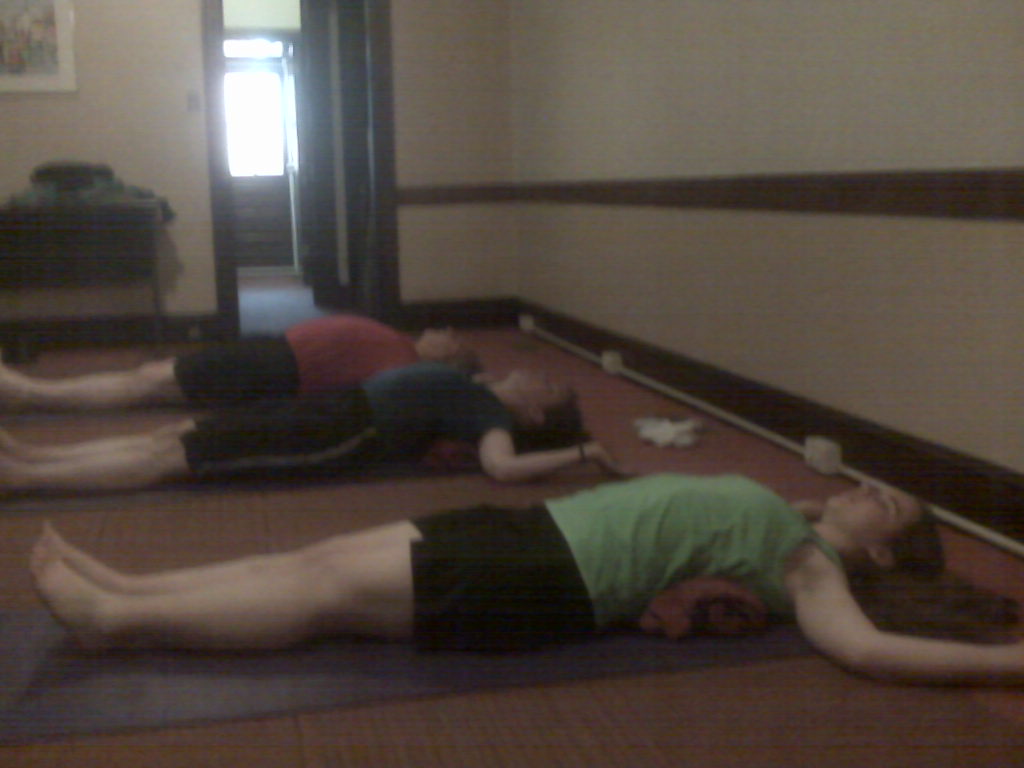
    At yoga class tonight, a couple of students advised of challenges with neck and shoulders; another was very tired. After we had centered and done some gentle warm-ups, I led the class into this simple restorative backbend. In the pose, a rolled up blanket (or even a towel or two) is placed across the back, right at the bottom of the shoulder blades, so that the roll firms the shoulder blades onto the back and allows the heart to open, the collarbones to broaden, and the shoulders to drape to the floor. The yogin keeps the legs somewhat active in supta tadasana–supine mountain–pose to make more easeful opening the back and chest.

    It was a good day for a quiet, nurturing practice designed to move us into our hearts. When we are faced with tragedy and outrage, but are not personally harmed, it is even more important that we choose to get deeper into our hearts. It is a time when it is good to choose to practice (whatever the practice) to foster clarity of vision, improve individual health and strength, and ground ourselves in a space where we can expand the possibility of responding with compassion, generosity, and common sense instead of unthinkingly reacting out of fear and rage.

    Peace and light, E — Posted with WordPress for BlackBerry.

  • | | |

    Gardening, Cleaning, Cooking (and Vinyasa Krama and Kali)

    Vinyasa krama is the art of sequencing.  How a yoga practice or flow is sequenced can determine whether it is uplifting or inward going, exhilarating or calming.  When we are trained and attentive, we start to know the most optimal order to open our bodies and our focus to align with the time of day, the season, the weather, our mood, and our health.  This incredible art helps us be positioned and aligned in a way that we feel free in time and space, rather than being constrained by time and space.

    This morning while I was out in the garden, I was thinking a lot about vinyasa krama and the goddess Kali — goddess of, among other things, time and change, and thus, of sequencing.  I woke very early, brought to consciousness by the long light of the solstice even through closed curtains.  As I went about my morning, rinsing the sprouts while heating the water for my morning coffee; cutting back the greens and herbs before starting breakfast; doing the major pruning and clean-up before doing more decorative garden work; finishing cooking before taking out the recycling; applying a facial mask before starting to vacuum; never walking up or down the stairs empty-handed; waiting to gather the bills until after I was clean and waiting for friends to arrive, etc., I realized how important sequencing is to the richness of my days.  By knowing the best way to order tasks for my needs, my day is simultaneously productive, unhurried, and enjoyable.

    By the time my friends arrived around noon, I had meditated, taken care of the garden, gathered food for my own breakfast and to share with friends, talked to neighbors, cleaned the house and myself, done a little asana, written in my journal, and sorted the mail.  Had I not known from long experience and conscious attention how to sequence all the different elements, knowing which ones went together, which took longest, which ones if done earlier or later would create double clean up, etc, I would have been tired and the tasks unfinished.  Instead, after brunch, I came home to a tended garden, a freshly made bed, and time to enjoy a quiet evening.

    These sequencing principles also apply for me on major projects at work.  If ordered one way, the work is exponentially harder, the deadline a fearsome thing; if ordered another way, everything comes together mostly as it should when it should.  When I order my work with attention (this assumes others cooperate with this endeavor), I have time to do a good, careful job and still take breaks, eat well, and leave the office in time to take or teach yoga class.

    Whether you are doing your home yoga practice or cooking or working, choose to sequence the elements of your practice, your activities, or your day, with attentiveness, reverence, love, and respect, and Kali will support you and not show you her most fearsome face.

Leave a Reply

Your email address will not be published. Required fields are marked *

This site uses Akismet to reduce spam. Learn how your comment data is processed.