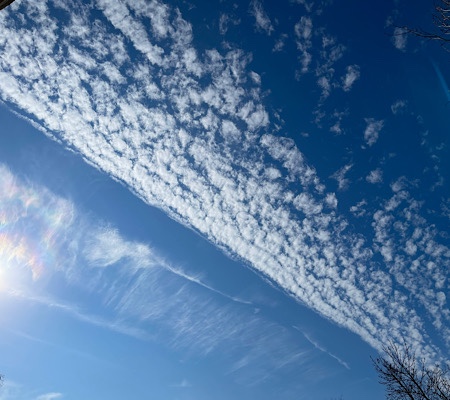
A Hawk

I saw a hawk when I was walking to work this morning.  It was in one of those stately oak trees in the park just north of the US Capitol.  I have occasionally seen hawks in the neighborhood alleys, but never one at the Capitol.  The hawk stood out for two reasons:  it was very large, and it was the only living being about.  Usually, there are a number of squirrels, pigeons, and maybe crows, sparrows, and common grackles about the park.  This morning, it was unearthly quiet; all of the other animals and birds were all in hiding.  It was probably a red-tailed hawk.  As I stood to watch this special being, a woman walked past me with her head hunched down, her hands shoved in her pockets, her briefcase weighing down her shoulder, and her face preoccupied, a common going to work look.  I called out to her, “look, a hawk.”  She was startled, maybe even a little upset at first that I had interrupted her thoughts, but then she, too, stopped and watched.  When I finally continued on to work, she stayed watching for a while, and she no longer looked preoccupied.  At the bottom of the steps of the park, I went past the police, who are there every morning with their cars parked on the sidewalk (blocking the way).  The police rarely say hello.  One of the cops, who had his dog out of the car, called out a good morning to me today, though.  I greeted him back, “good morning, did you see the hawk?”  “Yes, I’ve been watching it,” he said.  We had a nice chat about the hawk and about his being able to watch the bald eagles at Blue Fields in Virginia, where they do the training for the police dogs.

It would have been easy for me not to see the hawk.  I use my morning walk as a time for contemplation, and when I am in the park (leaving aside the Architect of the Capitol vehicles that sometimes intrude), it is a time I can be less careful about traffic and be more inward.  But it is also a time to look and to appreciate the opportunity to be outside, whatever the weather and the season.  The trees and birds and small animals and plantings and sky look different everyday.  While I go inward on my morning walk, I am also always noticing.  This is a kind of mindfulness — to be able to be resting with inward attention, but still be open to observing whatever is in view.  Is it less mindful to be so drawn inward that the outside disappears?  That perhaps depends on whether one has deliberately gone so far inward that the outside ceases to exist for a time, which is a meditation method, or whether one is just so preoccupied with the churning of the mind that one becomes less conscious.

Similar Posts

  • | |

    The Danger in Taking Instructions Out of Context (and Satcitananda)

    Those of you who are regular readers may sometimes wonder why this blog, which purports to be about yoga, only on the rarest of occasions goes into any detail about the physical alignment principles for asana.  I just received a comment on a post that I wrote several months ago that reminded me of my conviction that the optimal place to discuss and practice physical alignment principles is in class.  This conviction is not because there isn’t value in reading about the alignment principles–I look at the Anusara Teacher Training Manual on a regular basis–but because it is critical to understand the bigger picture, to have a loving eye on the alignment, and the opportunity to ask questions right away, which we can only get when we practice with a teacher.   In this instance, the commenter said in response to a post in which I had indicated that “thighs out” was shorthand for part of inner spiral that she had heard that “thighs out” in the common Anusara alignment instruction “shins in, thighs out” was just hitting the thighs apart and was something separate from inner spiral.  Would I mind clarifying.

    I found the comment timely as I was recently at a workshop where the teacher had noted the injuries that can flow from overdoing an isolated action that is intended to describe one part of an element of the basic principles of alignment (in that case “taking the armpit back.”)  I agreed with the teacher that just jamming the armpits back can stress the shoulder and limit freedom if it is done in isolation and as the first action in a movement involving the shoulder girdle.  It can be an incredibly helpful alignment instruction, though, if the students recognize (as reminded by the teacher) that we don’t take the armbone back without first opening to grace, including softening and expanding and making the “inner body bright” and also practicing the movement in a way that recognizes the point of the instruction is to encourage students to integrate the head of the armbone into the shoulder socket by means of muscular energy.

    Like taking the armbone or armpit back, I do not believe that taking the thighs apart should ever be treated as an isolated point of alignment.  It should only be done in proper sequence and in proportionate action to the amount the yogi is able to work the other principles.  “Shins in” should not be done without first opening to grace, including softening, expanding, listening to the body, and establishing a good foundation.  It is also only one of the three aspects of muscular energy.  “Shins in” is just one way a teacher might tell students to apply the principle of hugging to the midline, but the student should not neglect hugging the muscles to the bone or drawing energy from the periphery to the focal point of the pose just because the teacher only cued “shins in, thighs out.”  After all, there are only so many words that can be said in a single class and only so much on which we can focus at a time, but that does not mean we should be neglecting the basics as we seek to become more refined in our practice.  Just as “shins in” is only part of muscular energy, the companion shorthand instruction “thighs out,” emphasizes just one aspect of inner spiral — that which serves to broaden the broaden the pelvic floor by means of the movement of the thigh bones.  That does not mean that it is independent of the other aspects of inner spiral–spiraling inward and expansively from the feet upwards and taking the thighs back, both of which sequentially come before the “apart.”

    Wow.  For those of you who read this for the gardening or cooking or to enjoy the photographs, this level of detail might seem mind-numbing.   Part of the danger of getting into the weeds in writing about alignment is just that.  Not only is it distancing, but it gets educated readers into a space of debating the finer points and wondering whether things have been said just right.  It becomes far to easy to lose sight of the point of yoga in the first place, which is to bring us joy on and off the mat.  Remembering the intention to cultivate joy (ananda) when we are practicing actually physically protects us from getting in trouble by over-efforting with regard to one small aspect of alignment.  When we are (sat)  consciously (cit) in the moment with an intention to cultivate bliss, then we are much less likely to do any physical action so hard or so precisely that we forget the big picture and how the principle or the pose fits in with the overall flow and alignment principles and do more harm than good.


  • | |

    Looking Within

    The great texts and teachers of meditation exhort us to look within with the promise that by so doing we will find great peace or bliss or splendor.

    For many, though, initial attempts at meditation are just as likely to reveal troubling aspects of the self or agitating thoughts as any sense of beauty or quiet and the reaction can be a dismissal or disbelief in such teachings.

    The exhortation to look within is not directing us to introspection or the self-examination of therapy (which are also useful in appropriate circumstances), but rather is inviting us to open to seeing that the beauty and specialness that we might believe of and recognize in others is also within ourselves.

    Only when we can first look inside ourselves with love and empathy, can healing, change, growth, and compassion begin regarding those things that make introspection scary and challenging.

    Peace and light, E — Posted with WordPress for BlackBerry.

  • | |

    Samskara (and the awesome and the awful)

    Those of you who have been attending my classes for the past couple of weeks already know that my overall theme for the fall session is cultivating a sense of wonder (abhuta). Feeling wonder is one aspect of the Anusara principle of “opening to grace.” It is seeing who we are and what we are within space and time with a sense of amazement at the limitations and the foibles, as well as the strengths and delights.

    This week I was thinking about abhuta in the context of samskara — the markings or grooves or scars in our being from how we have lived our lives (and perhaps past lives, if those were also lived by us — personally not sure about that). I had a dialogue earlier this week that resulted from over 110 years of combined history that was not optimal. Reflecting on the precipitating factors, though, and marveling at the web of history, environment, education, and action that combined to give rise to the conversation led me to a sense of wonder indeed. It is by cultivating the ability to step back and appreciate the wondrousness of the dance that we learn from a steady practice that, I think, can help make it possible to shift in how we behave and react to things.

    From a physical perspective, most of our challenges and difficulties are based on what we have done with and in our bodies over the course of our lives. We use the yoga alignment principles to create new grooves and to shift from the old repetitive patterns, so that we can not only alleviate pain and misalignment, but to expand the possibility of discovering ever more joy and wonder in and through our bodies and senses. Both the physical and meditation practices help us shift similar patterns (dissolve and transform samscaras and their impact), so that instead of deepening old grooves, we erase or dissolve them and create new life-enhancing ones.

    It may seem odd to marvel at our stuff, especially when it does not appear to be serving us, but keep in mind that both the awesome and the awful, being both all about awe, can give rise to a recognition of the great and exquisite mysteries of being.

  • |

    Stand Steady in the Light (Workshop at Willow Street this Saturday)

    One of the most wonderful ways we can find our own steadiness using asana practice is the joy of standing balancing poses.  Even when our feet are not steady, a gentle turning of our mind to a focused, steady place will bring us a sense of calm and ease.

    Please join me this Saturday for:

    Standing Steady in the Light: A Standing Balance Workshop, Sat May 8, 2:30-5pm, Willow Street Yoga Center, Takoma Park, $35.  Find a place of deeper steadiness and balance in your own light and worthiness.  Learn how to use the Anusara principles to enhance your ability to stand or your own two feet or on just one foot at a time.  After we playfully explore a progressively expansive array of standing poses, we’ll finish with a few upside-down restorative postures to let our legs and feet feel the bright light created by the practice.  Whether you find standing poses a challenge or revel in the dance, this workshop will illuminate your practice.  Everybody welcome.  To register, please visit www.willowstreetyoga.com.

Leave a Reply

Your email address will not be published. Required fields are marked *

This site uses Akismet to reduce spam. Learn how your comment data is processed.