Sauca (and the blanket)
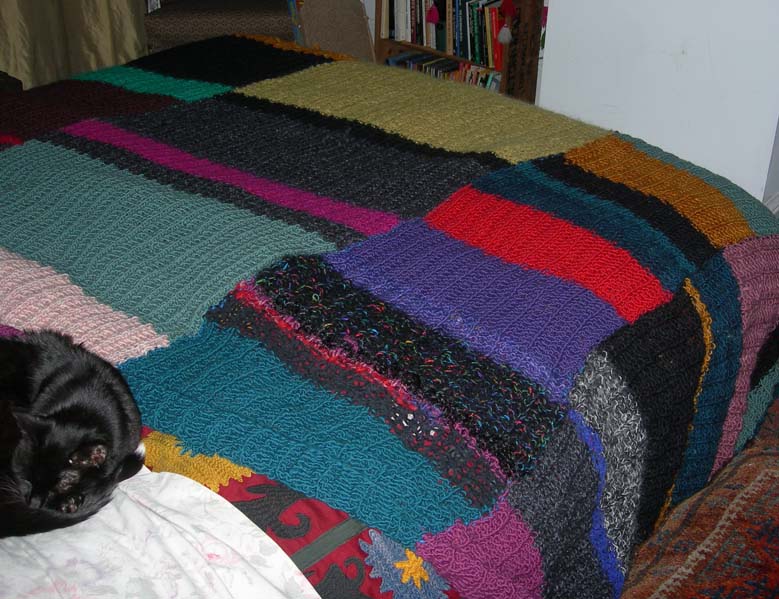
There are lots of ways to clean out a closet.  Partly, it depends on what is in the closet.   Per my earlier post about freecycle, I think that part of the practice of sauca or cleanliness, is making sure that the hidden parts of our homes are not overfilled with stuff we do not use.  Cleaning out the closet, does not mean throwing everything out.  It can mean creatively rethinking where things should be and how we should use them.  It also means for every artist, cook, crafts person, periodically making use of all those things you picked up or saved because they would be of use in something.

I was raised to save things that possibly could be used later, and to try and make every scrap usable.  I was taught this because my father was born in 1929 and my mother in 1936 of Jewish peasant immigrants.  Now, we are re-learning how to maximize the use of objects and minimize waste for ecological, rather than financial reasons, though the two are inextricably intertwined.  As the recession progresses, it will be interesting to see whether financial constriction will foster more environmentally conscious living.

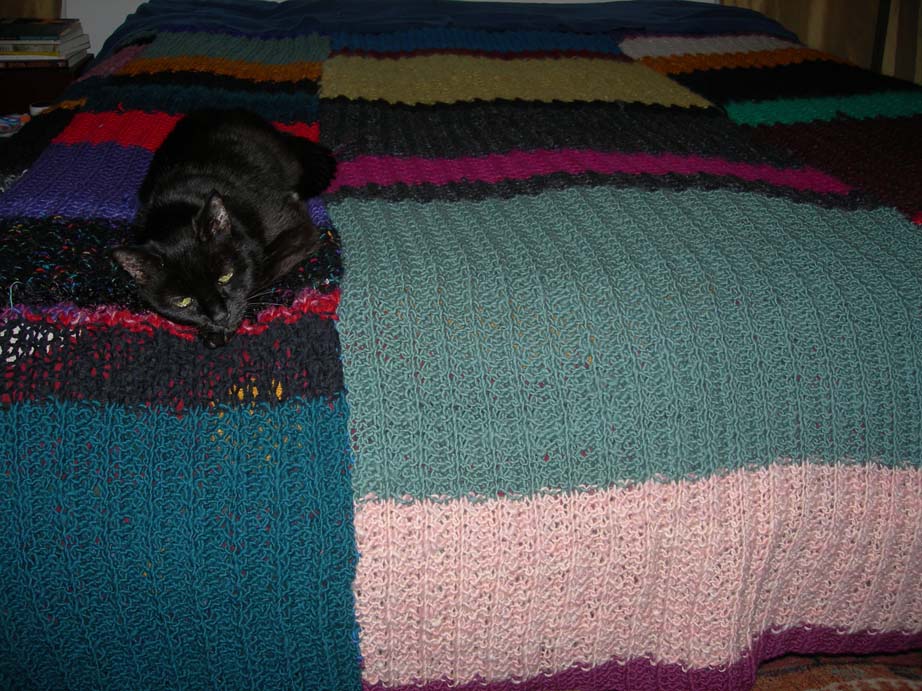
About four years ago, when I was engaged in a periodic review of what was in the hall closet, I came upon my big box of leftover yarn.  In the late eighties and early nineties, I traveled extensively for business, and spent many hours in airports and evenings in hotels.  I found it comforting to have a lapful of mohair, homespun, or other delicious to touch yarn.  Airport security was less invasive, and it was possible to knit in the airport and take knitting needles on board the airplane.    As I love working with multiple colors, that resulted in a leftover skeins from each project.  Over a 10-15 year period, even with only a couple of aborted projects and no yarn bought for imagined future projects (unlike a really serious knitter), I ended up with enough yarn for a queen-sized blanket (shocking, really).  As you can see, I designed it like a crazy quilt.  It took an educated sense of color and line — imagine this as a painting or pastel and you can see the influence of the Washington Color School, but it did not require much in the way of knitting skills (the whole blanket knit in panels of “mistake rib” — (k2, p2), end k2, p1 — about 50,000 times).  The patch of fire engine red and the grape juice purple next to it, came from my friend Sara, who is a fabulously talented knitter.  I felt the need for those colors, so we swapped for some of the teal and green that I had.

The blanket took almost four years to knit because I only did it in fits and starts.  Finally, last year, I decided that I needed to finish it in time for Becky be able to curl up on it.  As you can see, she thinks it is great.  Now my closet is not stuffed with a big box of yarn, I have an extra warm blanket that helps me keep the house just a little cooler, I made a thing of beauty where I might have been tempted to go out and buy something new, and Becky has a new happy spot.

Similar Posts

  • |

    The Man Who Would Not Be Pope (Habemus Papam)

    I used to go to the movies several times a month.  As independent cinemas closed and viewing opportunities moved in-home (where I don’t have a television), my desire to go to the movies ebbed.  In the past year or two, I am lucky if I see a movie once every several weeks, preferring to spend my time in practice and study or conversation.  I still keep my eye out for a film that looks like an invitation to beauty or engaged thinking.  I was called earlier this week to see Habemus Papam by this:

    “The unanswerable question at [Habemus Papam’s] heart is this: How does a leader hold onto his sense of self when the job he is about to take both demands and denies his own humanity?”  Michael O’Sullivan for the Washington Post.

    Habemus Papum is at one level a small story; it is just a few days in the life of a select group of individuals.  It is rendered with charm and love, but it asks some very big questions and ones highly relevant to any who contemplate (in this country that makes a cult of celebrity and celebrities in politics and spirituality and not just on stage and screen) what it means for an individual or a ruling body to have or to seek leadership, power, or worship, or to be given it in greater quantity than the one(s) on whom they are conferred can handle.

  • | | | | |

    What Are You Going to Do?

    Now is not the time for avoidance or passivity. What can you do or do more? Who are you going to support? These are the questions for an engaged yogi. Meditation, asana, and pranayama are life balance and support not ends in themselves for a householder yogi.

  • | |

    To do list? (Yoga citta vrtti nirodaha)

    Twitter?  What would be

    The point without an I-phone?

    Buy one? Save the nation?

    Last night I wrote this “twaiku” (why is it not a “twittiku?”) after having read yet another series of articles on why or why not to Twitter and still more articles on why it is important for a nation of consumers to keep consuming even if that is what got them into trouble in the first place.  One of the articles was lamenting the loss of true communication that comes with being limited to 140 characters, and it set forth some examples of how peculiar, when taken out of context, some twittering can sound, especially to the uninitiated.  In my attempt to keep an open mind about devaluing language while still communicating in language, I was led to think about haikus v. sonnets and other longer poetic forms.   A haiku easily fits into 140 characters.  This led me to wonder whether anyone had created a haiku trend on Twitter?  A quick Google search revealed that I am way behind the times in terms of the twaiku?

    One of the articles suggested that Twittering is about being in the moment.  Contrarians say it fosters attention deficit disorder and a host of other language-loss ills.  This led me to think of the Yoga Sutra of Patanjali “yoga citta vrtti nirodaha” (yoga is stilling/aligning with the thoughwaves of the mind).  When evaluating what to consume, when to consume, and how to consume (whether it is language and communication methods or electronic goods or anything else), if we are serious about taking yoga off the mat, it is good to think about whether our consumption eases the trials of being embodied or makes daily living more agitating, and whether our consumption brings us more into alignment with nature/spirit (brahmacharya) or turns us away.

  • | |

    My Top Yoga-Related Reads of 2010

    These are not in any particular order.  Nor have I attempted to make a list of round numbers, such as “top 10,” though I could have found 10 to be “top” if I had really tried.  The emphasis here, with the exception of the new edition of the Yoga Sutras is my continuing contemplation and study of the intertwining of east and west and how it has created, informed, and shaped my studies and teaching over the years.  There is an emerging body of scholarship on this topic, and this list has the highlights I have read.  I have put one book of older fiction on the list.  I have consistently made it a practice to read modern Indian literature to gain another perspective on Indian society other than the westernized yoga we practice.  Here’s the list.

    1.  Ram Das, Be Love Now.  Be Love Now is a beautiful expanding spiral of reflection from what started in Be Here Now. I got my first copy of Be Here Now when I was 13 or 14, not long after it was first published.  I learned about it from friends at Quaker Youth camp, and it was a not insignificant part of my youthful spiritual thought and growth.  Be Love Now is full of love and sweetness and a wonderful reflection on the relationship of a spiritual leader to his guru.  For those of us for whom Be Here Now was an important book early on, I think it is a wonderful opportunity to reflect on our own spiritual path and studies.  When I was reading it, I wondered whether Be Love Now, which seems to assume a certain basic level of understanding of yoga philosophy terms and readings and familiarity with a group of modern teachers and practitioners, would feel less accessible to someone who was moved by Be Here Now in their younger days, but never really followed up with the practices or studies advocated except on a most ethereal level.

    2.  Robert Love, The Great Oom. I found this biography of Pierre Bernard absolutely fascinating.  I have long been interested in the interrelationship between colonialism and Western practice of eastern spirituality and religion.  This book highlights a previously unexplored aspect of the relationship between east and west.  Of note for me, was that Pierre Bernard, though clearly an important influence on the practice of hatha yoga in America, did not himself travel to India.

    3.  Louis Bromfeld, The Rains Came. This is the only book on my list that was not published in 2009 or 2010.  It is also not a yoga book.  Although dated in some respects, it is a deeply engaging exploration of how Westerners (both religiously inspired do-gooders and colonial profiteers) and Indians (Hindus, Muslims, and Christians) collectively react to, respond, and in part cause the extremes of catastrophe in the wake of monsoon flooding.  All too timely in its own way as we watched what happened with the flooding in Pakistan.  I think of it as yoga-related because it provides perspective on the intertwining of religion, community, and society with colonization, which I think is an essential part of our understanding of our own western practice of hatha yoga and eastern styles of meditation.

    4.  Mark Singleton, The Yoga Body:  Origins of Modern Posture Practice. My friend Jane — fellow yogini and ever intelligent conversationalist on yoga philosophy and practice, and frequent commenter on this blog — lent me this book to read after we had been talking about our reactions to The Great Oom. It’s a bit of a tough read, as is common for dissertations turned into books, but it provides fresh perspective and interesting research and insights on our modern physical practice of yoga and, yes, still more information on the dance between east and west.

    5. Edwin Bryant, The Yoga Sutras of Patanjali:  A New Edition, Translation, and Commentary.  I haven’t read this through cover to cover, as that is not the point for books like this, but I have been dipping in and out of this translation and commentary from the moment I got it and expect to be doing so for years to come.  The scholarship and perspective is an excellent supplement the many translations and interpretations of Patanjali’s Yoga Sutras that I already have in my library.

    6. Stephen Phillips, Yoga, Karma, and Rebirth: A Brief History and Philosophy.  I bought this book several months ago after having overheard Dave Kennedy mentioning it to John Friend.  I am still working my way through it.  Like Singleton’s book, it is another slow read, but useful in its tying together and giving perspective on the relationship between traditional eastern thought and western practice and understanding.

2 Comments

  1. Nice blanket Elizabeth! Spot the fire engine red huh? Glad they worked out, this truly is a work of art.
    What’s next – Socks on Circulars I would guess… try to find Cat Bordhi’s book, it may by in the local libraries. I know Amazon have it. Then you can get yourself started with manageable Metro knitting – great for commuter trips and not to intrusive to the person sitting next to you. Good conversation starter too.
    Great Blog – when I update mine we can link. Namaste.

  2. Absolutely beautiful 🙂 I love the mix of colors. I stumbled upon this when I was looking for your pattern for hand warmers. Now I am inspired to make a crazy quilt…I’ll let you know how it goes.

Leave a Reply

Your email address will not be published. Required fields are marked *

This site uses Akismet to reduce spam. Learn how your comment data is processed.